Question
Solve the following quadratoic equations by factorization:
$\frac{1}{2\text{a}+\text{b}+2\text{x}}=\frac{1}{2\text{a}}+\frac{1}{\text{b}}+\frac{1}{2\text{x}}$
Answer

$\frac{1}{2\text{a}+\text{b}+2\text{x}}=\frac{1}{2\text{a}}+\frac{1}{\text{b}}+\frac{1}{2\text{x}}$$\Rightarrow\frac{1}{2\text{a}+\text{b}+2\text{x}}-\frac{1}{2\text{x}}=\frac{1}{2\text{a}}+\frac{1}{\text{b}}$
$\Rightarrow\frac{2\text{x}-(2\text{a}+\text{b}+2\text{x})}{(2\text{a}+\text{b}+2\text{x})2\text{x}}=\frac{\text{b}+2\text{a}}{2\text{ab}}$
$\Rightarrow\frac{-(2\text{a}+\text{b})}{(2\text{a}+\text{b}+2\text{x})2\text{x}}=\frac{(2\text{a}+\text{b})}{2\text{ab}}$
$\Rightarrow(2\text{a}+\text{b}+2\text{x})2\text{x}=-2\text{ab}$
$\Rightarrow4\text{ax}+2\text{bx}+4\text{x}^2+2\text{ab}=0$
$\Rightarrow4\text{x}^2+4\text{ax}+2\text{bx}+2\text{ab}=0$ (Dividing by 2)
$\Rightarrow2\text{x}^2+2\text{ax}+\text{bx}+\text{ab}=0$
$\Rightarrow2\text{x}(\text{x}+\text{a})+\text{b}(\text{x}+\text{a})=0$
$\Rightarrow(\text{x}+\text{a})(2\text{x}+\text{b})=0$
Either $\text{x}+\text{a}=0$ or $2\text{x}+\text{b}=0$
$\Rightarrow\text{x}=-\text{a}$ or $\text{x}=\frac{-\text{b}}{2}$

Need a full question paper?

Generate a complete, print-ready paper with questions like this in minutes — across 16+ boards, with answer keys.

Start Generating Free

Similar questions

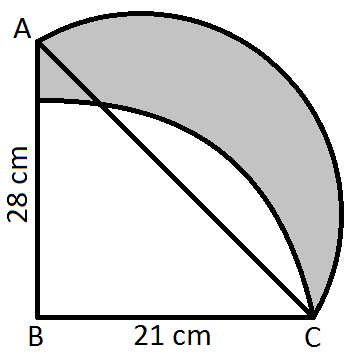
In the following figure, ABC is a right-angled triangle,$\angle\text{B}=90^\circ,$ $AB = 28\ cm$ and $BC = 21\ cm$.
With $AC$ as diameter a semicircle is drawn and with $BC$ as radius a quarter circle is drawn.
Find the area of the shaded region correct to two decimal places.
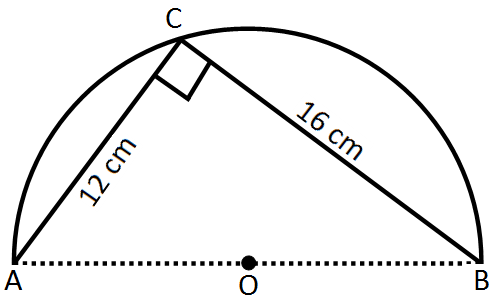
In the following figure, O is the centre of a circular arc and AOB is a straight line.
Find the perimeter and the area of the shaded region correct to one decimal place. $\big(\text{Take }\pi=3.142\big)$
Construct a $\triangle\text{ABC}$ in which AB = 5cm, $\angle\text{B} = 60^\circ,$ altitude $CD = 3cm.$ Construct a $\triangle\text{AQR}$ similar to $\triangle\text{ABC}$ such that side of $\triangle\text{AQR}$ is 1.5 times that of the corresponding sides of $\triangle\text{ABC}.$
An express train takes $1$ hour less than a passenger train to travel $132\ km$ between Mysore and Bangalore (without taking into consideration the time they stop at intermediate stations). If the average speed of the express train is $11\ km/hr$ more than that of the passenger train, find the average speed of two trains.
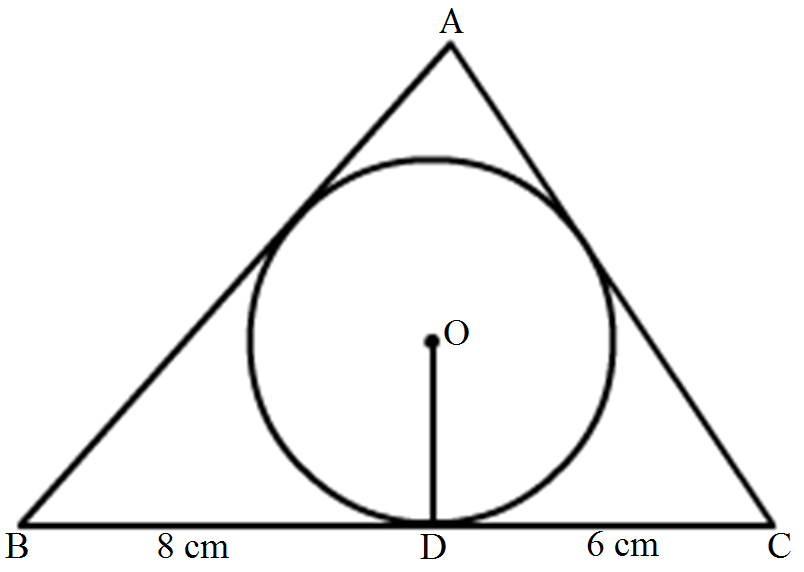
In the given figure, a $\triangle\text{ABC}$ is drawn to circumscribe a circle of radius $4\ cm$ such that the segments $BD$ and $DC$ are of lengths $8\ cm$ and $6\ cm$ respectively.
Find the lengths of sides $AB$ and $AC$, when area of $\triangle\text{ABC}$ is $84cm^2$

.
A milk container is made of metal sheet in the shape of frustum of cone whose volume is $10459\ cm^3$​​​​​​​. The radii of its lower and upper circular ends are $8\ cm$ and $20\ cm$ respectively. Find the cost of metal sheet used in making the container at the rate of $Rs. 1.40\ per\  cm^2​​​​​​​$​​​​​​​. $\Big(\text{use}\ \pi=\frac{22}{7}\Big)$
The $26^{th}, 11^{th}$ and last term of an A.P. are $0, 3$ and $-\frac{1}{5},$ respectively. Find the common difference and the number of terms.
If $\sin (\text{A} − \text{B}) = \sin \text{A} \cos \text{B} − \cos \text{A} \sin \text{B}$ and $\cos (\text{A − B}) = \cos\text{A} \cos\text{B} + \sin \text{A} \sin \text{B},$ find the values of sin 15° and cos 15°.
Show that the line segment joining the points $(5,7),(3,9)$ and $(8,6),(0,10)$ bisect each other.
Two water taps together can fill a tank in $6$ hours. The tap of larger diameter takes $9$ hours less than the smaller one to fill the tank separately. Find the time in which each tap can separately fill the tank.