Question
Solve the following simultaneous equations by the substitution method$:\ 13 + 2y = 9x,3y = 7x$

Answer

The given equations are
$ 13+2 y=9 x ....(i)$
$3 y=7 x ....(ii) $
Now, consider equation
$ 3 y=7 x$
$\Rightarrow y=\frac{7}{3} x ....(iii) $
Substituting the value of $y$ in eqn. $(i),$
we get $13+2\left(\frac{7}{3} x\right)=9 x$
$\Rightarrow 13+\frac{14}{3} x=13$
$\Rightarrow 9 x-\frac{14}{3} x=13$
$\Rightarrow \frac{27 x-14 x}{3}=13$
$\Rightarrow 13 x=39$
$\Rightarrow x=\frac{39}{13}$
$=3 $
Putting the value of $x$ in eqn. $(iii),$
we get $y=\frac{7}{3} \times 3$
$=7$
Thus, the solution set is $(3,7)$.

Need a full question paper?

Generate a complete, print-ready paper with questions like this in minutes — across 16+ boards, with answer keys.
Start Generating Free

Similar questions

Solve the following simultaneous equations by the substitution method$:\ 3 - (x + 5) = y + 2;2(x + y) = 10 + 2y$
Priyanka lends $Rs.15,500$ at $10\%$ for the first year, at $15\%$ for the second year and at $20\%$ for the third year. If the rates of interest are compounded yearly, find the difference between the compound interest of the second year and the third year.
Make $y$ the subject of the formula $x=\frac{1-y^2}{1+y^2}$. Find $y$ if $x=\frac{3}{5}$
Solve the following pairs of equations$:\frac{2}{3 x+2 y}+\frac{3}{3 x-2 y}=\frac{17}{5};\frac{5}{3 x+2 y}+\frac{1}{3 x-2 y}=2$
In parallelogram $\text{ABCD, P}$ is the mid$-$point of $AB. CP$ and $BD$ intersect each other at point $O$. If the area of $\triangle POB = 40 \ cm^2$, and $OP: OC = 1:2,$ find:$(i)$ Areas of $\triangle BOC$ and $\triangle PBC;(ii)$ Areas of $\triangle ABC$ and parallelogram $\text{ABCD}.$
If $x=(4-\sqrt{15})$, find the values of :$\left(x+\frac{1}{x}\right)^2$
The cost of manufacturing $x$ articles is $Rs. (50 + 3x)$. The selling price of $x$ articles is $Rs. 4x$.On a graph sheet, with the same axes, and taking suitable scales draw two graphs, first for the cost of manufacturing against no. of articles and the second for the selling price against the number of articles.Use your graph to determine:No. of articles to be manufactured and sold to break even $($no profit and no loss$)$.
Solve the following equations for the unknown: $\frac{6 x+7}{3 x+2}=\frac{4 x+5}{2 x+3}$
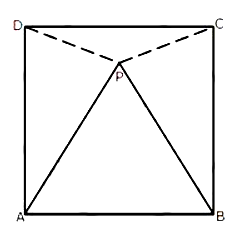
In the following diagram, $\text{ABCD}$ is a square and $\text{APB}$ is an equilateral triangle.

$(i)$ Prove that: $\triangle \mathrm{APD} \cong \triangle \mathrm{BPC},(ii)$ Find the angles of $\triangle \mathrm{DPC}$.
Construct a rhombus $\text{ABCD}$, given $AB = 3.8\ cm$ and $\angle A = 60^\circ $. Measure $AC.$