Question
Solve the following system of equations graphically:
2x + 3y = 8,
x - 2y + 3 = 0

Answer

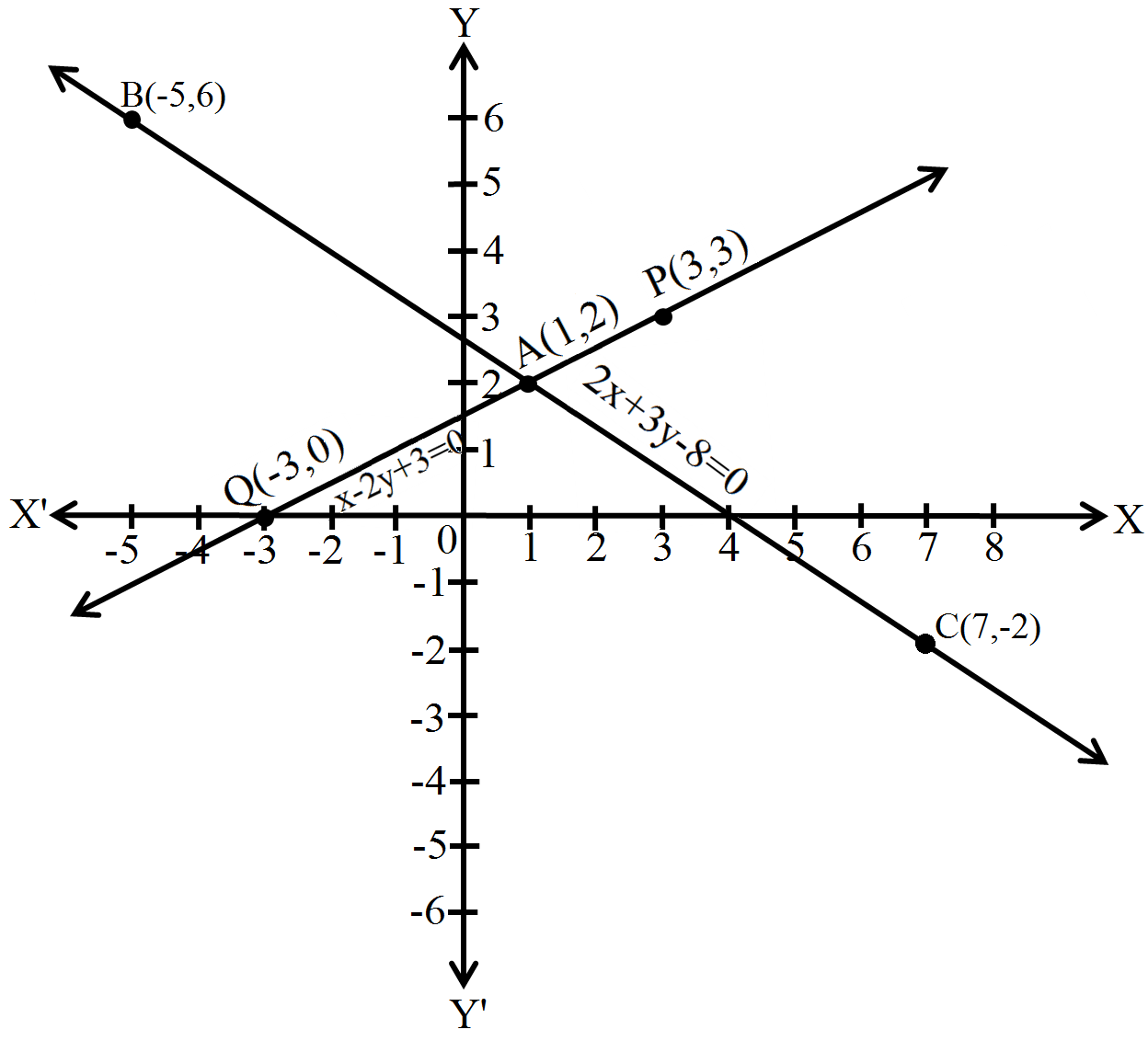
On a graph paper, draw a horizontal line X'OX and a vertical line YOY' representing the x-axis and y-axis, respectively. Given equations are 2x + 3y = 8 and x - 2y + 3 = 0 Graph of 2x + 3y = 8: 2x + 3y = 8 $\Rightarrow\text{y}=\frac{8-\text{2x}}{3}\ \dots(1)$ Thus we have the following table for 2x + 3y = 8
x:
1
-5
7
y:
2
6
-2
On the graph paper plot the points A(1, 2), B(-5, 6) and C(7, -2). Join AB and AC to get the graph line BC. Thus, the line AC is the equation of 2x + 3y = 8. Graph of x - 2y + 3 = 0: For graph of x - 2y + 3 = 0 $\Rightarrow\text{y}=\frac{\text{x}+3}{2}\ \dots(2)$ Thus, we have the following table for x - 2y + 3 = 0
x:
1
3
-3
y:
2
3
0
Now, on the same graph paper plot the points P(3, 3) and Q(-3, 0). The point A(1, 2) has already been plotted. Join PA and QA to get the line PQ. Thus, line PQ is the graph of the equation x - 2y + 3 = 0.
The two graph lines intersect at A(1, 2). $\therefore$ x = 1, y = -2 is the solution of the given system of equations.

Need a full question paper?

Generate a complete, print-ready paper with questions like this in minutes — across 16+ boards, with answer keys.
Start Generating Free

Similar questions

Solve the following systems of equations:
x - y + z = 4,
x - 2y - 2z = 9,
2x + y + 3z = 1.
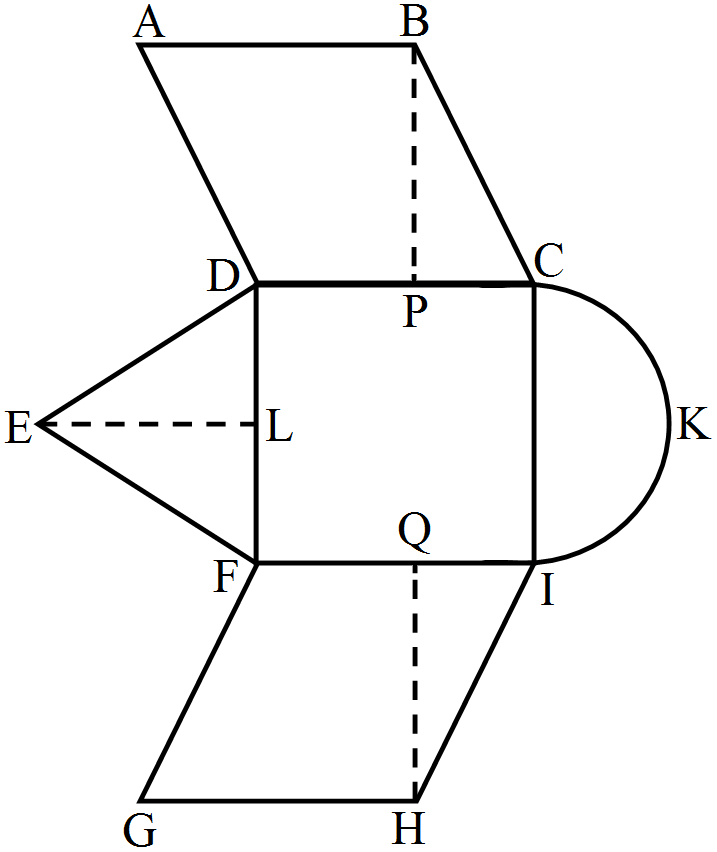
A child draws the figuie of an aeroplane as shown. Here, the wings ABCD and FGHI are parallelograms, the tail DEF is an sosceles triangle, the cockpit CKI is a semicircle and CDFI is a square. In the given figure, $\text{BP}\perp\text{CD},\ \text{HQ}\perp\text{FI}$ and $\text{EL}\perp\text{DF}.$ if $\text{CD}=8\text{cm},\ \text{BP}=\text{HQ}=4\text{cm}$ and $\text{DE}=\text{EF}=5\text{cm},$ find the area of the whole figure. $\big[\text{Take }\pi=3.14\big]$
Find the number of metallic circular discs with 1.5cm base diameter and of height 0.2cm to be melted to form a right circular cylinder of height 10cm and diameter
4.5cm.
The following is the distribution of weights (in kg) of 40 persons:
Weight (in kg)
40-45
45-50
50-55
55-60
60-65
65-70
70-75
75-80
Number of persons
4
4
13
5
6
5
2
1
Construct a cumulative frequency distribution (of the less than type) table for the data above.
The first and the last terms of an AP are 17 and 350 respectively. If the common difference is 9, how many terms are there and what is their sum?
If the mean of the following frequency distribution is 24, find the value of p.
Class
0-10
10-20
20-30
30-40
40−50
Frequency
3
4
p
3
2
In a cylindrical vessel of radius $10 \ cm ,$ containing some water, $9000$ small spherical balls are dropped which are completely immersed in water which raises the water level. If each spherical ball is of radius $0.5 \ cm ,$ then find the rise in the level of water in the vessel.
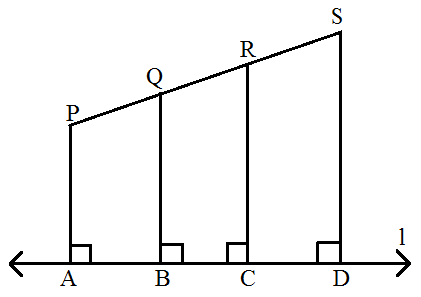
In PA, QB, RC and SD are all perpendiculars to a line l, AB = 6cm, BC = 9cm, CD = 12cm and SP = 36cm. Find PQ, QR and RS.
Find the-
sum of those integers from 1 to 500 which are multiples of 2 or 5.
[Hint: These numbers will be: multiples of 2 + multiples of 5 – multiples of 2 as well as of 5 ]
Sides $AB , BC$ and the median $AD$ of $\triangle ABC$ are respectively proportional to sides $PQ , QR$ and the median PM of another $\Delta PQR$. Prove that $\triangle ABC \sim \Delta PQR$.