Question
Solve the following system of equations graphically:
$3x + 2y = 4,$
$2x - 3y = 7$

Answer

On a graph paper, draw a horizontal line $X'OX$ and a vertical line $YOY$' representing the x-axis and y-axis, respectively.
Graph of $3x + 2y = 4:$
$3x + 2y = 4$
$\Rightarrow\text{y}=\frac{4-\text{3x}}{2}$
Thus we have the following table for $3x + 2y = 4$
$x:$
$0$
$2$
$-2$
$y:$
$2$
$-1$
$5$
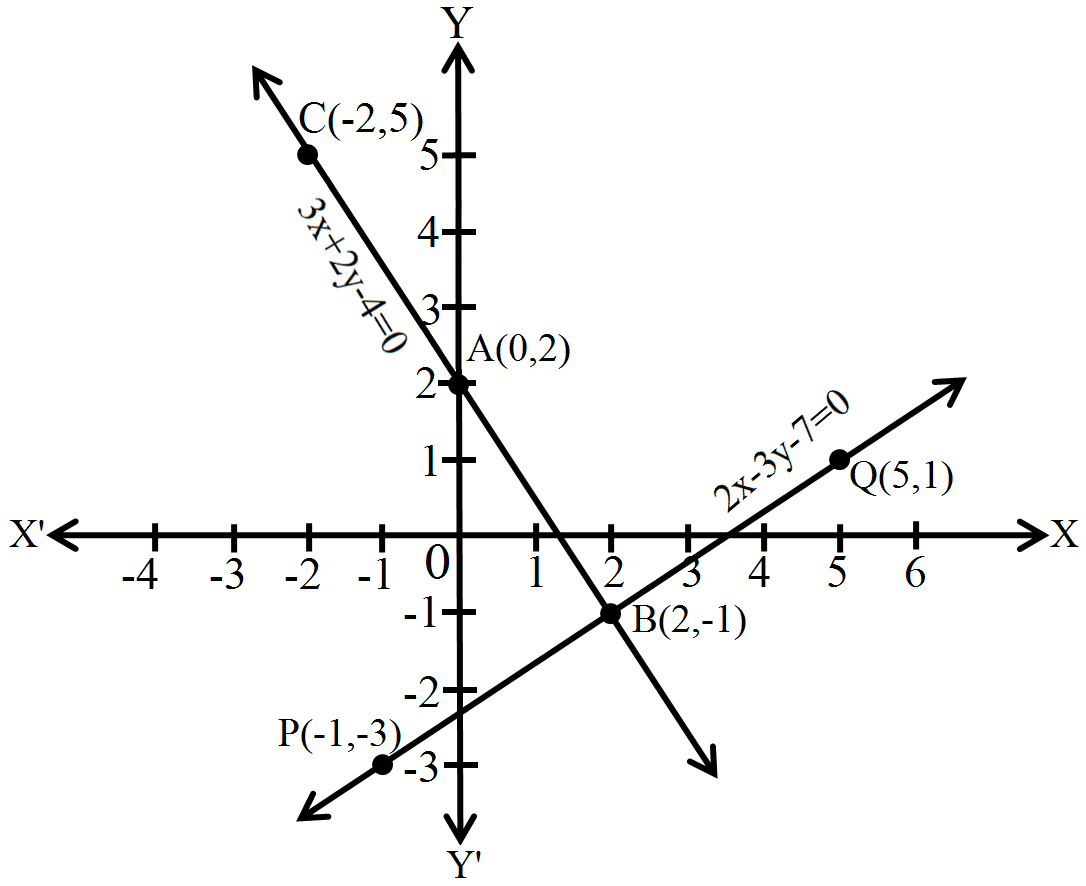
Plot the points $A(0,2), B(2,-1)$ and $C(-2,5)$ on the graph paper.
Join $A B$ and $A C$ to get the graph line $B C$.
Extend it on both ways.
Thus, the line $B C$ is the graph of $3 x+2 y=4$.
Graph of $2 x-3 y=7$ :
$\Rightarrow y=\frac{2 x-7}{3}$
Thus, we have the following table for $2 x-3 y=7$ is
$x:$
$2$
$-1$
$5$
$y:$
$-1$
$-3$
$1$
Now, on the same graph paper plot the points $P(-1,-3)$ and $Q(5,1)$. The point $B(2,-1)$ has already been plotted. Join $PB$ and $QB$ and extend it on both ways.
Thus, line $P Q$ is the graph of $2 x-3 y=7$.​​​​​​​

The two graph lines intersect at $B(2, -1).$
$\therefore x = 2, y = -1$ is the solution of the given system of equations.

Need a full question paper?

Generate a complete, print-ready paper with questions like this in minutes — across 16+ boards, with answer keys.
Start Generating Free

Similar questions

The numerator of a fraction is $3$ less than the denominator. If $2$ is added to both the numerator and the denominator, then the sum of the new fraction and the original fraction is $\frac{29}{20}.$ Find the original fraction.
Solve for $x$ and $y:$
$\frac{\text{bx}}{\text{a}}+\frac{\text{ay}}{\text{b}}=\text{a}^2+\text{b}^2,$
$\text{x}+\text{y}=\text{2ab}$
With the vertices $A, B$ and $C$ of a tringle $ABC$ as centres, arcs are drawn with radii $5\ cm$ each as shown in the given figure. If $AB = 14cm, BC = 48cm$ and $CA = 50\ cm$ then find the area of the shaded region. $\big[\text{Use }\pi=3.14\big]$
Prove the following trigonometric identities.
If $\text{T}_\text{n}=\sin^\text{n}\theta+\cos^\text{n}\theta,$ porve that $\frac{\text{T}_3-\text{T}_5}{\text{T}_1}=\frac{\text{T}_5-\text{T}_7}{\text{T}_3}.$
Prove that the points $(3, -2), (4, 0), (6, -3)$ and $(5, -5)$ are the vertices of a parallelogram.
Show that $(a-b)^2,\left(a^2+b^2\right)$ and $(a+b)^2$ are in $AP.$
If the points $A(4, 3)$ and $B(x, 5)$ lie on a circle with the center $O(2, 3)$, find the value of $x.$
Hint: $OA^2= OB^2$
Find the ratio in which the line segment joining the points $A(3,-3)$ and $B(-2,7)$ is divided by $x$-axis. Also, find the point of division.
The sum of first seven terms of an $A.P$. is $182$ . If its $4^{\text {th }}$ and the $17^{\text {th }}$ terms are in the ratio $1: 5$, find the $A.P.$
Solve the following system of equations graphically:
Shade the region between the lines and the $y-$axis.
$4x - y = 4,$
$3x + 2y = 14.$