Question
Solve the following systems of inequations graphically: $\text{x}+2\text{y}\leq40,3\text{x}+\text{y}\geq30,4\text{x}+3\text{y}\geq60,\text{x}\geq0,\text{y}\geq0$
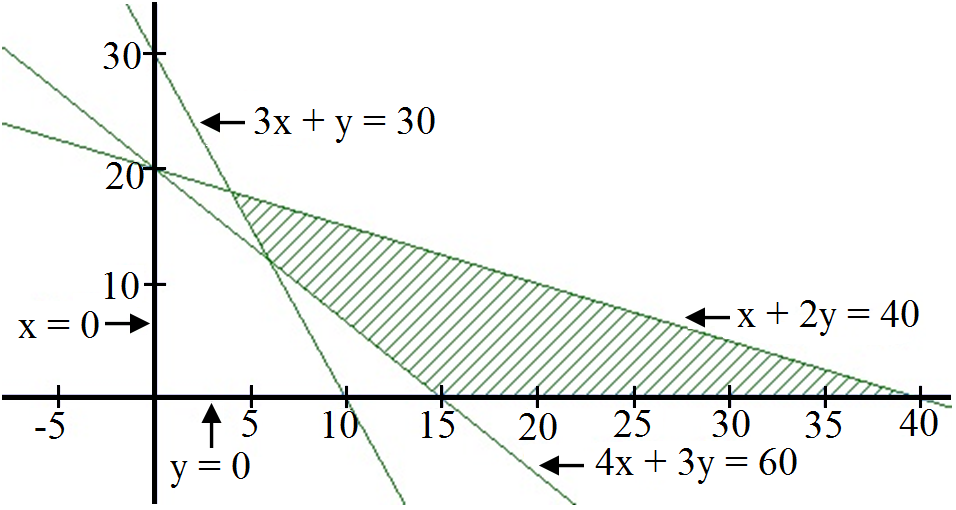
Answer


We have,
$\text{x}+2\text{y}\leq40,3\text{x}+\text{y}\geq30,4\text{x}+3\text{y}\geq60,\text{x}\geq0,\text{y}\geq0$
Converting the inequations into equations, we obtain,
x + 2y = 40, 3x + y = 30, 4x + 3y = 60, x = 0 and y = 0
Region represented by $\text{x} + 2\text{y} \leq 40:$
Putting x = 0 in x +2y = 40, we get $\text{y}=\frac{40}{2}=20$
Putting y - 0 in x + 2y = 40, we get x = 40
$\therefore$ The line x + 2y = 40, meets the coordinate axes at (0, 20) and (40, 0). Join these points by a thick line.
Now, putting x = 0 and y = 0 in $\text{x} + 2\text{y} \leq 40$ we get $0\leq40$
Therefore, (0, 0) satisfies the inequality $\text{x} + 2\text{y} \leq 40$ so, the portion containing the origin represents the solution set of the inequation $\text{x} + 2\text{y} \leq 40$
Region represented by $3\text{x} + \text{y} \geq 30$
Putting x = 0 in $3\text{x} + \text{y} \leq 30$ we get y = 30
Putting y = 0 in 3x + y = 30, we get, $\text{x}=\frac{30}{3}=10$
$\therefore$ The line 3x + y = 30 meets the coordinate axes at (0, 30) and (10, 0). Joining these points by a thick line.
Now, putting x = 0 and y = 0 in $3\text{x}+\text{y}\geq30$ we get, $0\geq30$ This is not possible.
Therefore (0, 0) does not satisfies the inequality $3\text{x} +\text {y} \geq 30.$ so, the portion not containing the origin is represented by the inequation $3\text{x} +\text {y} \geq 30.$
Region represented by 4x + 3y > 60:
Putting x = 0 in 4x + 3y = 60, we get, $\text{y}=\frac{60}{3}=20$
Putting y = 0 in 4x + 3y = 60, we get, $\text{x}=\frac{60}{4}=15.$
$\therefore$ The line 4x + 3y = 60 meets the coordinate axes at (0, 20) and (15, 0). Join these points by a thick line.
Now, putting x = 0, y = 0 in $4\text{x} + 3\text{y} \geq260,$ we get $0\geq60.$
This is not possible. Therefore, (0, 0) does not satisfies the inequality $4\text{x}+3\text{y}\geq60$ so, the portion not containing the origin is represented by the inequation $4\text{x}+3\text{y}\geq60$

Need a full question paper?

Generate a complete, print-ready paper with questions like this in minutes — across 16+ boards, with answer keys.

Start Generating Free

Similar questions

IQ of a person is given by the formula
$\mathrm{IQ}=\frac{\mathrm{MA}}{\mathrm{CA}} \times 100$
where MA is mental age and CA is chronological age. If 80 $\le$ IQ $\le$ 140 for a group of 12 years old children, find the range of their mental age.
Find the vertex, focus, axis, directrix and latus-rectum of the following parabolas: $y^2 + 4x + 4y - 3 = 0$
Find $\sin\frac{\text{x}}{2},\cos\frac{\text{x}}{2}$ and $\tan\frac{\text{x}}{2}$ in each of the following : $\cos\text{x}=-\frac{1}{3},$ x in quadrant III
Find the equation of an ellipse whose vertices are $(0,\pm10)$ and eccentricity $\text{e}=\frac{4}{5}.$
Differentiate the following from the first principle$\sin\text{x}+\cos\text{x}$
calculate the mean deviation from the median of the following frequency distribution:
Hights in inches
58
59
60
61
62
63
64
65
66
No. of students
15
20
32
35
35
22
20
10
8
Evaluate the following limit: If $\lim\limits_{\text{x}\rightarrow0}{\text{ kx cosec x}}=\lim\limits_{\text{x}\rightarrow0}\text{ x cosec kx,}{}$ find k.
The diameters of circles (in mm) drawn in a design are given below:
Diameters 33-36 37-40 41-44 45-48 49-52
No. of circles 15 17 21 22 25
Calculate the standard deviation and mean diameter of the circles.
[Hint First make the data continuous by making the classes as 32.5-36.5, 36.5-40.5, 40.5-44.5, 44.5 - 48.5, 48.5 - 52.5 and then proceed.]
Evaluate the following limit: $\lim\limits_{\text{x}\rightarrow0}\frac{(1+\text{x})^{{6}}-1}{(1+\text{x})^2-1}$
Prove that the centres of the three circles $x^2+ y^2 - 4x - 6y - 12 = 0, x^2 + y^2 + 2x + 4y - 10 = 0$ and $x^2 + y^2 - 10x - 16y - 1 = 0$ are collinear.