Question
Solve the following systems of linear inequations graphically: $\text{x}+\text{y}\geq1,7\text{x}+9\text{y}\leq63,\text{x}\leq6,\text{y}\leq5,\text{x}\geq0,\text{y}\geq0$
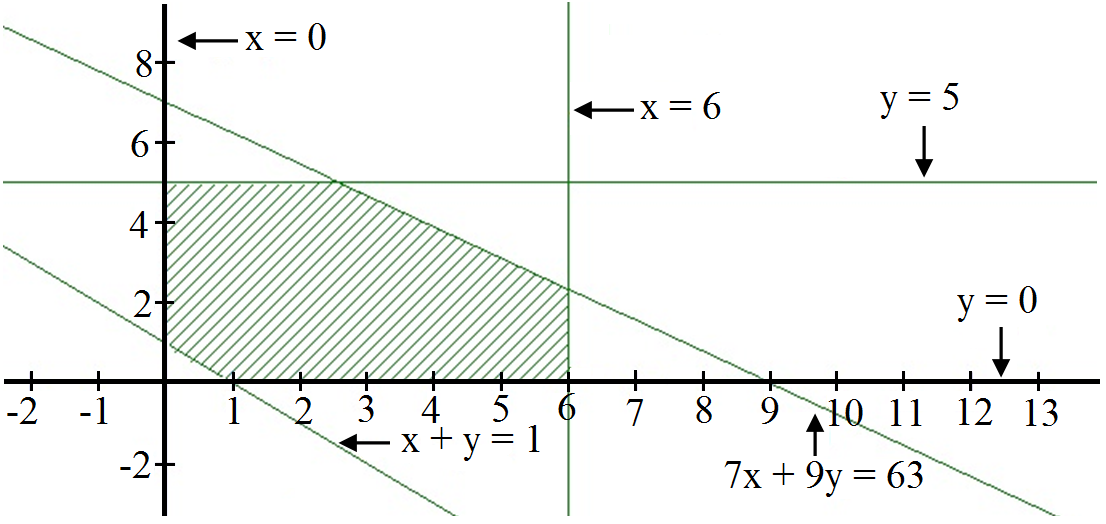
Answer


We have,
$\text{x}+\text{y}\geq1,7\text{x}+9\text{y}\leq63,\text{x}\leq6,\\\text{y}\leq5\text{x}\geq0\ \text{and }\text{y}\geq0$
Converting the inequations into equations, we obtain
x + y = 1, 7x + 9y = 63, x = 6, y = 5, x = 0 and y = 0.
Region represented by x + y > 1:
Putting x = 0 in x + y = 1, we get y = 1
Putting y = 0 in x + y = 1, we get x = 1
$\therefore$ The line x + y = 1 meets the coordinate axes at (0, 1) and (1, 0) join these point by a thick line.
Now, putting X = 0 and y = 0 in x + y > 1, we get $0\geq1$
This is not possible
$\therefore$ (0, 0) is not satisfies the inequality x + y > 1. So, the portion not containing the origin is represented by the inequation $\text{x}+\text{y}\geq1.$
Region represented by 7x + 9y = 63
Putting x = 0 in 7x +9y = 63, we get, $\text{y}=\frac{63}{9}=7.$
Putting y = 0 in 7x + 9y = 63 we get, $\text{y}=\frac{63}{7}=9.$
$\therefore$ The line 7x + 9y = 63 meets the coordinete axes of (0, 7) and (9, 0). Join these points by a thick line.
Now, putting x = 0 and y = 0 in $7\text{x}+9\text{y}\leq63,$ we get, $0\leq63$
$\therefore$ we find (0, 0) satisfies the inequality $7\text{x}+9\text{y}\leq63,$ So, the portion containing the origin represents the solution set of the inequation $7\text{x}+9\text{y}\leq63,$
Region represented by $\text{x}\leq6$: Clearly, x = 6 is a line parallel to y-axis at a distance of 6 units from the origin. Since (0, 0) satisfies the inequation X $ 6. so, the portion lying on the left side of x = 6 is the region represented by $\text{x}\leq6$
Region represented by $\text{y}\leq5$ Clearly, y = 5 is a line parallel to x-axis at a distance 5 from it. since (0, 0) satisfies by the given inequation.
Region represented by $\text{x}\geq0$ and $\text{y}\geq0$: cearly, $\text{x}\geq0$ and $\text{x}\geq0$ represent the first quadrant.
The common region of the above six regions represents the solution set of the given inequation as shown below.

Need a full question paper?

Generate a complete, print-ready paper with questions like this in minutes — across 16+ boards, with answer keys.

Start Generating Free

Similar questions

Planes are drawn through the points (5, 0, 2) and (3, -2, 5) parallel to the coordinate planes. Find the lengths of the edges of the rectangular parallelopiped so formed.
Find the equation of the circle passing through $(0, 0)$ and making intercepts a and b on the coordinate axes.
In a potato race 20 potatoes are placed in a line at intervals of 4 meters with the first potato 24 metres from the starting point. A contestant is required to bring the potatoes back to the starting place one at a time. How far would he run in bringing back all the potatoes?
For any two sets A and B, prove that
$\text{A}\cup(\text{B}-\text{A})=\text{A}\cup\text{B}$
The fifth term of a G.P. is 81 whereas its secound term is 24. Find the series and sum of its first eight terms.
Find the vertex, focus, axis, directrix and latus-rectum of the following parabolas: $y^2 = 5x - 4y - 9$.
Evaluate the following limit: $\lim\limits_{\text{x}\rightarrow{\frac{\pi}{2}}}\frac{\sqrt{2\sin\text{x}}-1}{\big(\frac{\pi}{2}-\text{x}\big)}$
Find the derivative of the following functions (it is to be understood that a, b, c, d, p, q, r and s are fixed non-zero constants and m and n are integers): $(\text{x}+\cos\text{x})(\text{x}-\tan\text{x})$
How many different selections of 4 books can be made from 10 different books, if
  1. There is no restriction.
  2. Two particular books are always selected.
  3. Two particular books are never selected?
Find the equation of the straight line which has y-intercept equal to $\frac{4}{3}$ and is perpendicular to 3x - 4y + 11 = 0.