Question

Solve the pairs of linear equation by the elimination method and the substitution method:$\frac{x}{2} + \frac{{2y}}{3} = - 1\,and\,x - \frac{y}{3} = 3$

Answer

  1. By Elimination method
    The given system of equation is
    $\frac { x } { 2 } + \frac { 2 y } { 3 } = - 1$...............(1)
    $x - \frac { y } { 3 } = 3$....................(2)
    Multiplying equation (2) by 2, we get
    $2 x - \frac { 2 y } { 3 } = 6$......................(3)
    Adding equation(1) and equation (2), we get
    $\frac { 5 } { 2 } x = 5 \Rightarrow x = \frac { 5 \times 2 } { 5 } \Rightarrow \quad x = 2$
    Substituting this value of x in equation(2), we get
    $2 - \frac { y } { 3 } = 3 \Rightarrow \frac { y } { 3 } = 2 - 3 = - 1 \Rightarrow \quad y = - 3$
    So, the solution of the given system of equation is
    x = 2, y = -3
  2. By substitution method
    The given system of equation is
    $\frac { x } { 2 } + \frac { 2 y } { 3 } = - 1$...............(1)
    $x - \frac { y } { 3 } = 3$....................(2)
    From equation (2),
    $x = \frac { y } { 3 } + 3$....................(3)
    Substituting this value of x in (1),
    $\frac { 1 } { 2 } \left( \frac { y } { 3 } + 3 \right) + \frac { 2 y } { 3 } = - 1$
    $\Rightarrow \quad \frac { y } { 6 } + \frac { 3 } { 2 } + \frac { 2 y } { 3 } = - 1 \Rightarrow \quad \frac { 5 y } { 6 } = - 1 - \frac { 3 } { 2 }$
    $\Rightarrow \quad \frac { 5 y } { 6 } - - \frac { 5 } { 2 } \Rightarrow y = - 3$
    Substituting this value of y in equation (3), we get
    $x = - \frac { 3 } { 3 } + 3 = - 1 + 3 - 2$
    So, the solution of the given system of equations is x = 2, y = -3
    Verification: Substituting x = 2, y = -3, we find that both the equation (1) and (2) are satisfied as shown below:
    $\frac { x } { 2 } + \frac { 2 y } { 3 } = \frac { 2 } { 2 } + \frac { 2 ( - 3 ) } { 3 } = 1 - 2 = - 1$

Need a full question paper?

Generate a complete, print-ready paper with questions like this in minutes — across 16+ boards, with answer keys.
Start Generating Free

Similar questions

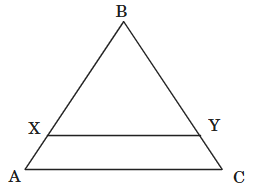
In the given figure, in $\triangle A B C, X Y| | A C$ and $X Y$ divides the $\triangle A B C$ into two regions such that $\operatorname{ar}(\triangle B X Y)=) 2 \operatorname{ar}(A C Y X)$. Determine $\frac{A X}{A B}$.
Image
A piece of cloth costs Rs. 35. If the piece were 4m longer and each meter costs Rs. one less, the cost would remain unchanged. How long is the piece?
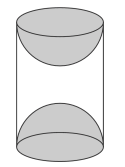
A wooden article was made by scooping out a hemisphere from each end of a solid cylinder, as shown in the figure. If the height of the cylinder is 5.8 cm and its base is of radius 2.1 cm , find the total surface area of the article.
Image
Find the next five terms of the following sequences given:
$\text{a}_1=-1,\text{a}_\text{n}=\frac{\text{a}_\text{n}-1}{\text{n}},\text{n}\geq2$
Find the roots of the following quadratic equation (if they exist) by the method of completing the square.
$\text{x}^2-4\sqrt{2\text{x}}+6=0$
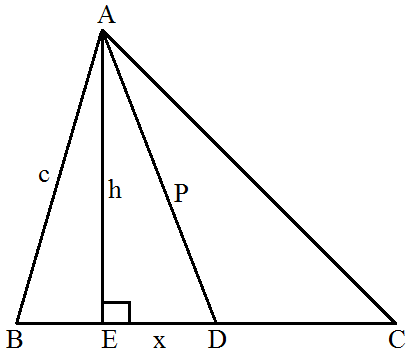
In the given figure, D is the mid-point of side BC and $\text{AE}\perp\text{BC}.$ If BC = a, AC = b, AB = c, ED = x, AD = p and AE = h, prove that:
  1. $\text{b}^2=\text{p}^2+\text{ax}+\frac{\text{a}^2}{4}$
  2. $\text{c}^2=\text{p}^2-\text{ax}+\frac{\text{a}^2}{4}$
  3. $\text{b}^2+\text{c}^2=2\text{p}^2+\frac{\text{a}^2}{4}$
For which values of a and b, will the following pair of linear equations have infinitely many solutions?
$x + 2y = 1$
$(a - b)x + (a + b)y = a + b - 2$
In a right triangle ABC in which $\angle\text{B}=90^\circ,$ a circle is drawn with AB as diameter intersecting the hypotenuse AC and P. Prove that the tangent to the circle at P bisects BC.
Draw a line segment of length 7.6cm and divide it in the ratio 5 : 8. Measure the two parts.
Cards numbered 1 to 30 are put in a bag. A card is drawn at random from this bag. Find the probability that the number on the drawn card is:
  1. Not divisible by 3.
  2. A prime number great than 7.
  3. Not a perfect square number.