Question
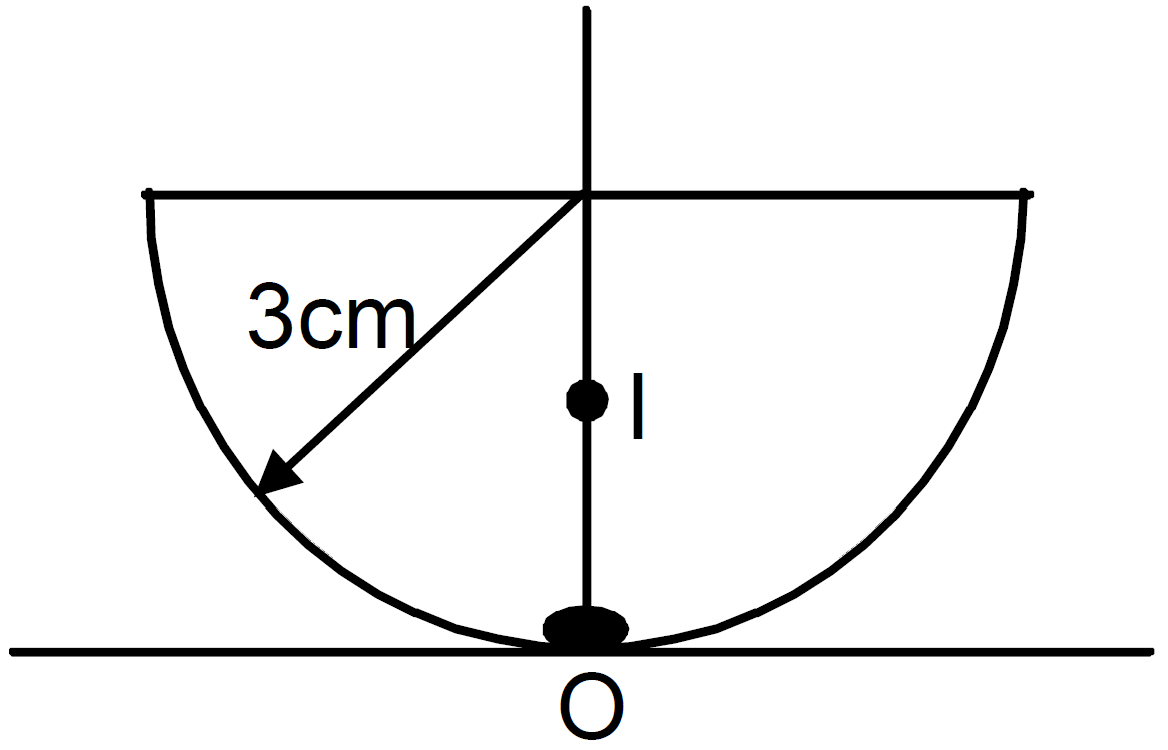
Solve the previous problem if the paperweight is inverted at its place so that the spherical surface touches the paper.
Answer

Thickness of glass $=3\text{cm}, \ \mu_{\text{g}}=1.5$ Image shif $=3\Big(1-\frac{1}{1.5}\Big)$ [Treating it as a simple refraction problem because the upper surface is flat and the spherical surface is in contact with the object]$=3\times\frac{0.5}{1.5}=1\text{cm}.$
The image will appear 1 cm above the point P.

Need a full question paper?

Generate a complete, print-ready paper with questions like this in minutes — across 16+ boards, with answer keys.
Start Generating Free

Similar questions

When a system is taken through the process abc shown in figure. 80J of heat is absorbed by the system and 30J of work is done by it. If the system does 10J of work during the process adc, how much heat flows into it during the process?
Two particles $A$ and $B$ having charges of $+2.00 \times 10^{-6}C$ and of $-4.00 \times 10^{-6}C$ respectively are held fixed at a separation of $20.0\ cm.$ Locate the point$(s)$ on the line $AB$ where
  1. The electric field is zero.
  2. The electric potential is zero.
If the operating potential in an X-ray tube is increased by 1%, by what percentage does the cutoff wavelength decrease?
A charge of $3.14 \times 10^{-6}C$ is distributed uniformly over a circular ring of radius $20.0\ cm$. The ring rotates about its axis with an angular velocity of $60.0\ rad/s$. Find the ratio of the electric field to the magnetic field at a point on the axis at a distance of $5.00\ cm$ from the centre.
Draw a schematic ray diagram of reflecting telescope showing how rays coming from a distant object are received at the eye-piece. Write its two important advantages over a refracting telescope.
Figure shows a cart. Complete the table shown.
The normal activity of living carbon-containing matter is found to be about 15 decays per minute for every gram of carbon. This activity arises from the small proportion of radioactive $ ^{14}_6\text{C}$ present with the stable carbon isotope $^{12}_6\text{C}.$ When the organism is dead, its interaction with the atmosphere (which maintains the above equilibrium activity) ceases and its activity begins to drop. From the known half-life (5730 years) of $^{14}_6\text{C },$ and the measured activity, the age of the specimen can be approximately estimated. This is the principle of  $^{14}_6\text{C}$ datingused in archaeology. Suppose a specimen from Mohenjodaro gives an activity of 9 decays per minute per gram of carbon. Estimate the approximate age of the Indus-Valley civilisation.
The band gap for silicon is 1.1eV.
  1. Find the ratio of the band gap to kT for silicon at room temperature 300K.
  2. At what temperature does this ratio become one tenth of the value at 300K?
(Silicon will not retain its structure at these high temperatures.)
Consider the situation of the previous problem. Find the average electric field energy stored in the capacitor and the average magnetic field energy stored in the coil.
  1. Name the phenomenon on which the working of an optical fibre is based.
  2. What are the necessary conditions for this phenomenon to occur?
  3. Draw a labelled diagram of an optical fibre and show how light propagates through the optical fibre using this phenomenon.