Question
Solve the question: $(-4) + (-1) + 2 + 5 + ..... + x = 437.$

Answer

Suppose $x$ is $n^{th}$ term of the given $A.P.$
$a_n= x$
Here, $a = -4, d = 3.$
It is given that, $S_n= 437.$
$\Rightarrow\ \frac{\text{n}}{2}[2(-4)+(\text{n}-1)3]=437$
$\Rightarrow\ 3\text{n}^2-11\text{n}-874=0$
$\Rightarrow\ 3\text{n}^2-57\text{n}+46\text{n}-874=0$
$\Rightarrow\ 3\text{n}(\text{n}-19)+46(\text{n}-19)=0$
$\Rightarrow\ \text{n}=-\frac{46}{3}, 19$
Since, $n$ cannot be in fraction so $n = 19.$
Now $a_n= x$
$⇒ (-4) + (19 - 1)3 = x$
$⇒ -4 + 54 = x$
$⇒ x = 50.$

Need a full question paper?

Generate a complete, print-ready paper with questions like this in minutes — across 16+ boards, with answer keys.
Start Generating Free

Similar questions

Find the volume of a solid in the form of a right circular cylinder with hemi-spherical ends whose total length is $2.7m$ and the diameter of each hemi-spherical end is $0.7m.$
Very-Short and Short-Answer Qustions:
Write the value of $3\cot^2\theta-3\text{cosec}^2\theta.$
The angle of elevation of the top of a building from the foot of the tower is $30^\circ $ and the angle of elevation of the top of the tower from the foot of the building is $60^\circ $. If the tower is $50 \ m$ high, find the height of the building.
Find the zeroes of quadratic polynomial $6x^2 - 3 - 7x$ and verify the relationship between the zeroes and their coefficients.
How many term are there in the $AP 6, 10, 14, 18,....174?$
Find two natural numbers which differ by 3 and whose squares have the sum 117.
A spherical ball of diameter $21\ cm$ is melted and recast into cubes. each of side $1\ cm.$ Find the number of cubes so formed.
Is the given series $2, 4, 8, 16, ......$ form an $AP?$ If It forms an $AP,$ then find the common difference d and write the next three terms.
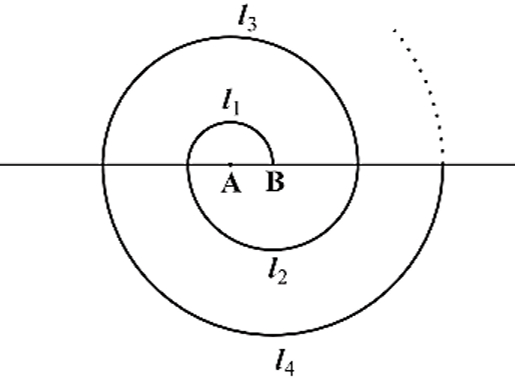
A spiral is made up of successive semicircles, with centres alternately at $A$ and $B$, starting with centre at $A$, of radii $0.5\ cm, 1.0\ cm, 1.5\ cm, 2.0\ cm, ...$ as shown in Figure. What is the total length of such a spiral made up of thirteen consecutive semicircles? $(Take\; \pi = \frac { 22 } { 7 } )$
$[$Hint: Length of successive semicircles is $l_1, l_2, l_3, l_4,...$ with centres at $A, B, A, B, ...$ respectively.$]$​​​​​​​
The sum of the first n terms of an $AP$ is given by $Sn = (3n^2- n).$ Find its:
  1. $n^{th}$ term
  2. First term
  3. Common difference.