Question
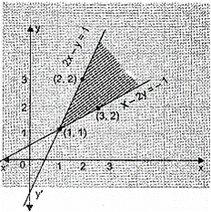
Solve the system of inequality graphically: 2x – y >1, x – 2y < –1

Answer

The given inequality is 2x - y > 1
Draw the graph of the line 2x - y = 1
Table of values satisfying the equation
2x - y = 1

X 1 2
Y 1 3


Putting (0, 0) in the given inequation, we have
$2 \times 0 - 0 > 1 \Rightarrow 0 > 1$, which is false.
$\therefore $ Half plane of 2x - y > 1 is away from origin.
Also the given inequality is x - 2y < -1
Draw the graph of the line x - 2y = -1
Table of values satisfying the equation x - 2y = -1

X 1 2
Y 1 2

Putting (0, 0) in the given inequation, we have
$0 - 2 \times 0 < - 1 \Rightarrow 0 < - 1$ which is false
$\therefore $ Half plane of x - 2y < - 1 is away from origin.

Need a full question paper?

Generate a complete, print-ready paper with questions like this in minutes — across 16+ boards, with answer keys.

Start Generating Free

Similar questions

Evaluate the following limit: $\lim\limits_{\text{x}\rightarrow1}\frac{(2\text{x}-3)\big(\sqrt{\text{x}}-1\big)}{3\text{x}^2+3\text{x}-6}$
Find the equations of the circles touching y-axis at $(0, 3)$ and making an intercept of $8$ units on the x-axis.
Prove the following by the principle of mathematical induction: $5^{2 n+2}+24 n-25$ is divisible by 576 for all $\mathbf{n} \in \mathbf{N}$
A man arranges to pay off a debt of ₹ 3600 by 40 annual instalments which form an arithmetic series. When 30 of the instalments are paid, he dies leaving one-third of the debt unpaid, find the value of the first instalment.
Evaluate the following limit: $\lim\limits_{\text{x}\rightarrow0}\frac{\{\sin(\alpha+\beta)\text{x}+\sin(\alpha-\beta)\text{x}+\sin2\alpha\text{x}\}}{\cos^2\beta\text{x}-\cos^2\alpha\text{x}}$
Reduce each of the following expressions to the sine and cosin of a single expression: $\sqrt{3}\sin\text{x}-\cos\text{x}$
Prove that: $\frac{\cos\text{A}+\cos\text{B}}{\cos\text{B}-\cos\text{A}}=\cot\Big(\frac{\text{A}-\text{B}}{2}\Big)\cot\Big(\frac{\text{A}-\text{B}}{2}\Big)$
Prove that: $\sin3\text{A}+\sin2\text{A}-\sin\text{A}=4\sin\text{A}\cos\frac{\text{A}}{2}\cos\frac{3\text{A}}{2}$
If the $4^{th}$, $10^{th}$ and $16^{th}$ terms of a G.P. are x, y and z respectiveiy. Prove that x, y, z are in G.P.
Let f and g be two real functions defined by $\text{f(x)}=\sqrt{\text{x}+1}$ and $\text{g(x)}=\sqrt{9-\text{x}^2}$ Then describe the following functions: $\frac{5}{\text{g}}$