MCQ
Some charge is being given to a conductor. Then its potential is
  • A
    maximum at surface
  • B
    maximum at centre
  • remain same throughout the conductor
  • D
    maximum somewhere between surface and centre

Answer

Correct option: C.
remain same throughout the conductor
c
Given that some charge is given to a conductor then the whole charge is distributed over its surface only. Inside of conductor, electric field is zero whereas potential is same as on the surface. Hence, throughout the conductor, potential is same i.e, the whole conductor is equipotential.

Need a full question paper?

Generate a complete, print-ready paper with questions like this in minutes — across 16+ boards, with answer keys.
Start Generating Free

Similar questions

A condenser having a capacity of 6mF is charged to 100 V and is then joined to an uncharged condenser of 14 μF and then removed. The ratio of the charges on 6mF and 14mF and the potential of 6mF will be
A lamp whose resistance is $280 \Omega$ is joined with an ac source of 200 V . The peak value of current flowing in the lamp is :
The wavelength of light in two liquids $‘x' $ and $‘y' $ is $3500 Å$ and $7000 Å$, then the critical angle of $x$ relative to $y$ will be.......$^o$
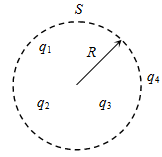
$q1,q2,q3$ and $q4$ are point charges located at points as shown in the figure and S is a spherical Gaussian surface of radius R. Which of the following is true according to the Gauss’s law
The fringe width in Young’s double slit experiment increases when
For protecting a sensitive equipment from external magnetic field, it should be:
Two conducting circular loops of radii $R_1$ and $R_2$ are placed in the same plane with their centre coinciding. If $R_1 >> R_2$ the mutual inductance $M$ between them will be directly proportional to
Basically, the product modulator is
In an $LR$ -circuit, time constant is that time in which current grows from zero to the value (where ${I_0}$ is the steady state current)
An astronaut is looking down on earth's surface from a space shuttle at an altitude of $400\,km.$ Assuming that the astronaut's pupil diameter is $5\,mm$ and the wavelength of visible light is $500\,nm.$ The astronaut will be able to resolve linear object of the size of about........$m$