MCQ
Some physical quantities are given in Column $I$ and some possible $SI$ units in which these quantities may be expressed are given in Column $II$. Match the physical quantities in Column $I$ with the units in Column $II$ and indicate your answer by darkening appropriate bubbles in the $4 \times 4$ matrix given in the $ORS$.

Column $I$ Column $II$

$(A)$ $\mathrm{GM}_e \mathrm{M}_5$

$\mathrm{G} \rightarrow$ universal gravitational constant, $\mathrm{M}_{\mathrm{e}} \rightarrow$ mass of the earth,

$\mathrm{M}_5 \rightarrow$ mass of the Sun

$(p)$ (volt) (coulomb) (metre)

$(B)$ $\frac{3 \mathrm{RT}}{\mathrm{M}} ; \mathrm{R} \rightarrow$ universal gas constant, $\mathrm{T} \rightarrow$ absolute temperature,

$\mathrm{M} \rightarrow$ molar mass

$(q)$ (kilogram) $(\text { metre) })^3$ (second) $)^{-2}$
$(C)$ $\frac{F^2}{q^2 B^2}$ ;$\quad F \rightarrow$ force, $q \rightarrow$ charge, $B \rightarrow$ magnetic field  $(r)$ $(\text { meter })^2$ (second) $)^{-2}$

$(D)$ $\frac{\mathrm{GM}_e}{\mathrm{R}_{\mathrm{e}}}, G \rightarrow$ universal gravitational constant,

$\mathrm{M}_{\mathrm{e}} \rightarrow$ mass of the earth, $\mathrm{R}_{\mathrm{e}} \rightarrow$ radius of the earth

$(s)$ (farad) $(\text { volt) })^2(\mathrm{~kg})^{-1}$
  • A
    $A \rightarrow(s) \&(q), B \rightarrow(q) \&(s), C \rightarrow(p) \&(s), D \rightarrow(r) \&(p)$
  • B
    $A \rightarrow(r) \&(q), B \rightarrow(s) \&(q), C \rightarrow(r) \&(s), D \rightarrow(r) \&(s)$
  • $A \rightarrow(p) \&(q), B \rightarrow(r) \&(s), C \rightarrow(r) \&(s), D \rightarrow(r) \&(s)$
  • D
    $A \rightarrow(p) \&(s), B \rightarrow(r) \&(s), C \rightarrow(q) \&(s), D \rightarrow(r) \&(p)$
Answer

Correct option: C.
$A \rightarrow(p) \&(q), B \rightarrow(r) \&(s), C \rightarrow(r) \&(s), D \rightarrow(r) \&(s)$
c

Need a full question paper?

Generate a complete, print-ready paper with questions like this in minutes — across 16+ boards, with answer keys.

Start Generating Free

Similar questions

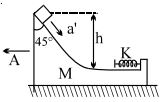
$A$ small block of mass $m$ is placed on $a$ wedge of mass $M$ as shown, which is initially at rest. All the surfaces are frictionless . The spring attached to the other end of wedge has force constant $k$. If $a'$ is the acceleration of $m$ relative to the wedge as it starts coming down and $A$ is the acceleration acquired by the wedge as the block starts coming down, then 
$A$ body $A$ is thrown vertically upwards with such a velocity that it reaches a maximum height of $h$. Simultaneously another body $B$ is dropped from height $h$. It strikes the ground and does not rebound. The velocity of $A$ relative to $B v/s$ time graph is best represented by : (upward direction is positive)
$A$ smooth sphere is moving on a horizontal surface with a velocity vector $(\,2\,\hat i + 2\,\hat j\,)$ $m/s$ immediately before it hit a vertical wall. The wall is parallel to vector $\hat j$ and coefficient of restitution between the sphere and the wall is $e = 1/2$ . The velocity of the sphere after it hits the wall is
$A$ man weighing $80\, kg$ is standing at the centre of a flat boat and he is $20\, m$ from the shore. He walks $8\, m$ on the boat towards the shore and then halts. The boat weight $200\, kg$. ........ $m$ far is he from the shore at the end of this time.
A ball is thrown on a lawn in such a way that it initially slides with a speed $v_0$ without  rolling. It gradually picks up  rotation motion. Speed of the ball at which there will be  rolling without slipping is
A uniform rope lies on a horizontal table so that a part of it hangs over the edge. The rope begins to slide down when the length of the hanging part is $25\%$ of the entire length. The coefficient of friction between the rope and the table is
The Bernoulli's theorem is based on the conservation of:
The principle of conservation of linear momentum can be strictly applied during a collision between two particles provided the time of impact is
The graph between terminal velocity (along $y-axis$ ) and square of radius (along $x-axis$ ) of spherical body of density $\rho $ allowed to fall through a fluid of density $\rho $  is $a$
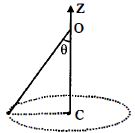
A conical pendulum of length $1\,m$ makes an angle $\theta \, = 45^o$ w.r.t. $Z-$ axis and moves in a circle in the $XY$ plane.The radius of the circle is $0.4\, m$ and its centre is vertically below $O$. The speed of the pendulum, in its circular path, will be ..... $m/s$ (Take $g\, = 10\, ms^{-2}$)