MCQ
Sometimes it is convenient to construct a system of units so that all quantities can be expressed in terms of only one physical quantity. In one such system, dimensions of different quantities are given in terms of a quantity $X$ as follows: [position $]=\left[X^\alpha\right] ;[$ speed $]=\left[X^\beta\right]$; [acceleration $]=\left[X^{ p }\right]$; [linear momentum $]=\left[X^{ q }\right]$; [force $]=\left[X^{ I }\right]$. Then -

$(A)$ $\alpha+p=2 \beta$

$(B)$ $p+q-r=\beta$

$(C)$ $p-q+r=\alpha$

$(D)$ $p+q+r=\beta$

  • $A,B$
  • B
    $A,C$
  • C
    $A,D$
  • D
    $B,C$

Answer

Correct option: A.
$A,B$
a
Given $L =x^\alpha$     $. . . . . . (1)$

$LT ^{-1}=x^\beta$        $. . . . . . (2)$

$LT ^{-2}=x^{ p }$          $. . . . . . (3)$

$MLT ^{-1}=x^q$           $. . . . . . (4)$

$MLT ^{-2}=x^{ I }V$     $. . . . . . (5)$

$\quad \frac{(1)}{(2)} \Rightarrow T =x^{\alpha-\beta}$

From $(3)$

$\frac{ x ^\alpha}{ x ^{2(\alpha-\beta)}}= x ^{ p }$

$\Rightarrow \alpha+ p =2 \beta$

From $(4)$

$M=x^{q-\beta}$

From $(5)$ $\Rightarrow x ^{ q }= x ^{ T } x ^{\alpha-\beta}$

$\Rightarrow \alpha+ r - q =\beta$

Replacing value ' $\alpha$ ' in equation $(6)$ from $(A)$

$2 \beta- p + r - q =\beta$

$\Rightarrow  p + q - r =\beta$

Replacing value of ' $\beta$ ' in equation $(6)$ from $(A)$

$2 \alpha+2 r-2 q=\alpha+p$

$\alpha=p+2 q-2 r$

Need a full question paper?

Generate a complete, print-ready paper with questions like this in minutes — across 16+ boards, with answer keys.

Start Generating Free

Similar questions

An ideal gas is filled in a vessel, then
A light string passing over a smooth light pulley connects two blocks of masses $m_1$ and $m_2$ (where $m_2>m_1$ ). If the acceleration of the system is $\frac{\mathrm{g}}{\sqrt{2}}$, then the ratio of the masses $\frac{\mathrm{m}_1}{\mathrm{~m}_2}$ is :
Find the gravitational field at a distance of $2000\, km$ from centre of earth. (in $m / s ^{2}$)

(Given $\left.R_{\text {earth }}=6400 km , r =2000 km , M _{\text {earth }}=6 \times 10^{24} kg \right)$

A source of sound emits waves with frequency $f \,Hz$ and speed $V\, m/sec$. Two observers move away from this source in opposite directions each with a speed $0.2\, V$ relative to the source. The ratio of frequencies heard by the two observers will be
A and B are two wires. The radius of A is twice that of B. They are stretched by the same load. Then, the stress on B is:
In the motion of a projectile freely under gravity, its
A wheel of radius $r$ rolling on a straight line, the velocity of its centre being $v$ .At a certain instant the point of contact of the wheel with the grounds is $M$ and $N$ is the highest point on the wheel (diametrically opposite to $M$). The incorrect statement is:
A modern grand-prix racing car of mass $m$ is travelling on a flat track in a circular arc of radius $R$ with a speed $v$. If the coefficient of static friction between the tyres and the track is $\mu_{s},$ then the magnitude of negative lift $F_{L}$ acting downwards on the car is

(Assume forces on the four tyres are identical and $g =$ acceleration due to gravity)

Two sources of sound placed close to each other, are emitting progressive waves given by $ y_1=4sin\left( {600\pi t} \right)$ and $y_2=5sin\left( {608\pi t} \right)$ An observer located near these two sources of sound will hear
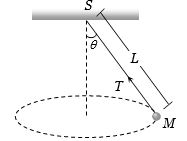
A string of length $L$ is fixed at one end and carries a mass $M$ at the other end. The string makes $2/\pi$ revolutions per second around the vertical axis through the fixed end as shown in the figure, then tension in the string is