Question
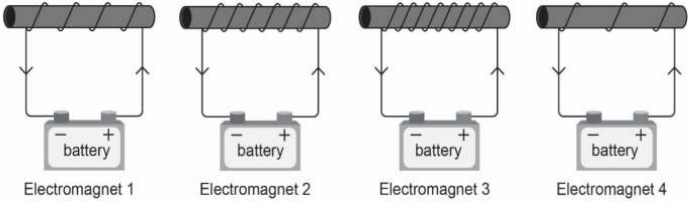
Sonia creates four electromagnets by placing iron bars in four different solenoids.
She brings a bunch of steel pins near each electromagnet.
Image
5. Which electromagnet will attract the maximum number of pins?
A. Electromagnet 1
B. Electromagnet 2
C. Electromagnet 3
D. Electromagnet 4
6. Which of these must Sonia keep the same for her activity?
Circle ‘Yes’ or ‘No’ for the correct response.

Should this be kept the same?

Yes or No

Thickness of the wires

Yes/No

Voltages of the batteries

Yes/No

Thickness of the iron bars

Yes/No

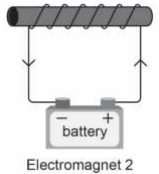
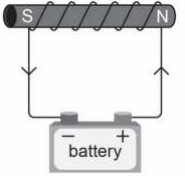
7. Label the north pole and south pole of the electromagnet in the diagram.
Image

8. Which of these devices works due to the magnetic effect of electric current?
A. LED bulb
B. Electric bell
C. Electric heater
D. Mobile charger
Answer

5. C. Electromagnet 3
6. Yes
Yes
No
7.
Image
8. B. Electric bell

Need a full question paper?

Generate a complete, print-ready paper with questions like this in minutes — across 16+ boards, with answer keys.

Start Generating Free

Similar questions

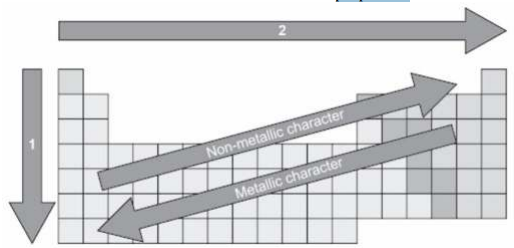
The picture shows an incomplete periodic table.
Arrow 1 and arrow 2 indicate increase or decrease in chemical properties.

Image
7. What do arrow 1 and arrow 2 represent?

Arrow 1

Arrow 2

A.

Decrease in atomic mass

Increase in atomic radius

B.

Increase in atomic radius

Increase in electronegativity

C.

Increase in electronegativity

Decrease in atomic radius

D.

Decrease in atomic radius

Decrease in atomic mass

Image
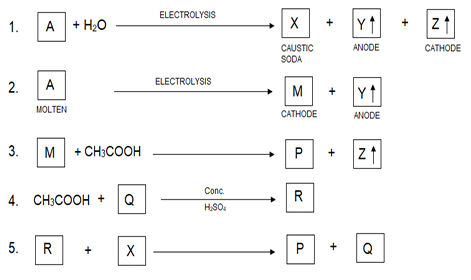
A. Derive the names of A, Y, Z, M, P & R
Attempt either subpart B or C.
B. Improvise an activity to test Z.
OR
C. Name the process in which compounds X, Y & Z are formed from A. Justify your response.
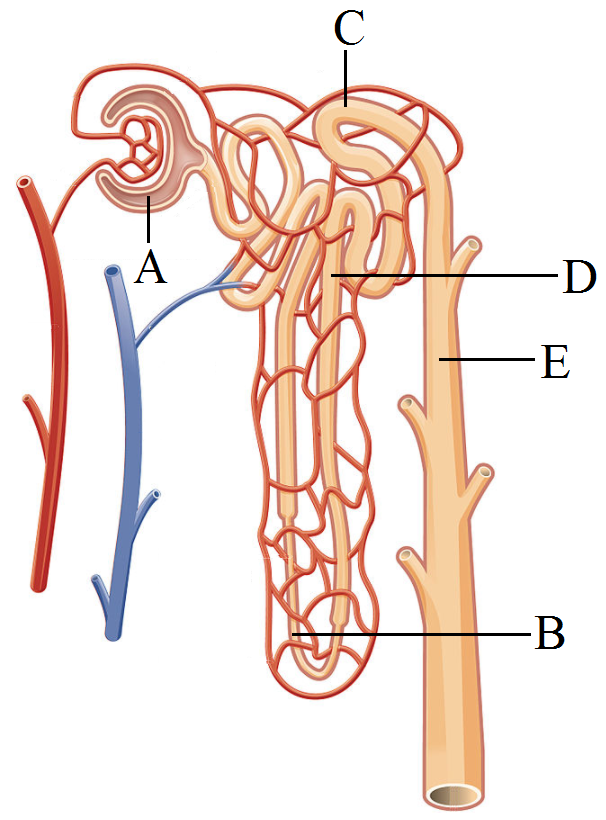
Read the following and answer any four questions from (i) to (v).Our body needs to remove the wastes that build up from cell activities and from digestion. It these wastes are not removed, then our cells can stop working and we can get very sick. The organs of our excretory system help to release wastes from our body. The excretory system consists of a pair of kidney, a pair of ureters, a urinary bladder and a urethra. Each kidney is made up of nearly one million complex tubular structures called nephrons. The formation of urine involves various processes that takes place in the different parts of the nephron. Each nephron consists of a cup-shaped upper end called Bowman's capsule containing a bunch of capillaries called glomerulus. Bowman's capsule leads to tubular structure-proximal convoluted tubule, loop of Henle and distal convoluted tubule which ultimately joins the collecting tubule.
  1. The following substances are the excretory products in animals. Choose the least toxic form.
  1. Urea
  2. Uric acid
  3. Ammonia
  4. $CO^2$
  1. The outline of principal events of urination is given below in random manner.
  1. Stretch receptors on the wall of urinary bladder send signals to the CNS.
  2. The bladder fills with urine and becomes distended.
  3. Micturition.
  4. CNS passes on motor messages to initiate the contraction of smooth muscles of bladder and simultaneous relaxation of urethral sphincter.
The correct sequence of the events is:
  1. (I) → (II) → (Ill) → (IV)
  2. (IV) → (III) → (II) → (I)
  3. (II) → (I) → (IV) → (III)
  4. (Ill) →(II) → (I) → (IV).
  1. A person who is not taking food or beverages will have in urine.
  1. Little glucose.
  2. Less urea.
  3. Excess urea.
  4. Little fat.
  1. Glomerular filtrate is first collected by:
  1. Distal convoluted tubule.
  2. proximal convoluted tubule.
  3. Bowman's capsule.
  4. Loop of Henle.
  1. The given figure represents a single nephron from a mammalian kidney. Identify the labelled parts, match them with the options (i-iv) and select the correct answer.
  1. The site of ultrafiltration
  2. Collect the urine and make it more concentrated
  3. The main site for the reabsorption of glucose and amino acids
  4. Largely responsible for the maintenance of blood $p_H$
  1. (I)-A, (II)-E, (III)-C, (IV)-D
  2. (I)-A, (II)-B, (III)-C, (IV)-D
  3. (I)-B, (II)-A, (III)-C, (IV)-E
  4. (I)-E, (II)-B, (III)-0, (IV)-A
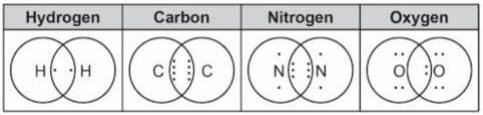
The pictures show the bonds formed by the sharing of electrons by the atoms of four different
molecules.

Image
1. Which molecule has the strongest bond between its atoms?
A. Hydrogen
B. Carbon
C. Nitrogen
D. Oxygen
2. What is this type of bond between atoms known as?
3. Which of these is another way of representing the bonds between the atoms of a nitrogen molecule?
A. $N 0 N$
C. $N \equiv N$
B. $N \times N$
D. $N - N$
4. Which of these statements is true about carbon compounds?
Circle ‘Yes’ or ‘No’ for the correct response.

Is this true about carbon compounds?

Yes or No

They are good conductors of electricity.

Yes/No

They exist in either saturated or unsaturated form

Yes/No

They have lower boiling points than ionic compounds.

Yes/No

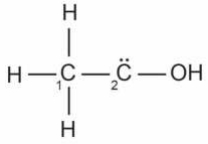
The picture shows the incomplete chain structure of a carbon compound.
The second carbon atom has two free electrons.

Image
5. How many oxygen atoms can combine with the second carbon atom to complete the structure?
A. One
B. Two
C. Three
D. Fou
6. Which of these molecules contains a double bond?
A. CH₄
B. C₂H₄
C. C₃H₈
D. C₄H₁₀
A part of a homologous series is shown below.
C₃H₄, C₄H₆, C₅H₈
7. Which of these compounds is a part of the series shown above?
A. C₂H₂
B. C₂H₄
C. C₈H₆
D. C₆H₁₄

The arrangement of metals in a vertical column in the decreasing order of their re-activities is called the reactivity series or activity series of metals. The most reactive metal is at the top position of the reactivity series. The least reactive metal is at the bottom of the reactivity series.
Hydrogen, though a non-metal, has been included in the activity series of metals only for comparison. Apart from it, the hydrogen atom also has tendency to lose its valence electron and form cation like the behaviour shown by metals. Thus,
$H \longrightarrow H ^{+}+ e ^{-}$
(i) An element ' $X$ ' after reacting with acids liberate hydrogen gas and can displace lead and tin from their salt solution. Write down the Name of $X$ metal.
(ii) Which metal can be displaced by copper from its salt solution?
or
(ii) Write down the name of most reactive metal and which metal does not liberate hydrogen gas after reacting with acid?
A near sighted person wears eye glass with power of $-5.0$ D for distant vision. Soon, he started having difficulties in viewing nearby objects also. His doctor prescribes a correction of $+1.5 D$ in near vision section of his bi-focal, which is measured relative to main part of the lens.

(i) Find the focal length of his distant viewing part of lens.
(ii) Find the focal length of near vision section of the lens.
(iii) What type of lens is to be used in this spectacles for near vision?
or
(iv) What is the reason of hypermetropia?

Questions are based on the two table given below. Study these tables related to blood pressure level and answer the question that follow :

TABLE- A

BLOOD PRESSURE CATEGORYSYSTOLIC mm Hg (Upper number)DIASTOLIC mm Hg (Lower number)
Normal12080
Elevated120-129Less than 80
High Blood Pressure (Hypertension) Stage 1130-13980-90
High Blood Pressure (Hypertension) Stage 2140 or higher90 or higher
Hypertensive crisis (consult your doctor immediately)Higher than 180Higher than 120

TABLE-B

Time of MeasurementBlood Pressure
Patient-XPatient-Y
Morning75-11585-125
Afternoon79-12280-120
Evening82-13275-110

(i) In the table B, at which time patent-Y have ideal normal blood pressure?
(ii) Identify the patient, which have hypertension stage-1 blood pressure ?
(iii) Which Diet is the best for high blood pressure patient?
or
(iv) What is the ideal blood pressure measurement of a human?

Read the following and answer any three questions from (i) to (iv).The electrical energy consumed by an electrical appliance is given by the product of its power rating and the time for which it is used. The SI unit of electrical energy is Joule. Actually, Joule represents a very small quantity of energy, and therefore it is inconvenient to use where a large quantity of energy is involved. So for commercial purposes we use a bigger unit of electrical energy which is called kilowatt-hour. 1 kilowatt-hour is equal to $3.6 × 10^6$ joules of electrical energy.
  1. The energy dissipated by the heater is E. When the time of operating the heater is doubled, the energy dissipated will?
     
  2. The power of a lamp is 60W. The energy consumed in 1 minute will?
     
  3. The electrical refrigerator rated 400W operates 8 hours a day. The cost of electrical energy is ₹ 5 per kWh. Find the cost of running the refrigerator for one day?
    OR
  4. Calculate the energy transformed by a 5A current flowing through a resistor of $2\Omega$ for 30 minutes?

Read the following and answer any three questions from (i) to (iv).
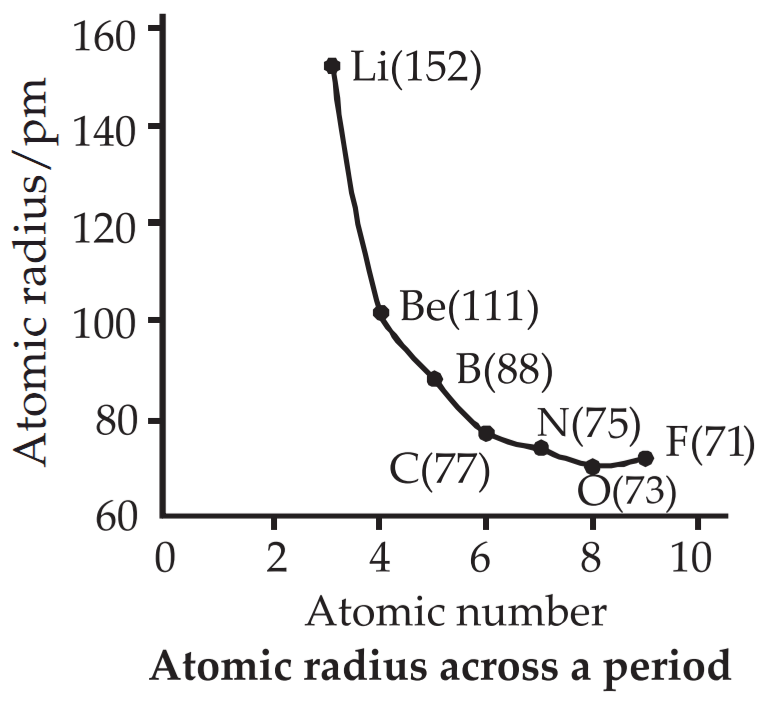
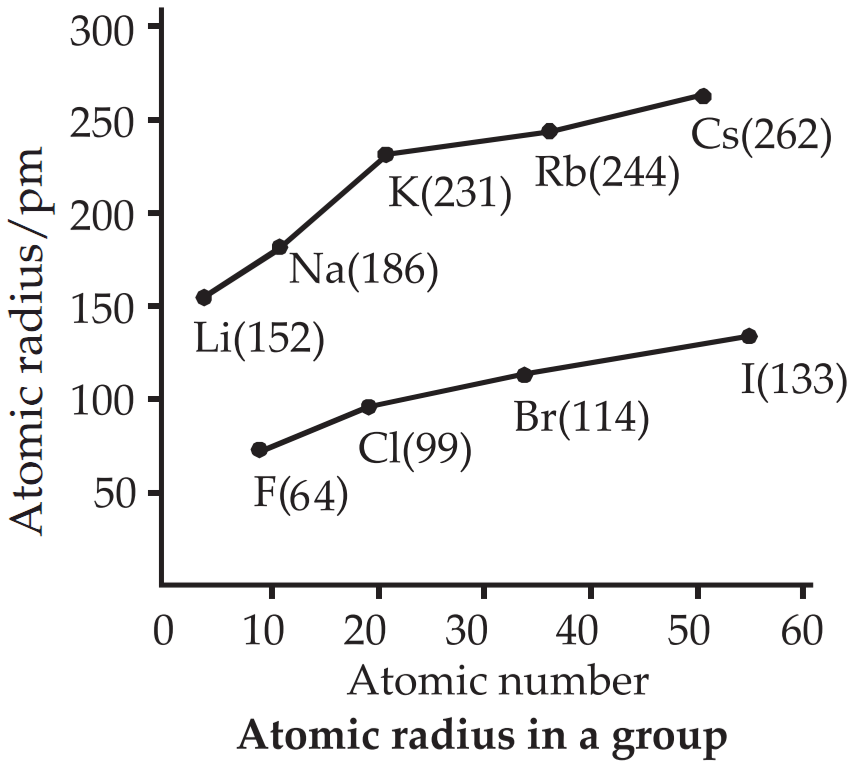
The distance between the centre of the nucleus and the outermost shell of electrons is known as atomic radius. On moving from left to right along a period, atomic radii decrease because effective nuclear charge increases. For example, the atomic size decreases regularly from Li to F in the second period and from Na to Cl in the third period. It may, however, be noted that in any period, the noble gas has the largest size. On moving down in a group, atomic radii increase.

  1. Write the maximum atomic radius?
     
  2. Which element is the smallest size in group 13?
     
  3. why the atomic radius decreases as we move across a period?

    OR
  4. A) ln the third period of the periodic table, Which element has the smallest size?
    b) define atomic radius?