Question
Sound is produced by vibrating objects. The matter or substance through which sound is transmitted is called a medium. It can be solid, liquid or gas. Sound moves through a medium from the point of generation to the listener. When an object vibrates, it sets the particles of the medium around it vibrating. The particles do not travel all the way from the vibrating object to the ear. Sound waves are characterized by the motion of particles in the medium and are called mechanical waves.When a vibrating objectmoves forward, it pushes and compresses theair in front of it creating a region of highpressure; this region is called a compression$(C)$.When the vibrating object moves backwards,it creates a region of low pressure calledrarefaction $(R)$. Hence sound is longitudinal wave.
(i) Sound waves are
$(a)$ Mechanical waves
$(b)$ Electromagnetic wave
$(c)$ Transverse waves
$(d)$ None of these
(ii) Sound travel in medium with
$(a)$ Compression and rare fraction
$(b)$ Crest and trough
$(c)$ Both can be possible
$(d)$ None of these
(iii) Compression is the region of
$(a)$ High pressure
$(b)$ Low pressure
$(c)$ Medium pressure
$(d)$ None of these
(iv) What is sound and how is it produced?
(v) Why sound wave is called as longitudinal wave?
Answer

$(i) a$
$(ii) a$
$(iii) a$
$(iv)$ Sound is vibrations created by object. When body vibrates, it forces the adjacent particles of the medium to vibrate. This results in disturbance in the medium, which travels as waves an reaches the ear hence sound is produced.
$(v)$ The vibration of medium that travels parallel to direction of wave or along in the direction of the wave is called longitudinal wave. The direction of particles of medium vibrates parallel to direction of propagation of disturbance. Therefore a sound is called longitudinal waves.

Need a full question paper?

Generate a complete, print-ready paper with questions like this in minutes — across 16+ boards, with answer keys.

Start Generating Free

Similar questions

Do we always need to heat or change pressure for changing the state of matter? Can you quote some examples from everyday life where change of state from liquid to vapour takes place without the liquid reaching the boiling point? In the case of liquids, a small fraction of particles at the surface, having higher kinetic energy, is able to break away from the forces of attraction of other particles and gets converted into vapour. This phenomenon of change of a liquid into vapors at any temperature below its boiling point is called evaporation.
$i.)$ Evaporation of liquid takes place at
$a.)$ Boiling point
$b.)$ Above boiling point
$c.)$ Below boiling point
$d.)$ None of these
$ii.)$ Evaporation takes place at surface of liquid because
$a.)$ They are heavy as compare to other particles
$b.)$ They have sufficient kinetic energy to break the force
$c.)$ They are light weight as compare to other particles
$d.)$ None of these
$iii.)$ During evaporation particles of liquid change into vapour
$a.)$ From the surface
$b.)$ From the bottom
$c.)$ From all over the liquid
$d.)$ None of these
$iv.)$ Define evaporation.
$v.)$ Explain process of evaporation
Muscular tissue consists of elongated cells, also called muscle fibres. This tissue is responsible for movement in our body. Muscles contain special proteins called contractile proteins, which contract and relax to cause movementWe can move some muscles by conscious will. Such muscles are called voluntary muscles. These muscles are also called skeletal muscles as they are mostly attached to bones and help in body movement. Under the microscope, these muscles show alternate light and dark bands or striations, hence they are also called striated muscles. The cells of this tissue are long, cylindrical, unbranched and multinucleate.
The movement of food in the alimentary canal or the contraction and relaxation of blood vessels are involuntary movements. We can’t control these muscle movement. The Smooth muscles or involuntary muscles control such movements. They are also found in the iris of the eye, in ureters and in the bronchi of the lungs. The cells are long with pointed ends (spindle-shaped) and uninucleate. They are also called unstriated muscles.
The muscles of the heart show rhythmic contraction and relaxation throughout life. These involuntary muscles are called cardiac. Heart muscle cells are cylindrical, branched and uninucleate.
(1) Which of the following muscle tissue are voluntary in nature?
$(a)$ Cardiac muscle
$(b)$ Smooth muscle
$(c)$ auto rhythmic muscle
$(d)$ None of the above
(2) The muscles whose contraction is under our control are known as
$(a)$ Voluntary muscles
$(b)$ Involuntary movements
$(c)$ Cardiac muscle
$(d)$ Unstrained muscle
(3) The smooth muscle are found in the
$(a)$ Iris of eye
$(b)$ Uterus
$(c)$ Bronchi of lungs
$(d)$ All of above
(4) Give the characteristic of striated muscles.
(5) Give the characteristic of unstriated muscles.
A solid mixture contains four constituents $P, Q, R$ and $S. P$ consists of tiny grains and it is mixed with cement for plastering the walls. $Q$ is a white solid which is recovered on a large scale from sea water by the process of evaporation. $R$ is in the form of tiny particles of a material whose corrosion is called rusting. And $S$ is a white solid which is used in making ordinary dry cells.
  1. What could $P, Q, R$ and $S$ be?
  2. How would you separate a mixture containing $P, Q, R$ and $S?$
Meristematic tissue take up a specific role and lose the ability to divide. As a result, they form a permanent tissue. This process of taking up a permanent shape, size, and a function is called differentiation. Differentiation leads to the development of various types of permanent tissues.
Simple Permanent Tissue
Tissue made of one type of cells, which look like each other. Such tissues are called simple permanent tissue. Parenchyma is the most common simple permanent tissue. It consists of relatively unspecialised cells with thin cell walls. They are living cells. They are usually loosely arranged, thus large spaces between cells (intercellular spaces) are found in this tissue. This tissue generally stores food. In some situations, it contains chlorophyll and performs photosynthesis, and then it is called chlorenchyma. In aquatic plants, large air cavities are present in parenchyma to help them float. Such a parenchyma type is called aerenchyma.Yet another type of permanent tissue is sclerenchyma. It is the tissue which makes the plant hard and stiff. We have seen the husk of a coconut. It is made of sclerenchymatous tissue. The cells of this tissue are dead. They are long and narrow as the walls are thickened due to lignin.
Simple Permanent Tissue
Complex tissues are made of more than one type of cells. All these cells coordinate to perform a common function. Xylem and phloem are examples of such complex tissues. They are both conducting tissues and constitute a vascular bundle. Xylem fibres are mainly supportive in function. Phloem transports food from leaves to other parts of the plant. Except phloem fibres, other phloem cells are living cells.
(1) Tissue made of only one type of cell is termed as _________
$(a)$ Simple permanent tissue
$(b)$ Complex permanent tissue
$(c)$ Simple Meristematic tissue
$(d)$ Complex Meristematic tissue
(2) Xylem and phloem are examples of
$(a)$ Meristematic tissue
$(b)$ Simple tissue
$(c)$ Protective tissue
$(d)$ Complex tissue
(3) In aquatic plants, which type of parenchymatissue is found?
$(a)$ Aerenchyma
$(b)$ Chlorenchyma
$(c)$ Sclerenchyma
$(d)$ Parenchyma
(4) What is mean by Differentiation?
(5) Enlist the type of parenchyma tissue.
The sum of momentum of the two objects before collision is equal to the sum of momentum after the collision provided there is no external unbalanced force acting on them. This is known as the law of conservation of momentum. This statement can alternatively be given as the total momentum of the two objects is unchanged or conserved by the collision. Law of conservation of momentum is applicable to system of particle. Answer the following questions.
(i)Law of conservation of momentum is applicable to
$(a)$ A system of particles
$(b)$ Only for $2$ particles
$(c)$ Only for $1$ particle
$(d)$ None of the above
(ii) Law of conservation of momentum holds good provided that
$(a)$ There should be external unbalanced force acting on particles
$(b)$ There should not be any external unbalanced force acting on particles
$(c)$ No internal forces acting on particles
$(d)$ None of the above
(iii)The total momentum of the two objects when collision occurs is
$(a)$ Changed
$(b)$ Remains conserved
$(c)$ Become zero
$(d)$ None of the above
(iv) State law of conservation of momentum.
(v) If action and Reaction are equal in magnitude and opposite in direction then why they do not cancel each other?
As you know, the density of a substance is defined as mass of a unit volume. The unit ofdensity is kilogram per meter cube $\left( kg / m ^{-3}\right)$. The density of a given substance, under specified conditions, remains the same. Therefore the density of a substance is one of its characteristic properties. It is different for different substances. For example, the density of gold is $19300\left(kg / m ^{-3}\right)$ while that of water is $1000\left(kg / m ^{-3}\right)$. The density of a given sample of a substance can help us to determine its purity. It is often convenient to express density of a substance in comparison with that of water. The relative density of a substance is the ratio of its density to that of water:Density of a substance
Relative density =
Density of water
Since the relative density is a ratio of similar quantities, it has no unit. Answer the following.
(i) SI unit of density is
$(a)$ $kg/m$
$(b)$ $kg /m^2$
$(c)$ $kg /m^3$
$(d)$ None of these
(ii) SI unit of relative density is
$(a)$ $
$(b)$ No unit
$(c)$ $kg /s^3$
$(d)$ None of these
(iii) Relative density of water is
$(a)$ $1000$
$(b)$ $1$
$(c)$ $10$
$(d)$ None of these
(iv)Define relative density.
(v) Comment of relative density value of substance which
(1) Sink in water
(2) float on water
There are three states of matter – solid, liquid and gas.
Solids have a definite shape, distinct boundaries and fixed volumes, that is, have negligible compressibility. Solids have a tendency to maintain their shape when subjected to outside force. Solids may break under force but it is difficult to change their shape, so they are rigid.
Liquids have no fixed shape but have a fixed volume. They take up the shape of the container in which they are kept. Liquids flow and change shape, so they are not rigid but can be called fluid.
Gas as has indefinite shape, no fixed volume. Gas gets the shape and volume of container.
Gas has very low density hence are light. Gas can flow easily and hence are called fluid.
$i.)$ Which of the following state of matter takes shape of container in which it is filled?
$a.)$ Solid
$b.)$ Liquid
$c.)$ Gas
$d.)$ Both $b$ and $c$
$ii.)$ Distance between particles of matter least in
$a.)$ Solid
$b.)$ Liquid
$c.)$ Gas
$d.)$ None of these
$iii.)$ Compressibility is least in case of
$a.)$ Solid
$b.)$ Liquid
$c.)$ Gas
$d.)$ None of these
$iv.)$ Give properties of solids.
$v.)$ Give properties of Gases.
Read the following text carefully and answer the questions that follow:
Homogeneous mixtures are regarded as solutions or true solutions. Heterogeneous mixtures are of two types. These are suspensions and colloidal solutions. These differ in the size of the particles responsible for the difference in their properties. In a suspension, the particle size is more than $10^{-5} \ cm$ whereas in a colloidal solution, it ranges between $10^{-5} \ cm$ to $10^{-7} \ cm$. The two phases which constitute colloidal solutions, are dispersed phase and dispersion medium. Based upon their nature, the colloidal solutions are classified into eight types. The mixture of the non$-$reacting gases is always homogeneous irrespective of their nature. Therefore, it is not a colloidal solution.
$i.$ Scattering of light occurs when a beam of light is passed through Blood. Why?
$ii.$ What is Tyndall effect?
$iii.$ What is called colloidal solution?
$OR$
Give an example of colloidal solution and identified their dispersed phase and dispersion medium?
Read the following text carefully and answer the questions that follow:
The tissue is a group of cells having similar origin, structure\& function. Study of tissues is called Histology. In unicellular organism (Amoeba) single cell performs all basic functions, whereas in multi-cellular organisms (Plants and Animals) shows division of labour as Plant tissue \& Animal tissues. Plant tissues are two types:
Image
Meristematic tissue:
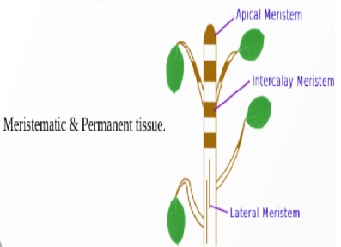
The meristems are the tissues having the power of cell division. It is found on that region of the plant which grows.
Following are the types of Meristems:
The Apical meristems- It is present at the growing tip of the stem and roots and increases the length.
The lateral meristems- It present at the lateral side of stem and root (cambium) and increases the girth.
The intercalary meristems- It present at internodes or base of the leaves and increases the length between the nodes.
i. Which tissue help in the secondary growth of the plant?
ii. In what region of the plant does intercalary meristematic growth occur?
iil. Where does meristematic tissue mostly found in a plant?