MCQ
Sound waves in air cannot be polarized because:
  • A
    Their speed is small
  • B
    They require medium
  • These are longitudinal
  • D
    Their speed is temperature dependent

Answer

Correct option: C.
These are longitudinal

Sound waves are longitudinal waves.

Need a full question paper?

Generate a complete, print-ready paper with questions like this in minutes — across 16+ boards, with answer keys.

Start Generating Free

Similar questions

The current density in a cylindrical wire of radius $r=4.0 \,mm$ is $1.0 \times 10^{6} \,A / m ^{2}$. The current through the outer portion of the wire between radial distances $r / 2$ and $r$ is $x \pi A$; where $x$ is ..........
The potential difference in open circuit for a cell is 2.2 volts. When a 4 ohm resistor is connected between its two electrodes the potential difference becomes 2 volts. The internal resistance of the cell will be
According to Hubble's law, the redshift $(\rlap{--} Z)$ of a receding galaxy and its distance $r$ from earth are related as
In two separate experiments the neutral points due to two small magnets are at a distance of r and 2r in broad side-on position. The ratio of their magnetic moments will be
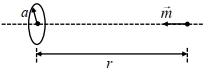
A special metal $S$ conducts electricity without any resistance. A closed wire loop, made of $S$, does not allow any change in flux through itself by inducing a suitable current to generate a compensating flux. The induced current in the loop cannot decay due to its zero resistance. This current gives rise to a magnetic moment which in turn repels the source of magnetic field or flux. Consider such a loop, of radius $a$, with its center at the origin. A magnetic dipole of moment $m$ is brought along the axis of this loop from infinity to a point at distance $r \gg a)$ from the center of the loop with its north pole always facing the loop, as shown in the figure below.

The magnitude of magnetic field of a dipole $m$, at a point on its axis at distance $r$, is $\frac{\mu_0}{2 \pi} \frac{m}{r^3}$, where $\mu_0$ is the permeability of free space. The magnitude of the force between two magnetic dipoles with moments, $m_1$ and $m_2$, separated by a distance $r$ on the common axis, with their north poles facing each other, is $\frac{k m_1 m_2}{r^4}$, where $k$ is a constant of appropriate dimensions. The direction of this force is along the line joining the two dipoles.

($1$) When the dipole $m$ is placed at a distance $r$ from the center of the loop (as shown in the figure), the current induced in the loop will be proportional to

$(A)$ $\frac{m}{r^3}$ $(B)$ $\frac{m^2}{r^2}$ $(C)$ $\frac{m}{r^2}$ $(D)$ $\frac{m^2}{r}$

($2$) The work done in bringing the dipole from infinity to a distance $r$ from the center of the loop by the given process is proportional to

$(A)$ $\frac{m}{r^5}$ $(B)$ $\frac{m^2}{r^5}$ $(C)$ $\frac{m^2}{r^6}$ $(D)$ $\frac{m^2}{r^7}$

Give the answer or qution ($1$) and ($2$)
As compared $^{12}C$ atom, $^{14}C$ atom has
Two bulbs of equal wattage, one having carbon filament and the other having a tungsten filament are connected in series to the mains, then
An alternating voltage $E = 200\sqrt 2\, \sin\, (100\,t)$ is connected to a $1$ microfarad capacitor through an ac ammeter. The reading of the ammeter shall be......$mA$
The line that draws power supply to your house from street has:
A battery of e.m.f. 3 volt and internal resistance 1.0 ohm is connected in series with copper voltameter. The current flowing in the circuit is 1.5 amperes. The resistance of voltameter will be