MCQ
Spin isomerism is shown by
  • A
    dichlorobenzene
  • hydrogen
  • C
    dibasic acid
  • D
    $n-$ butane

Answer

Correct option: B.
hydrogen
b
Spin isomerism is shown by hydrogen. In ortho-hydrogen, the spin of nuclei of two atoms of the molecule are in same direction whereas in case of para hydrogen, the spin of nuclei of two atoms are in opposite direction.

Need a full question paper?

Generate a complete, print-ready paper with questions like this in minutes — across 16+ boards, with answer keys.

Start Generating Free

Similar questions

The molality of a $10 \%( v / v )$ solution of di-bromine solution in $CCl _4$ (carbon tetrachloride) is $x$. $x=$ $......\times 10^{-2}\,M$. (Nearest integer)

[Given : molar mass of $Br _2=160\,g\,mol ^{-1}$

atomic mass of $C =12\,g\,mol ^{-1}$

atomic mass of $Cl =35.5\,g\,mol ^{-1}$

density of dibromine $=3.2\,g\,cm ^{-3}$

density of $\left.CCl _4=1.6\,g\,cm ^{-3}\right]$

Calcium imide on hydrolysis will give gas $(B)$ which on oxidation by bleaching powder given gas $(C)$. Gas $(C)$ on reaction with magnesium gives compound $(D)$. $(D)$ on hydrolysis gives again gas $(B), (B), (C)$ and $(D)$ are
The quantum numbers $+ 1/2$ and $-1/2$ for the electron spin represent
Match List $I$ With List $II$

सूची $I$ (यौगिक) सूची $II$ ($Pk_a$ मान)
$A$.ethanol $I$.  $10.0$
$B$. phenol $II$. $15.9$
$C$. $m$-nitrophenol $III$. $7.1$
$D$. $p$-nitrophenol  $IV$. $8.3$

Choose the correct answer from the options given below:

Which one of the following statements concerning lanthanide elements is false ?
Which of the following is correct
Match the coordination number and type of hybridisation with distribution of hybrid orbitals in space based on valence bond theory.
Coordination number and type of hybridisationDistribution of hybrid orbitals in space
i. $4, sp ^3$A. Trigonal bipyramidal
ii. $4, dsp ^2$B. Octahedral
iii. $5, sp ^3 d$C. Tetrahedral
iv. $6, d^2 sp ^3$D. Square planar
Select the CORRECT option:
Which of the following is the incorrect match for atom of element ?
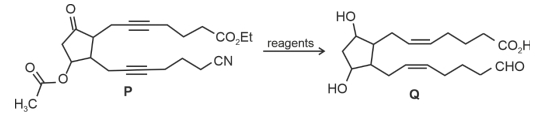
The option($s$) with correct sequence of reagents for the conversion of $P$ to $Q$ is(are)

$(A) i)$ Lindlar's catalyst, $H _2$; $ii$) $SnCl _2 / HCl$; iii) $NaBH _4$; iv) $H _3 O ^{+}$

$(B) i)$ Lindlar's catalyst, $H _2$; $ii$) $H _3 O ^{+}; iii)$ $SnCl _2 / HCl$; iv) $NaBH _4$

$(C) i)$ $NaBH _4; ii)$ $SnCl _2 / HCl; $iii$)$ $H _3 O ^{+}; iv)$ Lindlar's catalyst, $H _2$

$(D) i)$ Lindlar's catalyst, $H _2$; $ii$) $NaBH _4; iii)$ $SnCl _2 / HCl; iv)$ $H _3 O ^{+}$
The heat evolved in the combustion of methane is given by the following equations:$C{H_4}(g) + 2{O_2}(g)\, \to \,C{O_2}(g) + {H_2}O(l);$$\Delta H = - 890.3\,kJ$ How many grams of methane would be required to produce  $445.15\, kJ$  of heat of combustion......$g$