Question
State and explain the Clock face rule for determining the polarities of a circular wire carrying current.

Answer

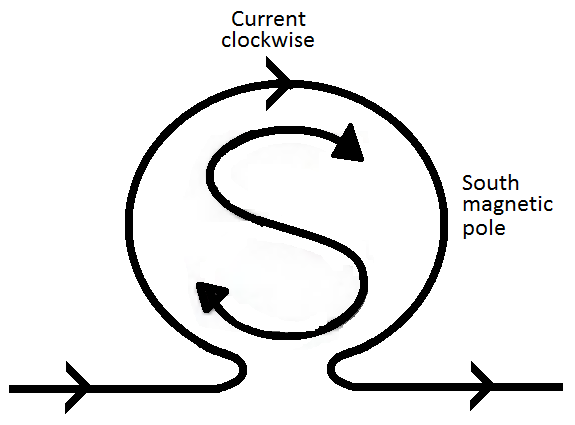
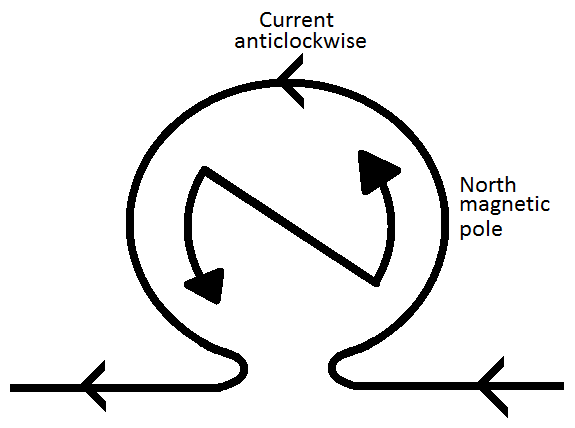
According to the Clock face rule, we look at one face of a circular wire (or coil) through which a current is passing:
  1. If the current around the face of the circular wire (or coil) flows in the clockwise direction, then that face of the circular wire will be South pole (S-pole)
  1. If the current around the face of the circular wire (or coil) flows in the anti-clockwise direction, then that face of the circular wire will be North pole (N-pole).

Need a full question paper?

Generate a complete, print-ready paper with questions like this in minutes — across 16+ boards, with answer keys.
Start Generating Free

Similar questions

How do organisms, whether reproduced asexually or sexually maintain a constant chromosome number through several generations? Explain with the help of suitable example.
Give an example of the characteristics being used to determine how close two species are in evolutionary terms.
What would be the effect on the resistance of a metal wire of:
  1. Increasing its length?
  2. Increasing its diameter?
  3. Increasing its temperature?
All the human races like Africans, Asians, Europeans, Americans and others might have evolved from a common ancestor. Provide a few evidences in support of this view.
Stomata of desert plants remain closed during the day. Explain how and when they take up $CO _2$ to perform photosynthesis?
What is meant by scattering of light? The sky appears blue and the sun appears reddish at sunrise and sunset. Explain these phenomena with reason.
Suggest three contraceptive methods to control the size of human population which is essential for the health and prosperity of a country. State the basic principle involved in each.
What is the cause of magnetic field inside a human body?
In the figure given alongside, a narrow beam of white light is shown to pass through a triangular glass prism. After passing through the prism, it produces a spectrum YX on the screen:
State the colour seen.
  1. At X, and
  2. At Y​​​​​​​​​​​​

​​​​​​​​​​​​
  1. violet.
  2. Red
  1. ​​​​​​​Why do different colours of white light bend through different angles with respect to the incident beam of light?
An object of height 5 cm is placed perpendicular to the principal axis of a concave lens of focal length 10 cm. If the distance of the object from the optical centre of the lens is 20 cm, determine the position, nature and size of the image formed using the lens formula.