Question
State and explain the New Cartesian Sign Convention for spherical lenses.

Answer

New Cartesian Sign Convention for spherical lenses:
  1. All the distances are measured from the optical centre of the lens.
  2. The distances measured in the same direction as that of incident light are taken as positive.
  3. The distances measured against the direction of incident light are taken as negative.
  4. The distances measured upward and perpendicular to the principal axis are taken as positive.
  5. The distances measured downward and perpendicular to the principal axis are taken as negative.

Need a full question paper?

Generate a complete, print-ready paper with questions like this in minutes — across 16+ boards, with answer keys.
Start Generating Free

Similar questions

An electric lamp of 100 Ω, a toaster of resistance 50 Ω, and a water filter of resistance 500 Ω are connected in parallel to a 220 V source. What is the resistance of an electric iron connected to the same source that takes as much current as all three appliances, and what is the current through it?
Out of bacteria, spider, fish and chimpanzee, which organism has a better body design in evolutionary terms? Give reason for your answer.
How does control and coordination take place in plants? How does it differ from that in animals?
Explain the term genetic drift.
A ray of light enters a diamond from air. If the refractive index of diamond is 2.42, what % (percentage) is speed of light in diamond with that of speed in air?
A compound which is prepared from gypsum has the property of hardening when mixed with proper quantity of water.
  1. Identify the compound.
  2. Write the chemical equation for its preparation.
  3. Mention one important use of this compound.
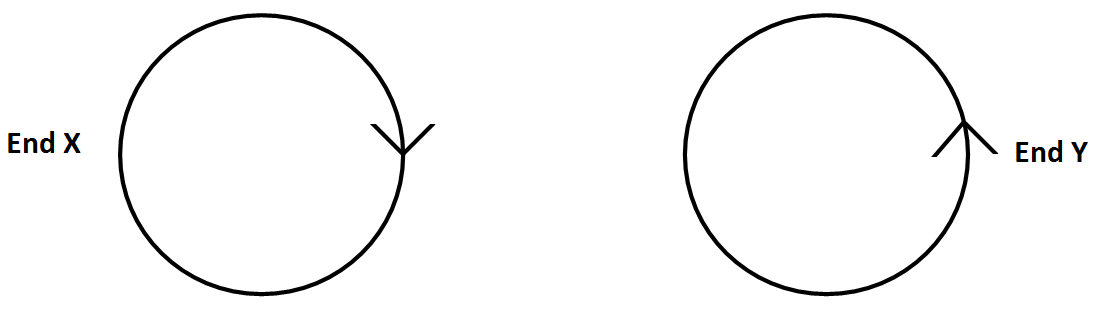
The direction of current flowing in the coil of an electromagnet at its two ends X and Y are as shown below:
  1. What is the polarity of end X?
  2. What is the polarity of end Y?
  3. Name and state the rule which you have used to determine the polarities.
The near point of a long-sighted person is 50cm from the eye:
  1. Can she see clearly an object at:
  1. A distance of 20 cm?
  2. At infinity?
  1. To read a book held at a distance of 25cm, will she need converging or diverging spectacle lenses?
How does DNA help in defining evolutionary relationship?
$Na , Mg$ and Al are the elements of the $3^{\text {rd }}$ period of the Modern Periodic Table having group number 1,2 and 13 respectively. Which one of these elements has the (a) highest valency, (b) largest atomic radius, and (c) maximum chemical reactivity? Justify your answer stating the reason for each.