Question
State and explain the theorem of parallel axes.

Answer

Statement: The moment of inertia $\left(I_0\right)$ of an object about any axis is the sum of its moment of inertia $\left(I_c\right)$ about an axis parallel to the given axis, and passing through the centre of mass and the product of the mass of the object and the square of the distance between the two axes. Mathematically, $I _{ O }= I _{ c }+ Mh ^2$
Proof:
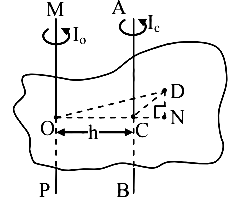
i. Consider an object of mass M. Axis MOP is an axis passing through point O .
ii. Axis $A C B$ is passing through the centre of mass $C$ of the object, parallel to the axis MOP, and at a distance $h$ from it $(\therefore h = CO )$.


  1. The theorem of parallel axes
  2. Consider a mass element ‘dm’ located at point D. Perpendicular on OC (produced) from point D is DN.
  3. Th
  4. e moment of inertia of the object about the axis ACB is $I_c = \int (DC)^2 $dm, and about the axis MOP, it is$ I_o = \int (DO)^2 dm.$
  5. $I_o = \int (DO)^2 dm = \int [(DN)^2 + (NO)^2] dm$
    $= \int [(DN)^2 + (NC)^2 + 2 . NC . CO + (CO)^2]dm$
    $= \int [(DC)^2 + 2NC . h + h^2]dm ...........…$.(using Pythagoras theorem in \triangle DNC)
    $= \int (DC)^2dm + 2h \int NC . dm + h^2 \int dm$
    $Now, \int (DC)^2dm = I_c and \int dm = M$
  6. NC is the distance of a point from the centre of mass. Any mass distribution is symmetric about the centre of mass. Thus, from the definition of the centre of mass, ∫ NC . dm = 0
    $\therefore I_o = I_c + Mh^2$
    This is the mathematical form of the theorem of parallel axes.

Need a full question paper?

Generate a complete, print-ready paper with questions like this in minutes — across 16+ boards, with answer keys.
Start Generating Free

Similar questions

State Biot-Savert law. Apply it to
(i) infinitely long current carrying conductor and (ii) a point on the axis of a current carrying circular loop.
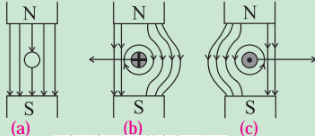
If a wire without any current is kept in a magnetic field, then it experiences no force as shown in figure (a). But when the wire is carrying a current into the plane of the paper in the magnetic field, a force will be exerted on the wire towards the left as shown in the figure (b). The field will be strengthened on the right side of the wire where the lines of force are in the same direction as that of the magnetic field and weakened on the left side where the field lines are in opposite direction to that of the applied magnetic field. For a wire carrying a current out of the plane of the paper, the force will act to the right as shown in figure (c).

Image

Describe what is Rayleigh’s criterion for resolution. Explain it for a telescope and a microscope.
Define and explain centripetal force.
A galvanometer has a resistance of $16 \Omega$ and gives a full scale deflection when a current of $20\ mA$ is passed through it. The only shunt resistance available is $0.04 \Omega$ which is not sufficient to convert the galvanometer to an ammeter to measure up to $10 A$. What resistance should be connected in series with the coil of the galvanometer so that the range of the ammeter is $10 A ?$
The dipole moment of a water molecule is $6.3 \times 10^{-30} Cm$.
A sample of water contains $1021$ molecules, whose dipole moments are all oriented in an electric field of strength $2.5 \times 10^5 N / C$.
Calculate the work to be done to rotate the dipoles from their initial orientation $\theta_1=0$ to one in which all the dipoles are perpendicular to the field, $\theta_2=90^{\circ}$.
Obtain an expression for the electric potential energy of a system of two isolated point charges.
Two coils of $100$ turns and $200$ turns have self inductances $25\ mH$ and $40\ mH$, respectively. Their mutual inductance is $3\ mH$. If a $6\ mA$ current in the first coil is changing at the rate of $4\ A / s$, calculate
State an expression for the radius of gyration of
(i) a thin ring
(ii) a thin disc, about respective transverse symmetry axis.
OR
Show that for rotation about respective transverse symmetry axis, the radius of gyration of a thin disc is less than that of a thin ring.
Derive an equation for the resultant wave produced due to superposition of two waves. Hence, state the expression for the amplitude of the resultant wave when two waves are
(1) in phase
(2) out of phase.