Question
State Bohr’s quantization condition of angular momentum. Calculate the shortest wavelength of the Bracket series and state to which part of the electromagnetic spectrum does it belong.

Answer

According to Bohr's quantisation, the electrons revolve around the nucleus only in those orbits for which the angular momentum is the integral multiple of
$\frac{\text{h}}{2\pi}$
$\text{L}=\frac{\text{nh}}{2\pi}$
For Bracket series $\text{n}_2=\infty,$
$\frac{1}{\lambda}=\text{R}_\text{H}\text{Z}^2\Big\{\frac{1}{4^2}-\frac{1}{\infty}\Big\}$
$\frac{1}{\lambda}=\frac{\text{R}_\text{H}}{16}$
$\lambda=\frac{16}{\text{R}_\text{H}}=14.58\times10^{-7}\text{m}$
This wavelength belongs to the inftra-red region.

Need a full question paper?

Generate a complete, print-ready paper with questions like this in minutes — across 16+ boards, with answer keys.
Start Generating Free

Similar questions

A different of 2.3 eV separates two energy levels in an atom. What is the frequency of radiation emitted when the atom make a transition from the upper level to the lower level?
A parallel beam of monochromatic light of wavelength 663nm is incident on a totally reflecting plane mirror. The angle of incidence is 60° and the number of photons striking the mirror per second is 1.0 × 10¹⁹. Calculate the force exerted by the light beam on the mirror.
The output of an OR gate is connected to both the inputs of a NAND gate. Draw the logic circuit of this combination of getes and write its truth table.
Obtain the de Broglie wavelength of a neutron of kinetic energy 150 eV. As you have seen in Exercise 11.31, an electron beam of this energy is suitable for crystal diffraction experiments. Would a neutron beam of the same energy be equally suitable? Explain. (mn = 1.675 × 10–27 kg).
What are $V-1$ characteristics of a $p-n$ junction?
Two metallic wires of the same material have the same length but cross-sectional areas are in the ratio 1 : 2. They are connected (i) in series and (ii) in parallel. Compare the drift velocities of electrons in the two wires in both the cases (i) and (ii).
Derive R=2f for spherical mirror.
(Where, R= radius of curvature and f = focal length)###Obtain relation between radius of curvature and focal length of spherical mirror.
Define the distance of closest approach. An α-particle of kinetic energy 'K' is bombarded on a thin gold foil. The distance of the closest approach is 'r'. What will be the distance of closest approach for an α-particle of double the kinetic energy?
Why cannot longitudinal waves be polarized?
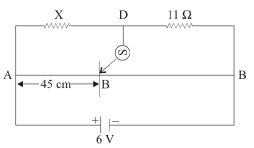
Find the value of X in the given figure.
Image