Question
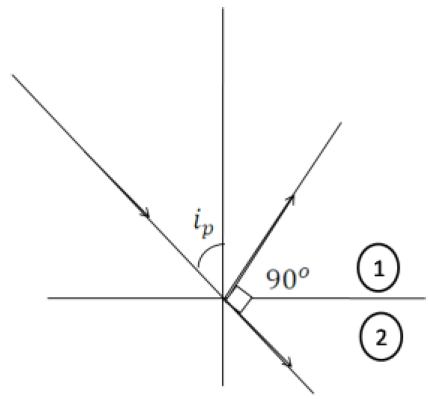
State Brewster’s law.
The value of Brewster angle for a transparent medium is different for light of different colours. Give reason.
Answer

When unpolarized light is incident on the surface separating two media, the reflected light gets (completely) polarised only when the reflected light and refracted light become perpendicular to each other.

The refractive index of denser medium, with respect to rarer medium, is given by $\mu = \tan\text{i}_{p}$
Since Refractive index (μ) of a transparent medium is different for different colours, hence Brewster angle is different for different colours.

Need a full question paper?

Generate a complete, print-ready paper with questions like this in minutes — across 16+ boards, with answer keys.

Start Generating Free

Similar questions

Consider a circuit containing an ideal battery connected to a resistor. Do "work done by the battery" and "the thermal energy developed" represent two names of the same physical quantity?
(a) Calculate the potential at a point $P$ due to a charge of $4 \times 10^{-7} C$ located $9 cm$ away.
(b) Hence obtain the work done in bringing a charge of $2 \times 10^{-9} C$ from infinity to the point P. Does the answer depend on the path along which the charge is brought?
What is a capacitive and an inductive AC circuit? Explain.
During an experiment, an ideal gas is found to obey an additional law $pV^2 =$ constant. The gas is initially at a temperature T and volume V. Find the temperature when it expands to a volume 2V.
If three identical prisms are combined, is it possible to pass a beam that emerges undeviated? Undispersed?
Discuss sign convention of distance for reflection by spherical mirror and refraction by spherical lens.
Describe briefly, with the help of a diagram, the role of the two important processes involved in the formation of a p-n junction.
A 1.0m long metallic rod is rotated with an angular frequency of 400 rad $s^{-1}$ about an axis normal to the rod passing through its one end. The other end of the rod is in contact with a circular metallic ring. A constant and uniform magnetic field of 0.5T parallel to the axis exists everywhere. Calculate the emf developed between the centre and the ring.
At a hydroelectric power plant, the water pressure head is at a height of 300m and the water flow available is $100m^3s^{-1}$. If the turbine generator efficiency is 60%, estimate the electric power available from the plant $(g = 9.8ms^{-2}).$
The equation $\omega=\frac{\mu_\text{v}-\mu_\text{r}}{\mu-1}$ asderived for a prism having small refracting angle. Is it also valid for a prism of large refracting angle? Is it also valid for a glass slab or a glass sphere?