Question
State Huygens' principle. Explain geometrical construction of a plane wavefront.

Answer

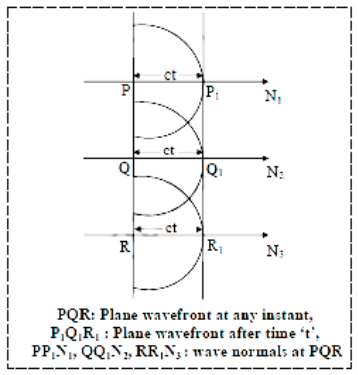
According to Huygens principle, each point of the wavefront is the source of a secondary disturbance and the wavelets emanating from these points spread out in all directions with the speed of the wave. These wavelets emanating from the wavefront are usually referred to as secondary wavelets and if we draw a common tangent to all these spheres, we obtain the new position of the wavefront at a later time.
Image
a. A plane wavefront is formed when point of observation is very far away from the primary source.
b. Let PQR represent a plane wavefront at any instant. According to Huygens' principle,all the points on this wavefront will act as secondary sources of light sending out secondary wavelets in the forward direction.
c. Draw hemispheres with $P, Q R$.... as centres and 'ct' as radius. The surface tangential to all such hemispheres is $P_1 Q_1 R_1 \ldots$. at instant ' $t$ '. It is a new wavefront at time ' $t$ '.
d. The plane wavefronts is propagated as plane waves in homogeneous isotropic medium. They are parallel to each other.
e. PP1N1, $Q Q_1 N_2, R R_1 N_3$ are the wave normals at $P, Q R$ respectively. These wave normals show the direction of propagation of plane wavefront.
f. The new wavefront $P_1 Q_1 R_1$ is parallel to primary wavefront PQR.

Need a full question paper?

Generate a complete, print-ready paper with questions like this in minutes — across 16+ boards, with answer keys.
Start Generating Free

Similar questions

Calculate the mean free path of a gas molecule with diameter $4 \mathring A$ if the pressure of the gas is $1.013 \times 10^5 \mathrm{~N} / \mathrm{m}^2$ and the temperature is $27^{\circ} \mathrm{C}$. (The Boltzmann constant, $\mathrm{k}_{\mathrm{B}}=1.38 \times 10^{-23}$ $\mathrm{J} / \mathrm{K})$
A rectangular coil having 100 turns each of length \(1 cm\) and breadth \(0.5 cm\) is suspended in radial magnetic induction \(0.002 T\). The torsional constant of suspension fiber is \(2 \times 10^{-8} Nm /\) degree. Calculate the current sensitivity of a moving coil galvanometer.
What is the nature of the interference pattern obtained using white light?
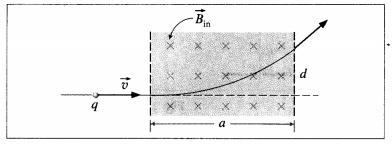
A particle of charge $q$ enters a region of uniform magnetic field $\vec{B}$ (pointing into the page). The field deflects the particle a distance $d$ above the original line of flight, as shown in below figure. Is the charge positive or negative? Find the momentum of the particle in terms of $a_{\text {, }}$ $d , B$ and $q$.
Image
A rectangular coil of a moving coil galvanometer contains 50 turns each having area \(12 cm ^2\). It is suspended in radial magnetic field \(0.025 Wb / m ^2\) by a fibre of twist constant \(15 \times 10^{-10} N - m /\) degree. Calculate the sensitivity of the moving coil galvanometer.
The velocity of the three molecules is $2 km s^{-1}, 4 km s^{-1}, 6 km s^{-1}.$
Find (i) mean square velocity (ii) root mean square velocity.
A tuning fork $C$ produces $8$ beats per second with another tuning fork D of frequency $340 Hz$. When the prongs of tuning fork $C$ are filed a little, the number of beats produced per second decreases to $4.$ Find the frequency of tuning fork $C$ before filing its prongs.
A small body of mass $0.3 \mathrm{~kg}$ oscillates in a vertical plane with the help of a string $0.5 \mathrm{~m}$ long with a constant speed of $2 \mathrm{~m} / \mathrm{s}$. It makes an angle of $60^{\circ}$ with the vertical. Calculate the tension in the string.
Find the kinetic energy per unit volume of nitrogen at a pressure of $76 \mathrm{~cm}$ of mercury. Hence, find the kinetic energy of $10 \mathrm{~cm}^3$ of the gas under the same condition. Take $\rho$ (mercury) = $13.6 \mathrm{~g} / \mathrm{cm}^3$ and $\mathrm{g}=9.8 \mathrm{~m} / \mathrm{s}^2$.
The thermal efficiency of a heat engine is $25 \%$. If in one cycle the heat absorbed from the hot reservoir is $50000 J$, what is the heat rejected to the cold reservoir in one cycle?