Question
State in brief the principle of immunisation.

Answer

Immunization, or immunisation, is the process by which an individual's immune system becomes fortified against an agent (known as the immunogen). The most important elements of the immune system that are improved by immunization are the T cells, B cells, and the antibodies B cells produce.

Need a full question paper?

Generate a complete, print-ready paper with questions like this in minutes — across 16+ boards, with answer keys.
Start Generating Free

Similar questions

You are provided with the seeds of gram, wheat, rice, pumpkin, maize and pea. Classify them whether they are monocot or dicot.
A body vibrating with a time-period of $\frac{1}{256}\text{s}$ produces a sound wave which travels in air with a velocity of $350\ m/s$. Calculate the wavelength.
A doctor/ nurse/ health-worker is exposed to more sick people than others in the community. Find out how she/he avoids getting sick herself/ himself.
How much drinking water is required daily for a cow?
An automobile engine propels a $1,000 \ kg$ car $A$ along a levelled road at a speed of $36 \ km\ h ^{-1}$. Find the power if the opposing frictional force is $100 N$ . Now, suppose after travelling a distance of $200 m ,$ this car collides with another stationary car $B$ of same mass and comes to rest. Let its engine also stop at the same time. Now, car $B$ starts moving on the same level road without getting its engine started. Find the speed of the car $B$ just after the collision.
What is muscular tissue? Describe structure and function of striated muscle fibres.
What is ultrasound$?$ What is the difference between ordinary sound and ultrasound$?$
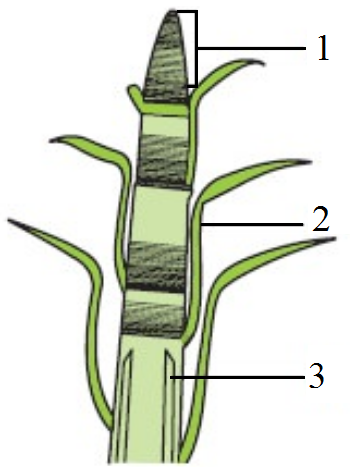
  1. Identify the figure.
  2. Labels the parts marked 1 to 3.
  3. Write the functions of parts marked 1 and 3.
Fill in the blanks: $A, B,$ and $C$.
The government of a state made it mandatory to install rainwater harvesting system and solar water heater in all buildings in urban areas. What can be the advantages of these changes to the environment?