Question
  1. State Kirchhoff’s rules for an electric network. Using Kirchhoff’s rules, obtain the balance condition in terms of the resistances of four arms of Wheat sone bridge.
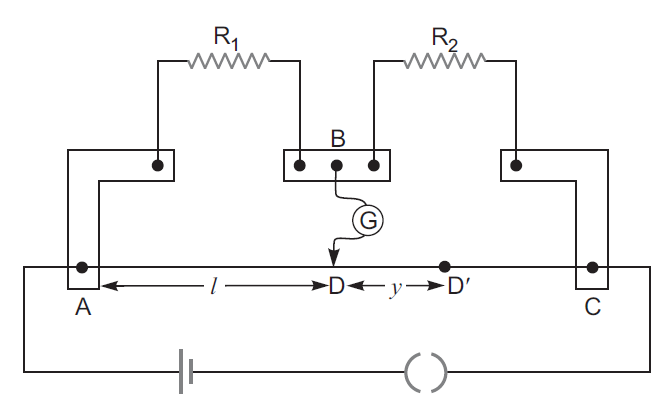
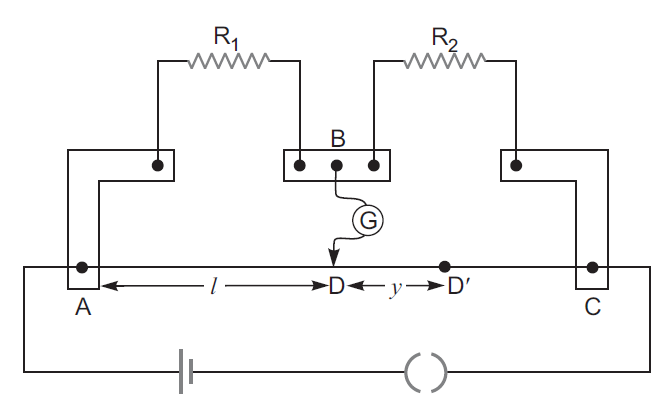
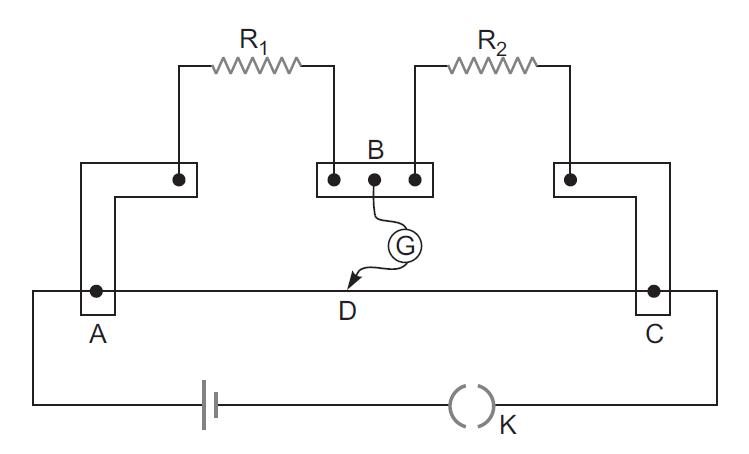
  2. In the meter bridge experimental set up, shown in the figure, the null point $'D\ '$ is obtained at a distance of $40 \ cm$ from end $A$ ofthe meter bridge wire. If a resistance of $10 \Omega$ is connected in series with $R_1,$ null point is obtained at $AD = 60 \ cm$. Calculate the value of $R_1$ and $R_2$.
Answer

  1. Kirchhoff’s Rule
    1. At any junction, the sum of the currents entering the junction is equal to the sum of the currents leaving the junction.
    2. The algebraic sum of the charges in potential around any closed loop involving resistors and cells in the loop is zero.
Condition of balance of a Wheatstone bridge :
The circuit diagram of Wheatstone bridge is shown in fig.
$\text{P, Q, R}$ and $\text{S}$ are four resistance forming a closed bridge, called Wheatstone bridge.
A battery is connected across $A$ and $C,$ while a galvanometer is connected between $B$ and $D$.
At balance, there is no current in galvanometer.
Derivation of Formula :
Let the current given by battery in the balanced position be $I$.
This current on reaching point $A$ is divided into two parts $I_1$ and $I_2$ . .
As there is no current in galvanometer in balanced state, current in resistances $P$ and $Q$ is $I_1$ and in resistances $R$ and $S$ it is $I_2$ .

Applying Kirchhoff’s $I$ law at point $A$
$I - I_1 - I_2 = 0$ or $I = I_1 + I_2 ........ (i)$
Applying Kirchhoff’s $II$ law to closed mesh $\text{ABDA}$
$- I_1P + I_2R = 0$ or $I_1P = I_2 R ........ (ii)$
Applying Kirchhoff’s II law to mesh $\text{BCDB}$
$- I_1Q + I_2S = 0$ or $I_1Q = I_2S ....... (iii)$
Dividing equation $(ii)$ by $(iii),$ we get
$\frac{\text{I}_{1}\text{P}}{\text{I}_{1}\text{Q}} = \frac{\text{I}_{2}\text{R}}{\text{I}_{2}\text{S}}$ or $\frac{\text{P}}{\text{Q}} = \frac{\text{R}}{\text{S}} .........(iv)$
This is the condition of balance of Wheatstone bridge.
  1.  

For null point at $D,$ balance length $\ell_{1} = 40 \ cm$
So, $\frac{\text{R}_{1}}{\text{R}_{2}} = \frac{\text{AD}}{\text{DC}} =\frac{40}{(100- 40)} = \frac{2}{3} ........ (i)$
If resistance 10 $\Omega$ is connected in series of $R_1,$ then balance length $AD\ '  >  AD$ i.e. balance point shifts by length $'y\ '$ towards $C$ i.e.$, AD = 60 \ cm.$
$\frac{\text{R}_{1} + 10}{\text{R}_{2}} = \frac{\text{AD}"}{\text{D}'\text{C}} = \frac{60}{100-60} = \frac{3}{2}$
$\frac{\text{R}_{1}}{\text{R}_{2}} + \frac{10}{\text{R}_{2}} =\frac{3}{2} ......... (ii)$
From equations $(1)$ and $(2),$ we have
$\frac{2}{3} +\frac{10}{\text{R}_{2}} =\frac{3}{2}$
$\frac{10}{\text{R}_{2}} = \frac{3}{2} - \frac{2}{3} =\frac{9-4}{6} = \frac{5}{6}$
$\Rightarrow\text{R}_{2} = \frac{ 10\times6}{5} = 12\text{ ohm}$
From equation $(1),$ we have
$\frac{\text{R}_{1}}{12} = \frac{2}{3}$
$\Rightarrow\text{R}_{1} $
$= \frac{12\times2}{3} =8\text{ ohm}.$

Need a full question paper?

Generate a complete, print-ready paper with questions like this in minutes — across 16+ boards, with answer keys.

Start Generating Free

Similar questions

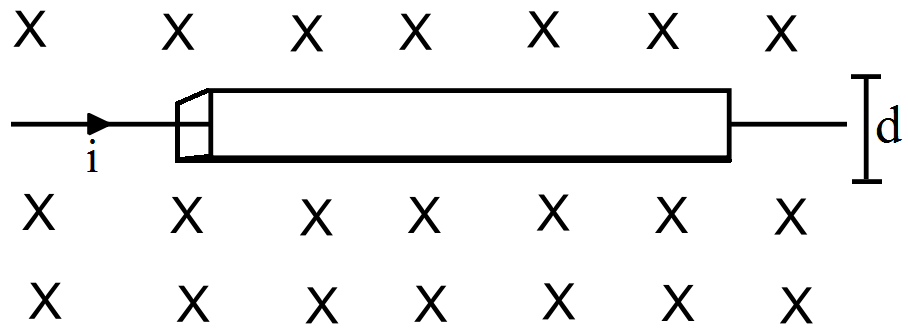
A current i is passed through a silver strip of width d and area of cross-section A. The number of free electrons per unit volume is n.
  1. Find the drift velocity v of the electrons.
  2. If a magnetic field B exists in the region, as shown in the figure, what is the average magnetic force on the free electrons?
  3. Due to the magnetic force, the free electrons get accumulated on one side of the conductor along its length. This produces a transverse electric field in the conductor, which opposes the magnetic force on the electrons. Find the magnitude of the electric field which will stop further accumulation of electrons.
  4. What will be the potential difference developed across the width of the conductor due to the electron-accumulation? The appearance of a transverse emf, when a current-carrying wire is placed in a magnetic field, is called Hall effect.
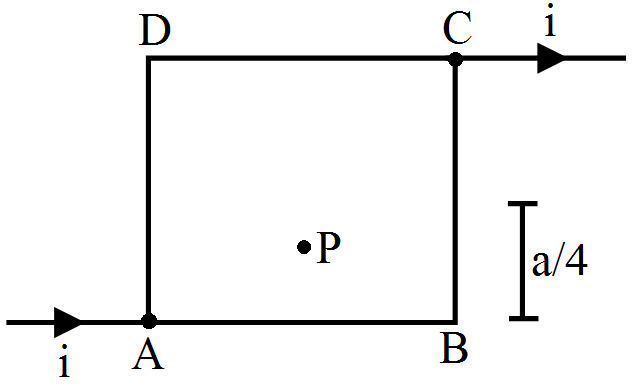
Figure shows a square loop of edge a made of a uniform wire. A current i enters the loop at the point A and leaves it at the point C. Find the magnetic field at the point P which is on the perpendicular bisector of AB at a distance $\frac{\text{a}}{4}$ from it.
$a.$ Draw the diagram of a device which is used to decrease high ac voltage into a low ac voltage and state its working principle. Write four sources of energy loss in this device.
$b.$ A small town with a demand of $1200 \ kW$ of electric power at $220 \ V$ is situated $20 \ km$ away from an electric plant generating power at $440 \ V$ . The resistance of the two wire line carrying power is $0.5 \Omega\text{ per \ km}$. The town gets the power from the line through a $4000-220 V$ step $-$ down transformer at a sub$-$station in the town. Estimate the line power loss in the form of heat
What is dispersion of light? Explain its cause. Deviation of red colour is minimum white that for violet colour is minimum due to dispersion by prism. Explain it. Draw a diagram for dispersion.
  1. Plot a graph showing variation of voltage vs the current drawn from the cell. How can one get information from this plot about the emf of the cell and its internal resistance?
  2. Two cells of emf’s $E_1$ and $E_2$ and internal resistance $r_1$ and $r_2$ are connected in parallel. Obtain the expression for the emf and internal resistance of a single equivalent cell that can replace this combination?
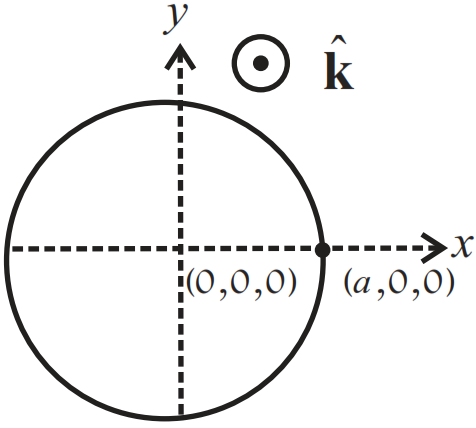
A magnetic field in a certain region is given by $\text{B}=\text{B}_0\cos(\omega\text{t})\hat{\text{k}}$ and a coil of radius a with resistance R is placed in the x-y plane with its centre at the origin in the magnetic field (see Fig). Find the magnitude and the direction of the current at (a, 0, 0) at $\text{t}=\frac{\pi}{2\omega},\text{t}=\frac{\pi}{\omega} \text{ and }\text{t}=\frac{3\pi}{2\omega}$.
Two identical pith balls are charged by rubbing against each other. They are suspended from a horizontal rod through two strings of length $20\ cm$ each, the separation between the suspension points being $5\ cm$. In equilibrium, the separation between the balls is $ 3\ cm$. Find the mass of each ball and the tension in the strings. The charge on each ball has a magnitude $2.0 \times 10^{-8}C.$
Prove that energy remains conserved in electromagnetic induction.
An inductor of inductance 2.00H is joined in series with a resistor of resistance $200\Omega$ and a battery of emf 2.00V. At t = 10ms, find
  1. The current in the circuit.
  2. The power delivered by the battery.
  3. The power dissipated in heating the resistor.
  4. The rate at which energy is being stored in magnetic field.
The short-wavelength limit shifts by 26pm when the operating voltage in an X-ray tube is increased to 1.5 times the original value. What was the original value of the operating voltage?