Question
  1. State Kirchhoff’s rules for an electric network. Using Kirchhoff’s rules, obtain the balance condition in terms of the resistances of four arms of Wheat sone bridge.
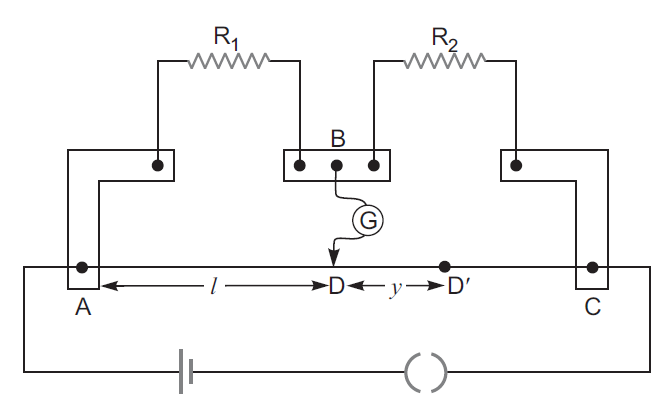
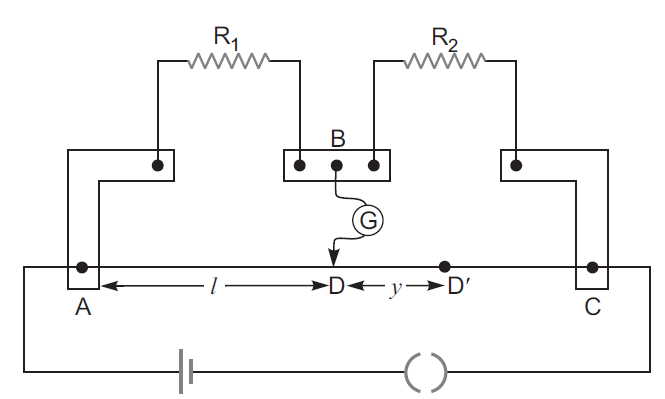
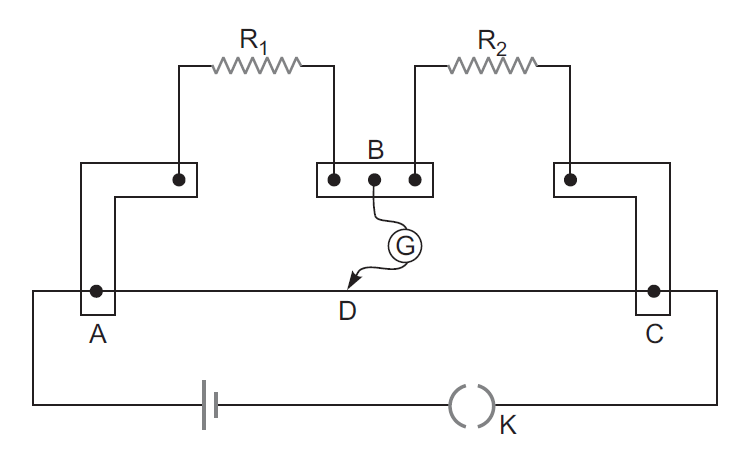
  2. In the meter bridge experimental set up, shown in the figure, the null point ‘D’ is obtained at a distance of 40 cm from end A ofthe meter bridge wire. If a resistance of 10 Ω is connected in series with $R_1$, null point is obtained at AD = 60 cm. Calculate the value of $R_1$ and $R_2.$
Answer

  1. Kirchhoff’s Rule
    1. At any junction, the sum of the currents entering the junction is equal to the sum of the currents leaving the junction.
    2. The algebraic sum of the charges in potential around any closed loop involving resistors and cells in the loop is zero.
Condition of balance of a Wheatstone bridge: The circuit diagram of Wheatstone bridge is shown in fig.
P, Q, R and S are four resistance forming a closed bridge, called Wheatstone bridge. A battery is connected across A and C, while a galvanometer is connected between B and D. At balance, there is no current in galvanometer.
Derivation of Formula: Let the current given by battery in the balanced position be I. This current on reaching point A is divided into two parts $I_1$ and $I_2$ . As there is no current in galvanometer in balanced state, current in resistances P and Q is $I_1$ and in resistances R and S it is $I_2 .$​​​​​​​

Applying Kirchhoff’s I law at point A
$I - I_1 - I_2 = 0$ or $I = I_1 + I_2 - - - - - - - - (i)$
Applying Kirchhoff’s II law to closed mesh ABDA
$- I_1P + I_2R = 0$ or $I_1P = I_2 R - - - - - - - (ii)$
Applying Kirchhoff’s II law to mesh BCDB
$- I_1Q + I_2S = 0$ or $I_1Q = I_2S - - - - -- - (iii)$
Dividing equation (ii) by (iii), we get
$\frac{\text{I}_{1}\text{P}}{\text{I}_{1}\text{Q}} = \frac{\text{I}_{2}\text{R}}{\text{I}_{2}\text{S}}\text{ or }\frac{\text{P}}{\text{Q}} = \frac{\text{R}}{\text{S}}$ - - - - - - -(iv)
This is the condition of balance of Wheatstone bridge.
  1.  

For null point at D, balance length $\ell_{1}$ = 40 cm
So, $\frac{\text{R}_{1}}{\text{R}_{2}} = \frac{\text{AD}}{\text{DC}} =\frac{40}{(100- 40)} = \frac{2}{3}$ - - - -- - (i)
If resistance 10 $\Omega$ is connected in series of $R_1$, then balance length AD' > AD i.e. balance point shifts by length ‘y’ towards C i.e., AD = 60 cm.
$\frac{\text{R}_{1} + 10}{\text{R}_{2}} = \frac{\text{AD}"}{\text{D}'\text{C}} = \frac{60}{100-60} = \frac{3}{2}$
$\frac{\text{R}_{1}}{\text{R}_{2}} + \frac{10}{\text{R}_{2}} =\frac{3}{2}$- - - - - -- -- - -(ii)
From equations (1) and (2), we have
$\frac{2}{3} +\frac{10}{\text{R}_{2}} =\frac{3}{2}$
$\frac{10}{\text{R}_{2}} = \frac{3}{2} - \frac{2}{3} =\frac{9-4}{6} = \frac{5}{6}$
$\Rightarrow\text{R}_{2} = \frac{ 10\times6}{5} = 12\text{ ohm}$
From equation (1), we have
$\frac{\text{R}_{1}}{12} = \frac{2}{3}\Rightarrow\text{R}_{1} = \frac{12\times2}{3} =8\text{ ohm}.$

Need a full question paper?

Generate a complete, print-ready paper with questions like this in minutes — across 16+ boards, with answer keys.

Start Generating Free

Similar questions

Consider the Atwood machine of the previous problem. The larger mass is stopped for a moment 2.0s after the system is set into motion. Find the time elapsed before the string is tight again.
If neutrons exert only attractive force, why don't we have a nucleus containing neutrons alone?
One mole of an ideal gas undergoes a process $\text{p}=\frac{\text{p}_0}{1+\Big(\frac{\text{V}}{\text{V}_0}\Big)^2}$ where $P_0$ and $V_0$ are constants. Find the temperature of the gas when $V = V_0.$
A sample of an ideal gas $(\gamma=1.5)$ is compressed adiabatically from a volume of $150cm^3$ to $50cm^3$. The initial pressure and the initial temperature are 150kPa and 300K. Find,
  1. The number of moles of the gas in the sample.
  2. The molar heat capacity at constant volume.
  3. The final pressure and temperature.
  4. The work done by the gas in the process.
  5. The change in internal energy of the gas.
A beam of white light is incident normally on a plane surface absorbing 70% of the light and reflecting the rest. If the incident beam carries 10W of power, find the force exerted by it on the surface.

Consider the arrangement shown in figure (17-E4). The distance D is large compared to the separation d between the slits.
  1. Find the minimum value of d so that there is a dark fringe at 0.
  2. Suppose d has this value. Find the distance x at which the next bright fringe is formed.
  3. Find the fringe-width.
An adiabatic vessel of total volume V is divided into two equal parts by a conducting separator. The separator is fixed in this position. The part on the left contains one mole of an ideal gas (U = 1.5nRT) and the part on the right contains two moles of the same gas. Initially, the pressure on each side is p. The system is left for sufficient time so that a steady state is reached. Find,
  1. The work done by the gas in the left part during the process.
  2. The temperature on the two sides in the beginning.
  3. The final common temperature reached by the gases.
  4. The heat given to the gas in the right part.
  5. The increase in the internal energy of the gas in the left part.
Prove that energy remains conserved in electromagnetic induction.
How many wavelengths are emitted by atomic hydrogen in visible range (380nm-780nm)? In the range 50nm to 100nm?
Crystal diffraction experiments can be performed using X-rays, or electrons accelerated through appropriate voltage. Which probe has greater energy? (For quantitative comparison, take the wavelength of the probe equal to 1 Å, which is of the order of inter-atomic spacing in the lattice) $(m^e = 9.11 \times 10^{–31} kg).$