Question
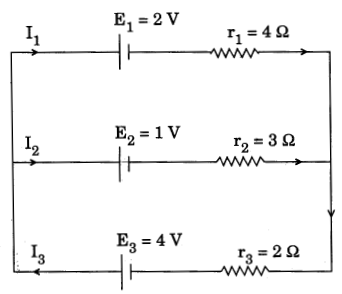
State Kirchhoff’s rules. Use these rules to write the expressions for the currents $I_1, I_2$ and $I_3$ in the circuit diagram shown.
Answer

  1. Junction rule: At any junction, the sum of the currents entering the junction is equal to the sum of currents leaving the junction.
  2. Loop rule: The algebraic sum of changes in potential, around any closed loop, involving resistors and cells in the loop, is zero.
Expressions for the currents $I_1, I_2$ and $I_3$ using given loop.
  1. $I_3 = I_2 + I_1$
  2. $4I_1 – 3I_2 + 1 = 0$
  3. $3I_2 + 2I_3 – 3 = 0.$

Need a full question paper?

Generate a complete, print-ready paper with questions like this in minutes — across 16+ boards, with answer keys.
Start Generating Free

Similar questions

State Kirchhoff's laws and explain them by giving examples.###Explain that first law of Kirchhoff is equivalent to law of conservation of charge and the second law is a descriptive form of Ohm's law.###For a current carrying conductor, write Kirchhoff's laws of charge and energy conservation.
It is said that any charge given to a conductor comes to its surface. Should all the protons come to the surface? Should all the electrons come to the surface? Should all the free electrons come to the surface?
A particle moves in a circle of radius 1.0cm at a speed given by v = 2.0t where v is in cm/s and t in seconds.
  1. Find the radial acceleration of the particle at t = 1s.
  2. Find the tangential acceleration at t = 1s.
  3. Find the magnitude of the acceleration at t = 1s.
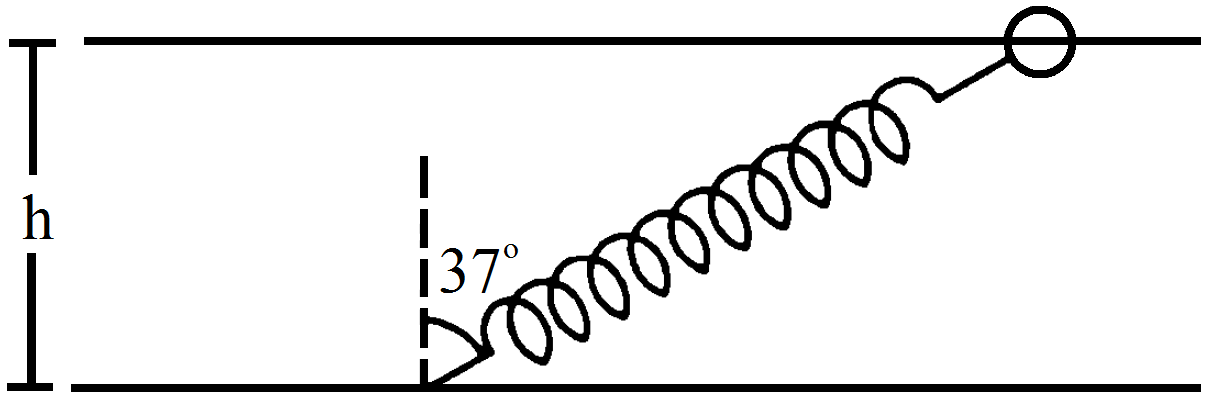
One end of a spring of natural length h and spring constant k is fixed at the ground and the other is fitted with a smooth ring of mass m which is allowed to slide on a horizontal rod fixed at a height h (figure). Initially, the spring makes an angle of 37° with the vertical when the system is released from rest. Find the speed of the ring when the spring becomes vertical.
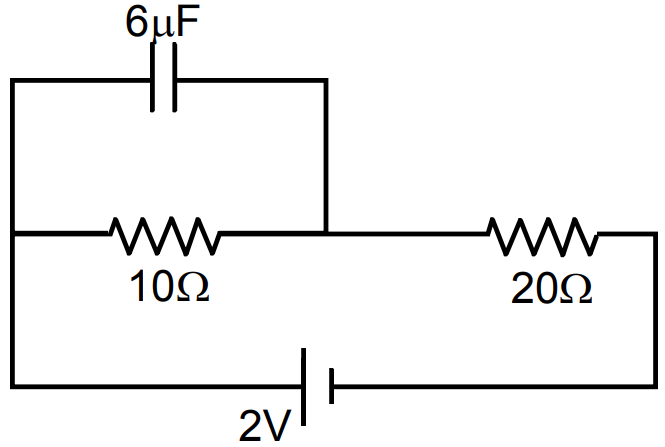
Find the charge on the capacitor shown in figure.
The heat current is written as $\frac{\triangle\text{Q}}{\triangle\text{t}}.$ Why don't we write $\frac{\text{dQ}}{\text{dt}}?$
What is the force between two small charged spheres having charges of $2 \times 10^{-7}C$ and $3 \times 10^{-7}C$ placed 30cm apart in air?
  1. A screen is placed at a distance of 100 cm from an object. The image of the object is formed on the screen by a convex lens for two different locations of the lens separated by 20 cm. Calculate the focal length of the lens used.
  2. A converging lens is kept coaxially in contact with a diverging lens - both the lenses being of equal focal length. What is the focal length of the combination?
What is the energy of a hydrogen atom in the first excited state if the potential energy is taken to be zero in the ground state?
Answer the following:
  1. Name the em waves which are suitable for radar systems used in aircraft navigation- Write the range of frequency of these waves.
  2. If the earth did not have atmosphere, would its average surface temperature be higher or lower than what it is now? Explain.
  3. An em wave exerts pressure on the surface on which it is incident. Justify.