Question
State Newton's third law of motion. Discuss its consequences.

Answer

Newton's third law of motion states that for any action, there is equal and opposite reaction.
So, if a body applies a force F12 on body 2 (action), then body 2 also applies a force F21 on body 1 but in opposite direction, then
F21 = - F12
In terms of magnitude
|F21 | = | F12 |
It is very important to note that F12 and F21, though are equal in magnitude and opposite in direction yet act on different points or else no motion will be possible.
For example, hands pull up a chest expander (spring) and spring in turn exerts force on the arms. A football pressed reacts on the foot with the same force and so on.
The most important consequence of the third law of motion is the law of motion is the law of conservation of linear momentum and its application in collision problems.
Since $\text{F}_{12}=\text{F}_{21}$ and $\text{F}=\text{m}\frac{\Delta\upsilon}{\Delta\text{t}}$
$\therefore\text{m}_1\frac{\Delta\upsilon_1}{\Delta\text{t}}=-\text{m}_2\frac{\Delta\upsilon_2}{\Delta\text{t}}$
Here $\Delta\text{t}$ is the time for which the bodies come in contact during impact. This is same for the two bodies of masses m1 and m2 and having velocity changes $\Delta\text{v}_1$ and $\Delta\text{v}_2$ respectively.
Let $\text{u}_1,\text{u}_2$ and $\text{v}_1,\text{v}_2$ be the initial and final velocities of the two masses before and after collision, then,
$\text{m}_1(\text{v}_1-\text{u}_1)=\text{m}_2(\text{v}_2-\text{u}_2)$
or $\text{m}_1\text{u}_1+\text{m}_2\text{u}_2=\text{m}_1\text{v}_1+\text{m}_2\text{v}_2$
Momentum before impact = Momentum after impact.
(This is known as the law of conservation of momentum).

Need a full question paper?

Generate a complete, print-ready paper with questions like this in minutes — across 16+ boards, with answer keys.

Start Generating Free

Similar questions

  1. With the help of a simple case of an object moving with constant velocity show that the area under velocity-time curve represents the displacement over a given time interval.
  2. Establish the relation

$\text{c}=\text{v}_0\text{t}+\frac{1}{2}\text{at}^2$ graphically.
  1. A car moving with a speed of 126km/ h is brought to a stop within a distance of 200m. Calculate the retardation of the car and the time required to stop it.
A block of mass 2.0kg is pushed down an inclined plane of inclination 37° with a force of 20N acting parallel to the incline. It is found that the block moves on the incline with an acceleration of 10m/s2. If the block started from rest, find the work done.
  1. By the applied force in the first second.
  2. By the weight of the block in the first second.
  3. By the frictional force acting on the block in the first second. Take g = 10m/s2.
At what temperature is the root mean square speed of an atom in an argon gas cylinder equal to the rms speed of a helium gas atom at-20°C? (atomic mass of Ar = 39.9u, of He = 4.0u).
The flux of magnetic field through a closed conducting loop changes with time according to the equation, $\phi=\text{at}^2+\text{bt}+\text{c}.$
  1. Write the SI units of a, band c.
  2. If the magnitudes of a, b and c are 0.20, 0.40 and 0.60 respectively, find the induced emf at t = 2s.
A ball of mass 50g moving at a speed of 2.0m/s strikes a plane surface at an angle of incidence 45°. The ball is reflected by the plane at equal angle of reflection with the same speed. Calculate
  1. The magnitude of the change in momentum of the ball.
  2. The change in the magnitude of the momentum of the ball.
One end of a long string of linear mass density 8.0 × 10⁻³kg m–1 is connected to an electrically driven tuning fork of frequency 256Hz. The other end passes over a pulley and is tied to a pan containing a mass of 90kg. The pulley end absorbs all the incoming energy so that reflected waves at this end have negligible amplitude. At t = 0, the left end (fork end) of the string x = 0 has zero transverse displacement (y = 0) and is moving along positive y-direction. The amplitude of the wave is 5.0cm. Write down the transverse displacement y as function of x and t that describes the wave on the string.
It is 260km from Patna to Ranchi by air and 320km by road. An aeroplane takes 30 minutes to go from Patna to Ranchi whereas a delux bus takes 8 hours.
  1. Find the average speed of the plane.
  2. Find the average speed of the bus.
  3. Find the average velocity of the plane.
  4. Find the average velocity of the bus.
What are the methods of heat transmission? Describe them and explain their practical applications.
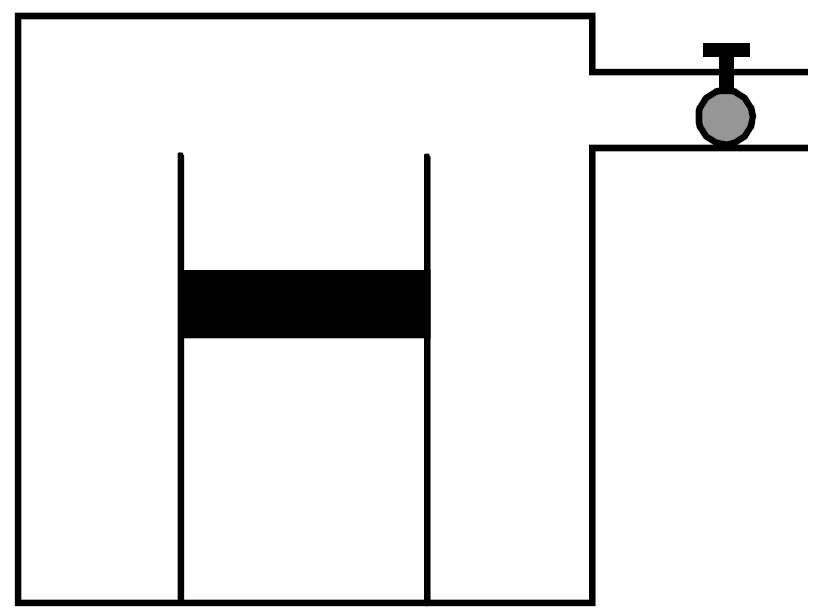
An ideal gas is kept in a long cylindrical vessel fitted with a frictionless piston of cross-sectional area 10cmand weight 1kg (figure.) The vessel itself is kept in a big chamber containing air at atmospheric pressure 100kPa. The length of the gas column is 20cm. If the chamber is now completely evacuated by an exhaust pump, what will be the length of the gas column? Assume the temperature to remain constant throughout the process.

3 A man stands on a rotating platform, with his arms stretched horizontally holding a 5kg weight in each hand. The angular speed of the platform is 30 revolutions per minute. The man then brings his arms close to his body with the distance of each weight from the axis changing from 90cm to 20cm. The moment of inertia of the man together with the platform may be taken to be constant and equal to 7.6kgm2.
  1. What is his new angular speed? (Neglect friction).
  2. Is kinetic energy conserved in the process? If not, from where does the change come about?