Question
State Ohm's law. What are its limitations?

Answer

According to Ohm's law, the current flowing in a conductor is directly proportional to the potential difference across its ends provided the physical conditions and temperature of conductor remains constant.
Limitations of Ohm's law:
1. Ohm's law does not apply to conductors such as diode, radio valves, metal rectifiers, where electricity passes through gases.
2. Ohm's law is applicable only when the physical conditions remain constant.
3. Ohm's law is applicable only when the temperature of the conductor is constant.

Need a full question paper?

Generate a complete, print-ready paper with questions like this in minutes — across 16+ boards, with answer keys.
Start Generating Free

Similar questions

Explain, why do sandy soils, get heated up quickly as compared to wet soils?
State the two properties of the magnetic lines of force around a circular coil.
A mass of $50 g$ of a certain metal at $150^{\circ} C$ is immersed in $100 g$ of water at $11^{\circ} C$. The final temperature is $20^{\circ} C$. Calculate the specific heat capacity of the metal. Assume that the specific heat capacity of water is $4.2 Jg ^{-1} K^{-1}$.
An electric toaster draws 8 A current in a 220 V circuit. It is used for 2 hr. Find the cost of operating the toaster if the cost of electrical energy is Rs. 4.50 per kWh.
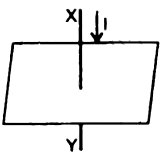
In the diagram XY is a straight conductor carrying current in the direction marked by the arrow. The conductor is held vertical by passing it through a horizontal cardboard sheet.

Draw three magnetic lines of force on the board and mark the direction of magnetic field in your diagram. State two factors on which magnitude of magnetic field at a point, depends.

In following figure shows a thin beam of white light from a source S striking on one face of a prism.
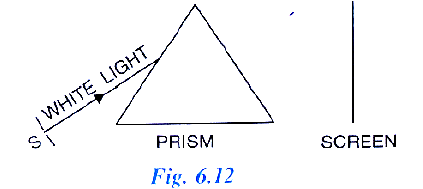


Complete the diagram to show effect of prism on the beam and to show what is seen on the screen.
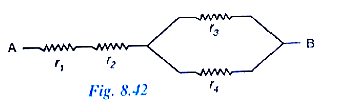
Calculate the equivalent resistance of the following combination of resistors $r 1, r 2$, $r 3$ and $r 4$ if $r_1=r_2=r_3=r_4=2.0 \Omega$ between the points $A$ and $B$ in Fig. 8.42

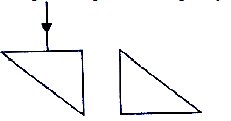
Two isosceles right –angles glass prisms are placed near each other as shown in Fig. 4.63. Complete the path of the light ray entering the first prism till it emerges out of the second prism.

What are infrared radiations? How are they detected? State one use of these radiations.
Calculate the time taken by an immersion heater, which supplies energy at the rate of 7000 J/minute to raise temp. of 5 kg water from 22°C to 47°C.