Question
State Ohm's law

Answer

If physical conditions remain constant, the magnitude of current flowing in a conductor is proportional to the potential difference V across the ends of the conductor.
$V \propto I$
$V = IR$
Where R is a constant.

Need a full question paper?

Generate a complete, print-ready paper with questions like this in minutes — across 16+ boards, with answer keys.
Start Generating Free

Similar questions

If length of a wire of resistivity p is stretched to three times, then what will be new resistivity?
Why a core of soft iron is used in a moving coil galvanometer?
Which part of electromagnetic spectrum form sun is absorbed by the ozone layer?
Kamla peddles a stationary bicycle. The pedals of the bicycle are attached to a 100 turn coil of area $0.10 m ^2$. The coil rotates at half a revolution per second and it is placed in a uniform magnetic field of $0.01 T$ perpendicular to the axis of rotation of the coil. What is the maximum voltage generated in the coil?
Can you, have an AG series circuit in which there is. a phase difference of 180° between the emf and the current? 120°?
Do you expect the gas in a cooking gas cylinder to obey the ideal gas equation?
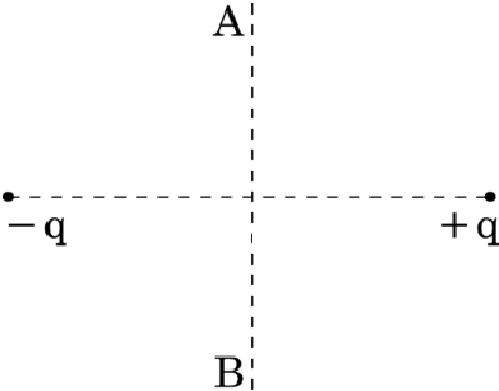
A charge 'q' is moved from a point A above a dipole of dipole moment 'p' to a point B below the dipole in equatorial plane without acceleration. Find the work done in the process.

Suppose a charge +Q1 is given to the positive plate and a charge -Q2 to the negative plate of a capacitor. What is the ''charge on the capacitor''?
What kind of value is $m$ for an inverted (and real) image formed by a convex or concave lens?
Ultraviolet radiations of different frequencies and are incident on two photosensitive materials having work functions W1 and W2 (W1>W2) respectively. The kinetic energy of the emitt3ed electrons is same in both the cases. Which one of the two radiations will be of higher frequency?