Question
State the laws of vibrating strings

Answer

The fundamental frequency of a vibrating string under tension is given as, $n =\frac{1}{2 l} \sqrt{\frac{ T }{ m }}$
From this formula, three laws of vibrating string can be given as follows:
i. Law of length: The fundamental frequency of vibrations of a string is inversely proportional to the length of the vibrating string if tension and mass per unit length are constant.
$\therefore n \alpha \frac{1}{l}$ .(if $T$ and $m$ are constant.)
ii. Law of tension: The fundamental frequency of vibrations of a string is directly proportional to the square root of tension if the vibrating length and mass per unit length are constant.
$\therefore n \alpha \sqrt{ T }$
(if I and $m$ are constant.)
iii. Law of linear density: The fundamental frequency of vibrations of a string is inversely proportional to the square root of mass per unit length (linear density), if the tension and vibrating length of the string are constant.
$\therefore n \alpha \frac{1}{\sqrt{ m }}$ (if $T$ and I are constant.)
If $r$ is the radius and $r$ is the density of the material of string, linear density is given as
Linear density $=$ mass per unit length
$=$ volume per unit length $\times$ density
$ =\frac{\pi r^2 l}{l} \times \rho$
$=\pi r^2 \rho$
As $n \propto \frac{1}{\sqrt{ m }}$, if $T$ and I are constant, we have,
$n \propto \frac{1}{\sqrt{\pi r^2 \rho}}$
i.e., $n \propto \frac{1}{\sqrt{\rho}}$ and $n \propto \frac{1}{ r }$
Thus the fundamental frequency of vibrations of a stretched string is inversely proportional to the radius of string and the square root of the density of the material of vibrating string.

Need a full question paper?

Generate a complete, print-ready paper with questions like this in minutes — across 16+ boards, with answer keys.
Start Generating Free

Similar questions

A resistance of $3 \Omega$ is connected to the secondary coil of $60$ turns of an ideal transformer. Calculate the current $($peak value$)$ in the resistor if the primary has $1200$ turns and is connected to $240 V \ ($peak$)$ ac supply. Assume that all the magnetic flux in the primary coil passes through the secondary coil and that there are no other losses.
Explain back emf in a motor.
Define period or periodic time, frequency, amplitude and path length of simple harmonic motion (SHM).
Give an example of some familiar process in which heat is added to an object, without changing its temperature.
In a hydraulic lift, the input piston has surface area $20 \mathrm{~cm}^2$. The output piston has surface area $1000 \mathrm{~cm}^2$. If a force of $50 \mathrm{~N}$ is applied to the input piston, it raises the output piston by $2 \mathrm{~m}$. Calculate the weight of the support on the output piston and the work done by it.
A dynamo attached to a bicycle has a 200 turn coil, each of area $0.10 m ^2$. The coil rotates half a revolution per second and is placed in a uniform magnetic field of $0.02 T$. Find the maximum voltage generated in the coil.
Which combination of four identical capacitors has the maximum capacitance? Which combination of these capacitors will store minimum energy when a constant p.d. is applied across it?
A particle performing S.H.M. has velocities of $8\ cm/s$ and $6\ cm/s$ at displacements of $3\ cm$ and $4\ cm$ respectively. Calculate the amplitude and period of S.H.M.
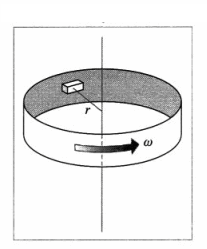
A thin cylindrical shell of inner radius 1.5 m rotates horizontally, about a vertical axis, at an angular speed ω. A wooden block rests against the inner surface and rotates with it. If the coefficient of static friction between block and surface is 0.3, how fast must the shell be rotating if the block is not to slip and fall ?

Image

Derive an expression for the effective capacitance of three parallel plate capacitors connected in series.