Question
State the main points of difference between homogeneous and heterogeneous mixtures.

Answer

Those mixtures in which the substances are completely mixed together and are indistinguishable from one another, are called homogeneous mixtures. They have a uniform composition throughout its mass. All the homogeneous mixtures are called solutions.
Examples: Sugar solution, salt solution, copper sulphate solution, etc.
Those mixtures in which the substances remain separate and one substance is spread throughout the other substance as small particles, droplets or bubbles, are called heterogeneous mixtures. Heterogeneous mixture does not have a uniform composition throughout its mass.
Example: Starch solution, soap solution.

Need a full question paper?

Generate a complete, print-ready paper with questions like this in minutes — across 16+ boards, with answer keys.

Start Generating Free

Similar questions

Explain the mechanism of compost formation.
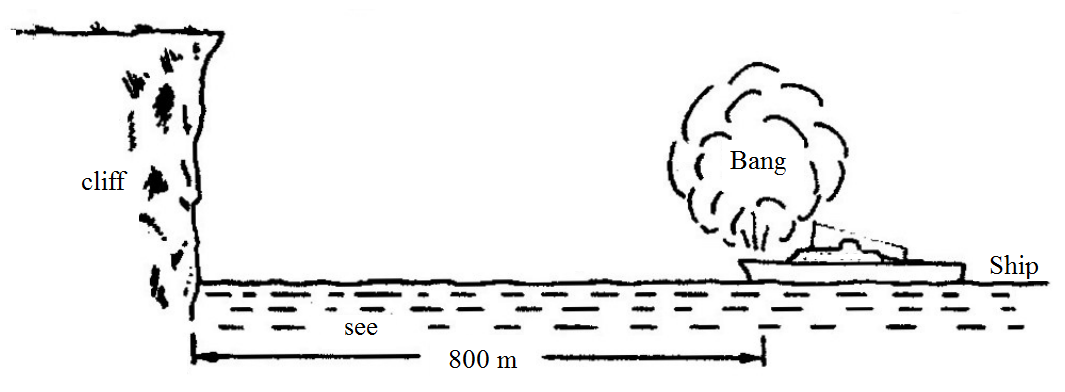
The drawing shoes a ship 800m from a cliff. A gun is fired on the ship. After 5 seconds the people at the front of the ship hear the sound of the gun again.

  1. What is the name of this effect?
  2. What happens to the sound at the cliff?
  3. How far foes the sound travel in 5 seconds?
  4. Calculate the speed of sound.
Describe Bohr’s model of the atom.
How will you separate a mixture of kerosene oil and water? Explain with the help of a labeled diagram

Two objects of masses m1 and m having the same size are dropped simultaneously from heights h1 and h2 respectively. Find out the ratio of time they would take in reaching the ground. Will this ratio remain the same if

  1. One of the objects is hollow and the other one is solid.
  2. Both of them are hollow, size remaining the same in each case. Give reason.
Double Matching:

Match the columns I, II and III.

 
Column I
 
Column II
 
Column III
1.
Oil seeds
a.
Red Sindhi
i.
Sahiwal
2.
Intercropping
b.
Mustard
ii.
Sunflower
3.
Local breeds
c.
Vitamin A
iii.
Maize
4.
Poultry feed
d.
Soybean
iv.
Vitamin K
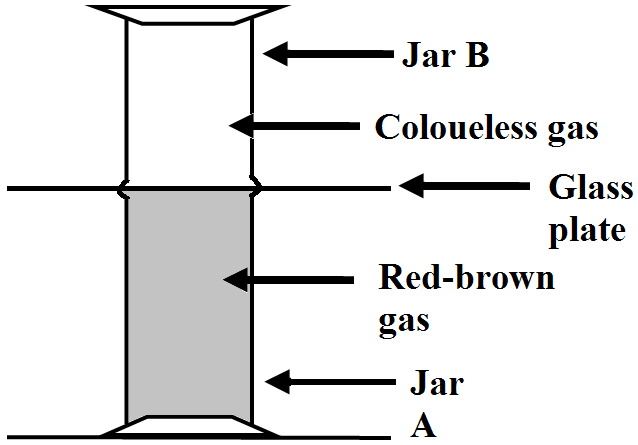
Look at the diagram on the right side. Jar A contains are d-brown gas whereas Jar B contains a colourless gas. The two gas jars are separated by a glass plate placed between them:

  1. What will happen when the glass plate between the two jars is pulled away?
  2. What name is given to the phenomenon which takes place?
  3. Name the brown gas which could be in jar A.
  4. Which is the colorless gas most likely to be present in jar B?
  5. Name one coloured solid and one colourless liquid which can show the same phenomenon.
Name the following compounds. Also write the symbols/ formulae of the ions present in them:
  1. CuSO4
  2. (NH4)2SO4
  3. Na2O
  4. Na2CO3
  5. CaCl2

What are pisces? Classify and explain two different kinds of fishes by the help of suitable examples.

A girl of mass 50kg jumps out of a rowing boat of mass 300kg on to the bank, with a horizontal velocity of 3m/s. With what velocity does the boat begin to move backwards?