Question
State the main points of difference between homogeneous and heterogeneous mixtures.

Answer

Those mixtures in which the substances are completely mixed together and are indistinguishable from one another, are called homogeneous mixtures. They have a uniform composition throughout its mass. All the homogeneous mixtures are called solutions.
Examples: Sugar solution, salt solution, copper sulphate solution, etc.
Those mixtures in which the substances remain separate and one substance is spread throughout the other substance as small particles, droplets or bubbles, are called heterogeneous mixtures. Heterogeneous mixture does not have a uniform composition throughout its mass.
Example: Starch solution, soap solution.
Need a full question paper?

Generate a complete, print-ready paper with questions like this in minutes — across 16+ boards, with answer keys.

Start Generating Free

Similar questions

How many grams of magnesium will have the same number of atoms as 6 grams of carbon?
(Mg = 24u; C = 12u)
An atom of an element X may be written as $^{9}_4\text{X} $
  1. What does the figure 9 indicate?
  2. What does the figure 4 indicate?
  3. What is the number of protons in atom X?
  4. What is the number of neutrons in atom X?
  5. What is the number of electrons in atom X?
  6. How many electrons are there in the outermost shell of an atom of element X?
  7. Write the symbol of ion formed by an element Z is 2, 8, 8.
Raunak took 5 moles of carbon atoms in a container and Krish also took 5 moles of sodium atoms in another container of same weight.
  1. Whose container is heavier?
  2. Whose container has more number of atoms?
Define the following:
  1. Sol
  2. Aerosol
  3. Emulsion
  4. Foam
Given one example of each.
Tabulate the differences in the characterisitcs of states of matter.

In what way is the Rutherford’s atomic model different from that of Thomson’s atomic model?

Which has more atoms, 50g of aluminium or 50g of iron? Illustrate your answer with the help of calculations.
(Atomic masses: Al = 27u; Fe = 56u)
If one gram of sulphur contains x atoms, calculate the number of atoms in one gram of oxygen element.
(Atomic masses: S = 32u; O = 16u)
A mixture contains water, kerosene and sand. How will you separate this mixture?
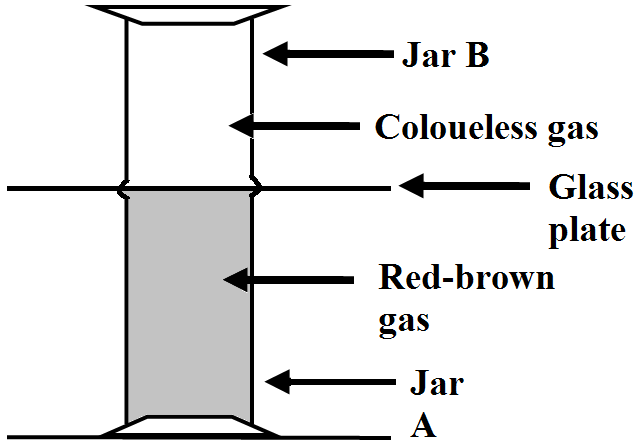
Look at the diagram on the right side. Jar A contains are d-brown gas whereas Jar B contains a colourless gas. The two gas jars are separated by a glass plate placed between them:

  1. What will happen when the glass plate between the two jars is pulled away?
  2. What name is given to the phenomenon which takes place?
  3. Name the brown gas which could be in jar A.
  4. Which is the colorless gas most likely to be present in jar B?
  5. Name one coloured solid and one colourless liquid which can show the same phenomenon.