Question
State the preparation, properties and uses of methanol.

Answer

$\rightarrow$ Methanol$, \ce{CH3OH},$ also known as 'wood spirit', was produced by destructive distillation of wood. Today, most of the methanol is produced by catalytic hydrogenation of carbon monoxide at high pressure and temperature and in the presence of $\ce{ZnO - Cr2O3}$ catalyst.
$\ce{CO +2 H 2} \xrightarrow[\substack{200-300\ atm\ 
573-673 k }]{ \ce{ZnO - Cr2O3}CH3OH}$
$\rightarrow$ Methanol is a colourless liquid and boils at $337 K$. It is highly poisonous in nature. Ingestion of even small quantities of methanol can cause blindness and large quantities causes even death. Methanol is used as a solvent in paints, varnishes and chiefly for making formaldehyde.

Need a full question paper?

Generate a complete, print-ready paper with questions like this in minutes — across 16+ boards, with answer keys.
Start Generating Free

Similar questions

How do you convert:
  1. Chlorobenzene to biphenyl.
  2. Propene to I-iodopropane.
  3. 2-bromobutane to but-2-ene.
Explain kohlrausch Law with example.
How much electricity will be required to obtain 1.5 gram on copper in 3 hours in an electrolytic cell of aqueous solution of copper sulphate? (Atomic mass of Cu = 63.5 )
The conductivity of $0.001028 \ mol \ L^{-1}$ acetic acid is $4.95 \times 10^{-5} S \ cm^{-1}$. Calculate its dissociation constant $\Lambda^{\circ}_{\text{m}}$ if for acetic acid is $390.5 S \ cm^2 \ mol^{-1}.$
Giving a suitable example for each, explain the following:
  1. Crystal field splitting.
  2. Linkage isomerism.
  3. Ambidentate ligand.
A current of $1.50A $ was passed through an electrolytic cell containing $AgNO_3$ solution with inert electrodes. The weight of Ag deposited was $1.50g$. How long did the current flow?
Account for any two of the following:
  1. Amines are basic substances while amides are neutral.
  2. Nitro compounds have higher boiling points than the hydrocarbons having almost the same molecular mass.
  3. Aromatic amines are weaker bases than aliphatic amines.
  1. The cell in which the following reaction occurs$:$
  1. $\ce{2 Fe^{3+} (aq) + 2 I^- (aq) \longrightarrow 2 Fe^{2+}(aq) + I_2(s)}$
    has $\text{E}^0_{\text{cell}} = 0·236 V$ at $298 K.$ Calculate the standard Gibbs energy of the cell reaction. $($Given $: 1 F = 96,500 \ce{C mol^{-1})}$
  2. How many electrons flow through a metallic wire if a current of $0.5 A$ is passed for $2$ hours? $($Given $: 1 F = 96,500 \ce{C mol^{-1})}$
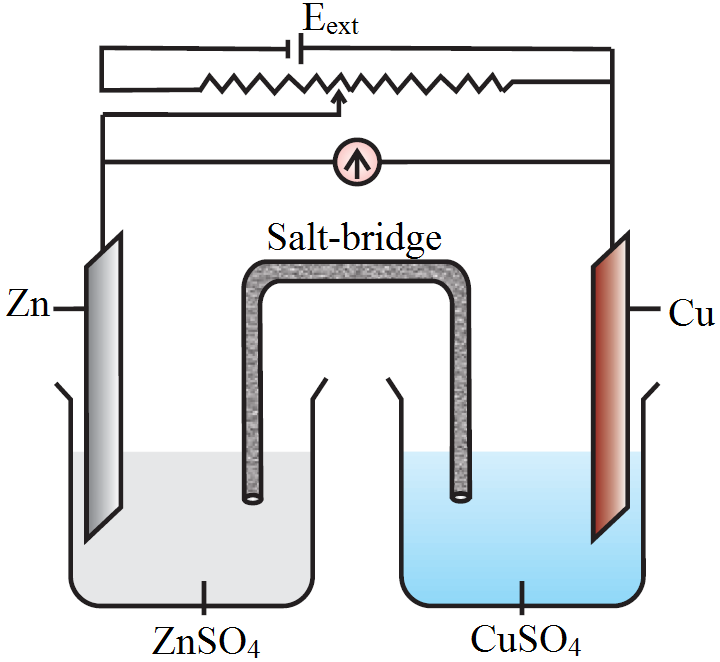
The electrochemical cell given alongside converts the chemical energy released during the redox reaction
$\text{Zn(s) + Cu}^{2+}\text{(aq)}\xrightarrow{ \ \ \ \ \ \ \ }\text{Zn}^{2+}(\text{aq) + Cu(s)}$
to electrical energy. It gives an electrical potential of $1.1V$ when concentration $Zn^{2+}$ and $Cu^{2+}$ ions is unity. State the direction of flow of current and also specify whether zinc and copper are deposited or dissolved at their respective electrodes when:
  1. An external opposite potential of less than $1.1V$ is applied.
  2. An external potential of $1.1V$ is applied.
  3. An external potential of greater than $1.1V$ is applied.
Explain the structure and function of salt bridge of molten galvanic cell.