Question
  1.  
  1. State the principle on which a potentiometer works. How can a given potentiometer be made more sensitive?
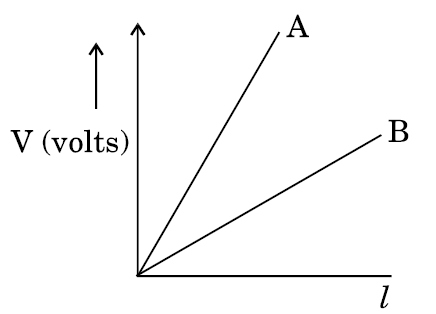
  2. In the graph shown below for two potentiometers, state with reason which of the two potentiometers$, A$ or $B,$ is more sensitive.
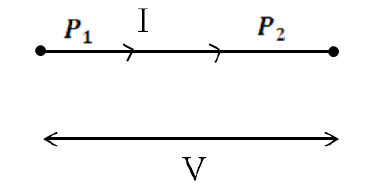
  1. Two metallic wires$, P_1$ and $P_2$ of the same material and same length but different cross$-$sectional areas$, A_1$ and $A_2$ are joined together and connected to a source of emf. Find the ratio of the drift velocities of free electrons in the two wires when they are connected $(i)$ in series, and $(ii)$ in parallel.
Answer

  1.  
  1. The potential difference across any length of wire is directly proportional to the length provided current and area of cross section are constant i.e.$, ? ? = ??$ where $?$ is the potential drop per unit length.
It can be made more sensitive by decreasing current in the main circuit/decreasing potential gradient/increasing resistance put in series with the potentiometer wire.
  1. Potentiometer $B$
Has smaller value of $\text{ }^V/_l\ ($slope/potential gradient$).$​​​​​​​
  1. In series, the current remains the same.

$I=neA_1V_{d1}=neA_2V_{d2}$
$\therefore\frac{V_{d1}}{V_{d2}}=\frac{A_2}{A_1}$
In parallel potential difference is same but currents are different.
$V=I_1R_1=neA_1V_{d1}\frac{\rho l}{A_1}=ne\rho V_{d1}l$
Similarly, $V=I_2R_2=ne\rho V_{d2}l$
$I_1R_1=I_2R_2$
$\therefore\frac{V_{d1}}{V_{d2}}=1$

Need a full question paper?

Generate a complete, print-ready paper with questions like this in minutes — across 16+ boards, with answer keys.

Start Generating Free

Similar questions

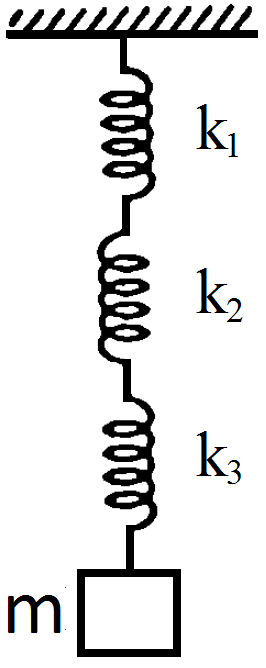
Find the elastic potential energy stored in each spring shown in figure when the block is in equilibrium. Also find the time period of vertical oscillation of the block.
The friction coefficient between the horizontal surface and each of the blocks shown in figure is $0.20$. The collision between the blocks is perfectly elastic. Find the separation between the two blocks when they come $O$ rest. Take $g = 10 m/s^2$.
Two point charges $q_A = 3 \mu C$ and $q_B = –3 \mu C$ are located $20 \ cm$ apart in vaccum.
  1. What is the electric field at the midpoint $O$ of the line $AB$ joining the two charges?
  2. If a negative test charge of magnitude $1.5 \times 10^{-9} C $ is placed at this point, what is the force experienced by the test charge?
​​​​​
An ideal gas is kept in a long cylindrical vessel fitted with a frictionless piston of cross$-$sectional area $10\ cm^{2 }$ and weight $1\ kg$. The length of the gas column in the vessel is $20\ cm$ The atmospheric pressure is $100\ kPa$ The vessel is now taken into a spaceship revolving round the earth as a satellite. The air pressure in the spaceship is maintained at $100\ kPa$ Find the length of the gas column in the cylinder.
$i$. What do you understand by the sharpness of resonance in a series $L-C-R$ circuit? Derive an expression for $Q$ factor of the circuit.
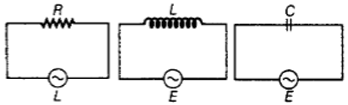
$ii$. Three electrical circuits having $AC$ sources of variable frequency are shown in the figures.
Initially, the current flowing in each of these is same. If the frequency of the applied $AC$ source is increased, how will the current flowing in these circuits be affected? Give the reason for your answer.
Image ​​​​​​​
A thin lens made of a material of refractive index $\mu_2$ has a medium of refractive index $\mu_1$ on one side and a medium of refractive index $\mu_3$ on the other side. The lens is biconvex and the two radii of curvature have equal magnitude $R.$ A beam of light travelling parallel to the principal axis is incident on the lens. Where will the image be formed if the beam is incident from:
  1. The medium $\mu_1$
  2. From the medium $\mu_3?$
How many is energy states are present in one mole of sodium vapour? Are they all filled in normal conditions? "How many $3s$ energy states are present in one mole of sodium vapour? Are they all filled in normal conditions?
Figure shows three equidistant slits being illuminated by a monochromatic parallel beam of light.
Let $\text{BP}_0-\text{AP}=\frac{\lambda}{3}$ and $\text{D}>\lambda.$
  1. Show that in this case $\text{d}=\sqrt{\frac{2\lambda\text{D}}{3}}.$
  2. Show that the intensity at $P,$ is three times the intensity due to any of the three slits individually.
A parallel-plate capacitor of capacitance $5\mu\text{F}$ is connected to a battery of emf 6V. The separation between the plates is 2mm:
  1. Find the charge on the positive plate.
  2. Find the electric field between the plates.
  3. A dielectric slab of thickness 1mm and dielectric constant 5 is inserted into the gap to occupy the lower half of it. Find the capacitance of the new combination.
  4. How much charge has flown through the battery after the slab is inserted?
The energy of a silver atom with a vacancy in $K$ shell is $25.31keV,$ in L shell is $3.56keV$ and in $M$ shell is $0.530keV$ higher than the energy of the atom with no vacancy. Find the frequency of $\text{K}_\alpha\text{K}_\beta$ and $\text{L}_\alpha X-$ rays of silver.