Question
  1.  
  1. State the principle on which a potentiometer works. How can a given potentiometer be made more sensitive?
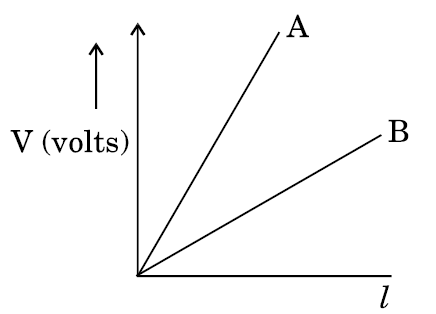
  2. In the graph shown below for two potentiometers, state with reason which of the two potentiometers, A or B, is more sensitive.
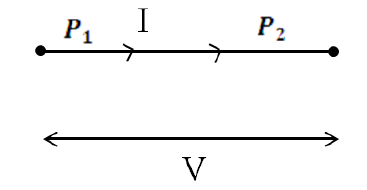
  1. Two metallic wires, P1 and P2 of the same material and same length but different cross-sectional areas, A1 and A2 are joined together and connected to a source of emf. Find the ratio of the drift velocities of free electrons in the two wires when they are connected (i) in series, and (ii) in parallel.
Answer

  1.  
  1. The potential difference across any length of wire is directly proportional to the length provided current and area of cross section are constant i.e., 𝐸 𝑙 = 𝜙𝑙 where 𝜙 is the potential drop per unit length.

It can be made more sensitive by decreasing current in the main circuit/decreasing potential gradient/increasing resistance put in series with the potentiometer wire.

  1. Potentiometer B

Has smaller value of $\text{ }^V/_l$ (slope/potential gradient).

  1. In series, the current remains the same.

$I=neA_1V_{d1}=neA_2V_{d2}$

$\therefore\frac{V_{d1}}{V_{d2}}=\frac{A_2}{A_1}$

In parallel potential difference is same but currents are different.

$V=I_1R_1=neA_1V_{d1}\frac{\rho l}{A_1}=ne\rho V_{d1}l$

Similarly, $V=I_2R_2=ne\rho V_{d2}l$

$I_1R_1=I_2R_2$

$\therefore\frac{V_{d1}}{V_{d2}}=1$

Need a full question paper?

Generate a complete, print-ready paper with questions like this in minutes — across 16+ boards, with answer keys.

Start Generating Free

Similar questions

Sunil and his parents were travelling to their village in their car. On the way his mother noticed some grey coloured panels installed on the roof of a low building. She enquired from Sunil what those panels were and Sunil told his mother that those were solar panels.
  1. What were the values displayed by Sunil and his mother? State one value for each.
  2. In what way would the use of solar panels prove to be very useful?
  3. Name the semiconductor device used in solar panels. Briefly explain with the help of a diagram, how this device works.
Consider an infinitely long wire carrying a current I (t), with $\frac{\text{dI}}{\text{dt}}=\lambda=\text{constant}$. Find the current produced in the rectangular loop of wire ABCD if its resistance is R (Fig).

A parallel-plate capacitor has plate area 20cm2, plate separation 1.0mm and a dielectric slab of dielectric constant 5.0 filling up the space between the plates. This capacitor is joined to a battery of emf 6.0V through a $100\text{k}\Omega$ resistor. Find the energy of the capacitor $8.9\mu\text{s}$ after the connections are made.
Two balls having masses m and 2m are fastened to two light strings of same length (l). The other ends of the strings are fixed at O. The strings are kept in the same horizontal line and the system is released from rest. The collision between the balls is elastic.
  1. Find the velocities of the balls just after their collision.
  2. How high will the balls rise after the collision?

Is it possible that in a Coolidge tube characteristic $\text{L}_\alpha$ X-rays are emitted but not $\text{K}_\alpha$ X-rays?
Two point charges qA = 3 μC and qB = –3 μC are located 20 cm apart in vaccum.
  1. What is the electric field at the midpoint O of the line AB joining the two charges?
  2. If a negative test charge of magnitude 1.5 × 10⁻⁹ C is placed at this point, what is the force experienced by the test charge?
A rectangular conducting loop consists of two wires on two opposite sides of length l joined together by rods of length d. The wires are each of the same material but with cross-sections differing by a factor of 2. The thicker wire has a resistance R and the rods are of low resistance, which in turn are connected to a constant voltage source V0. The loop is placed in uniform a magnetic field B at 45° to its plane. Find $\tau$, the torque exerted by the magnetic field on the loop about an axis through the centres of rods.
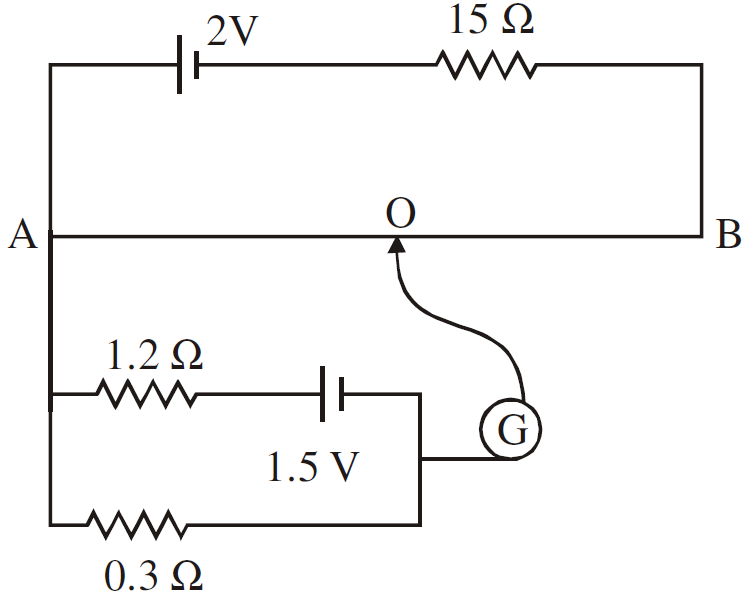
  1. State the principle of working of a potentiometer.
  2. In the following potentiometer circuit, AB is a uniform wire of length 1 m and resistance 10Ω. Calculate the potential gradient along the wire and balance length AO ( = l).

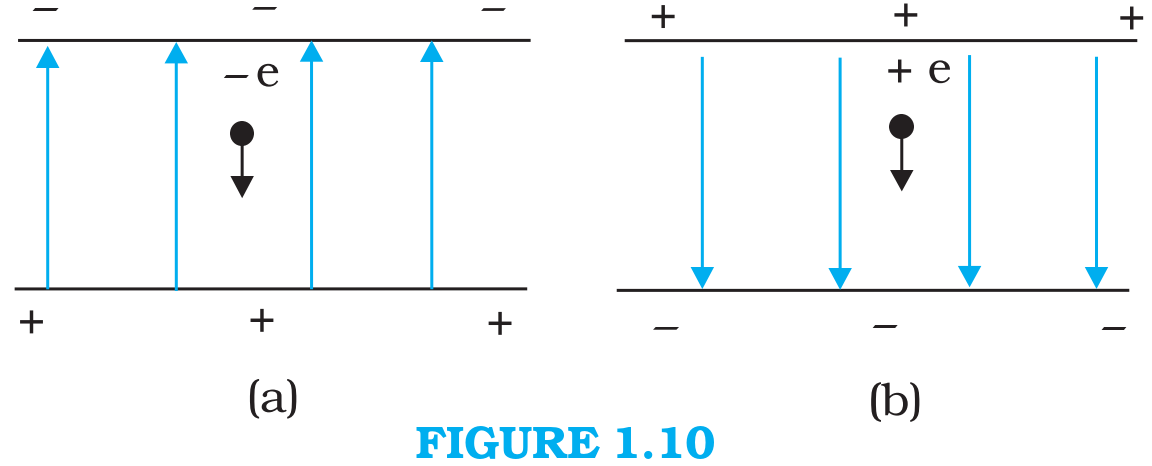
An electron falls through a distance of $1.5 cm$ in a uniform electric field of magnitude $2.0 \times 10^4 N C ^{-1}$ [Fig. 1.10(a)]. The direction of the field is reversed keeping its magnitude unchanged and a proton falls through the same distance [Fig. 1.10(b)]. Compute the time of fall in each case. Contrast the situation with that of 'free fall under gravity'.
Image