Question
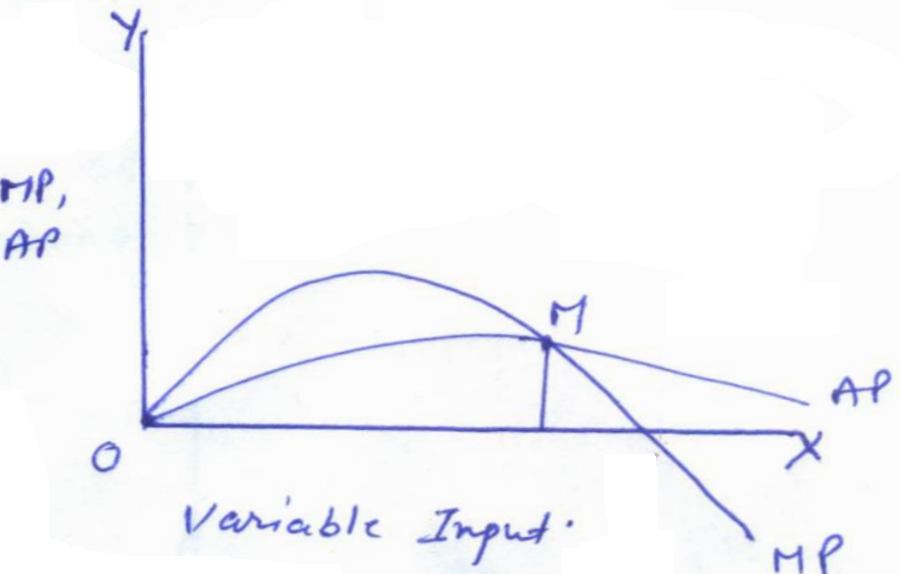
State the relation between marginal product and average product. Show this relation in a diagram.
Answer


When MP > AP, AP rises i.e. between O and M.
When MP = AP, AP is constant i.e. at M.
When MP < AP, AP falls i.e. after M.

Need a full question paper?

Generate a complete, print-ready paper with questions like this in minutes — across 16+ boards, with answer keys.

Start Generating Free

Similar questions

The price elasticity of supply of commodity X and Y are equal. The price of X falls from $₹ 10$ to $₹ 8$ per unit and its quantity supplied falls by $16$ percent. The price of Y rises by $10$ percent. Calculate the percentage increase in its supply.
Given the price of a good, how does a consumer decide as to how much of that good to buy.
Or
Explain the condition of determining how many units of a good consumer will buy at a given price.
OR
Explain why the price a consumer is willing to pay for a good equals the marginal utility of X when in equilibrium.
OR
Explain why consumer's equilibrium is attained when the utility of a product in terms of money is equal to its price.
What is Elasticity of Demand under perfect competition and monopolistic competition?
Find out average variable cost in:
Total Output
(Units)
Total Cost (Rs)
0
120
1
180
2
200
3
210
4
230
5
270
6
360
When the price of a commodity falls by $20\%$, its demand rises from $400$ units to $500$ units. Calculate its Price Elasticity of Demand.
A consumer wants to consume two goods. The prices of the two goods are Rs $4$ and Rs $5$ respectively. The consumer’s income is Rs $20$.
  1. Write down the equation of the budget line.
  2. How much of good $1$ can the consumer consume if she spends her entire income on that good?
  3. How much of good $2$ can she consume if she spends her entire income on that good?
  4. What is the slope of the budget line?
A consumer buys 50 units of a good at a price of Rs. 10 per unit. When price falls to Rs. 5 per unit he buys 100 units. Find out price elasticity of demand by the ‘Total Expenditure Method’.
Define demand. State the factors affecting market demand.
When price of a commodity falls by ₹ $1$ per unit, its quantity demanded rises by $3$ units. Its price elasticity of demand is $(-)2$. Calculate its quantity demanded if the price before the change was ₹ $10$ per unit.
Under perfect competition, MR = AR, but under monopoly, MR < AR. Explain.