Question
State the sign convention for applying Kirchhoff's loop rules.

Answer

(1) If our journey through the resistor is in the direction of flow of current, IR ( $= V$ potential) should be considered negative and if the direction of journey and the direction of current are opposite to each other, IR should be considerd positive (while writing on the left side of the equation.)
    (2) The emf of a battery should be considered positive while moving from negative terminal to the positive terminal of a battery (while writing on the left side of the equation.) The emf of a battery should be considered negative while moving from positive to the negative terminal of a battery.
The direction of the electric current can be arbitrarily chosen while using Kirchhoff's rules to analyze any network. If we shall get negative value of the current, the direction of current which is arbitrarily chosen is opposite to the actual direction of current.

Need a full question paper?

Generate a complete, print-ready paper with questions like this in minutes — across 16+ boards, with answer keys.
Start Generating Free

Similar questions

How does Ampere-Maxwell law explain the flow of current through a capacitor when it is being charged by a battery? Write the expression for the displacement current in terms of the rate of change of electric flux.
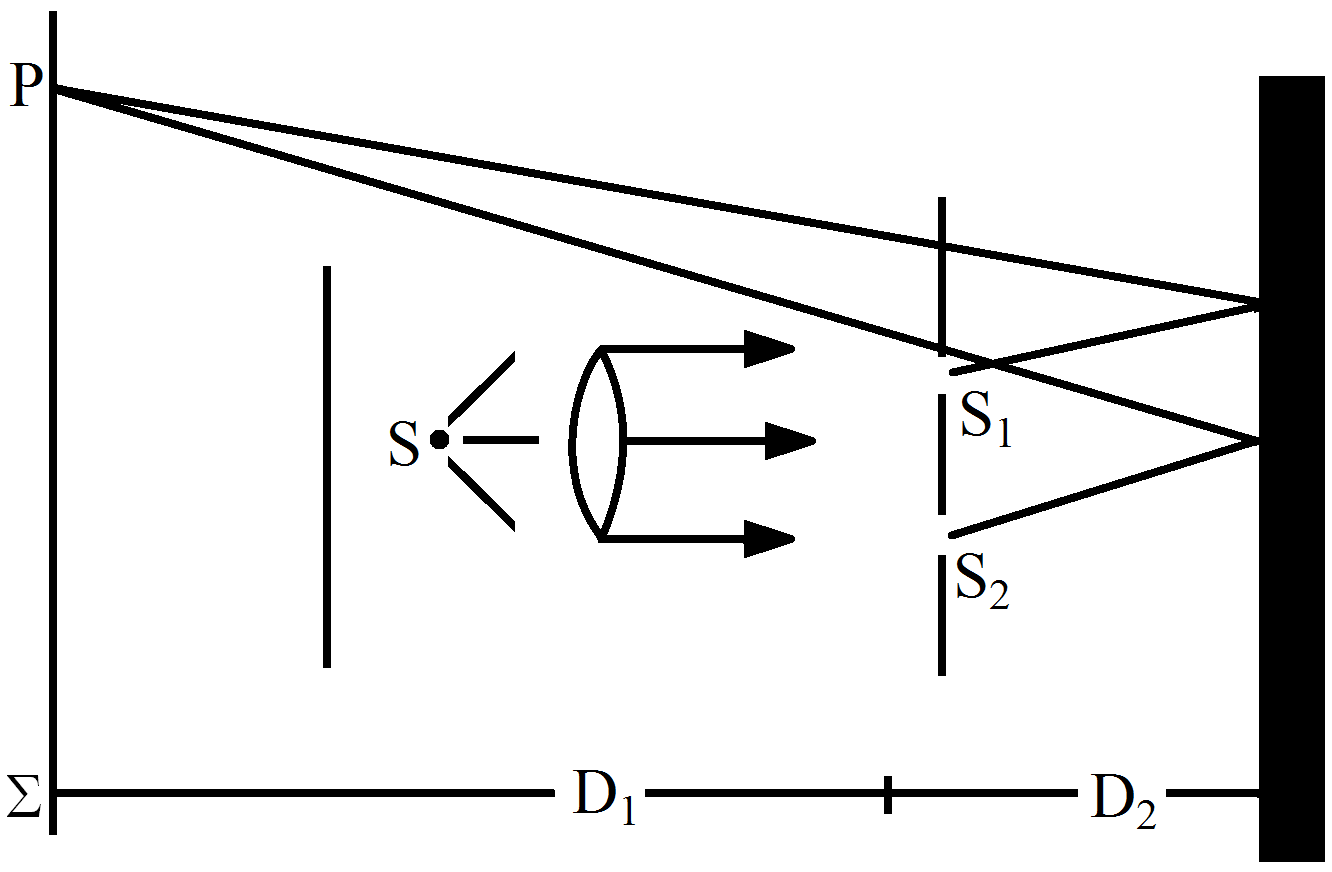
A double slit $S_1 - S_2$ is illuminated by a coherent light of wavelength $\lambda.$ The slits are separated by a distance $d.$ A plane mirror is placed in front of the double slit at a distance $D_1$ from it and a screen $\sum$ is placed behind the double slit at a distance $D_2$ from it $($figure $17-E_2).$ The screen $E$ receives only the light reflected by the mirror. Find the fringe$-$width of the interference pattern on the screen.
Define the distance of closest approach. An α-particle of kinetic energy 'K' is bombarded on a thin gold foil. The distance of the closest approach is 'r'. What will be the distance of closest approach for an α-particle of double the kinetic energy?
An electric current of 5 A is flowing through a wire of area of cross-section $4 \times 10^{-6} m^2$. If the number density of charge carriers (free electrons) is $5 \times 10^{26}$ $m ^{-3}$. Find the drift velocity of the electrons.
A parallel beam of monochromatic light is used in a Young's double slit experiment. The slits are separated by a distance $d$ and the screen is placed parallel to the plane of the slits. Show that if the incident beam makes an angle $\theta=\sin^{-1}\Big(\frac{\lambda}{2\text{D}}\Big)$ with the normal to the plane of the slits, there will be a dark fringe at the centre $P_0$ of the pattern.
A small metal sphere with $+Q$ charge is placed in the cavity of a larger uncharged metal sphere. As shown in the Fig. Find the value of electric field intensity at point $P_1$ and $P_2$ from Gauss's law.
Find the acceleration due to gravity in a mine of depth $640m$ if the value at the surface is $9.800\ m/s^2.$ The radius of the earth is $6400\ km.$
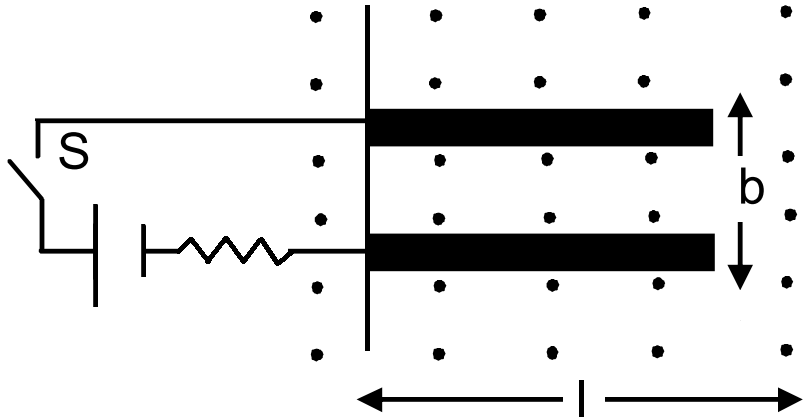
Two metal strips, each of length l, are clamped parallel to each other on a horizontal floor with a separation b between them. A wire of mass m lies on them perpendicularly, as shown in A vertically-upward magnetic field of strength B exists in the space. The metal strips are smooth but the coefficient of friction between the wire and the floor is $\mu.$ A current i is established when the switch S is closed at the instant t = 0. Discuss the motion of the wire after the switch is closed. How far away from the strips will the wire reach?
Write down the limitations of Coulomb's law.
A farsighted person cannot see objects placed closer to 50cm. Find the power of the lens needed to see the objects at 20cm.