Question
State the steps involved in the process of communication.

Answer

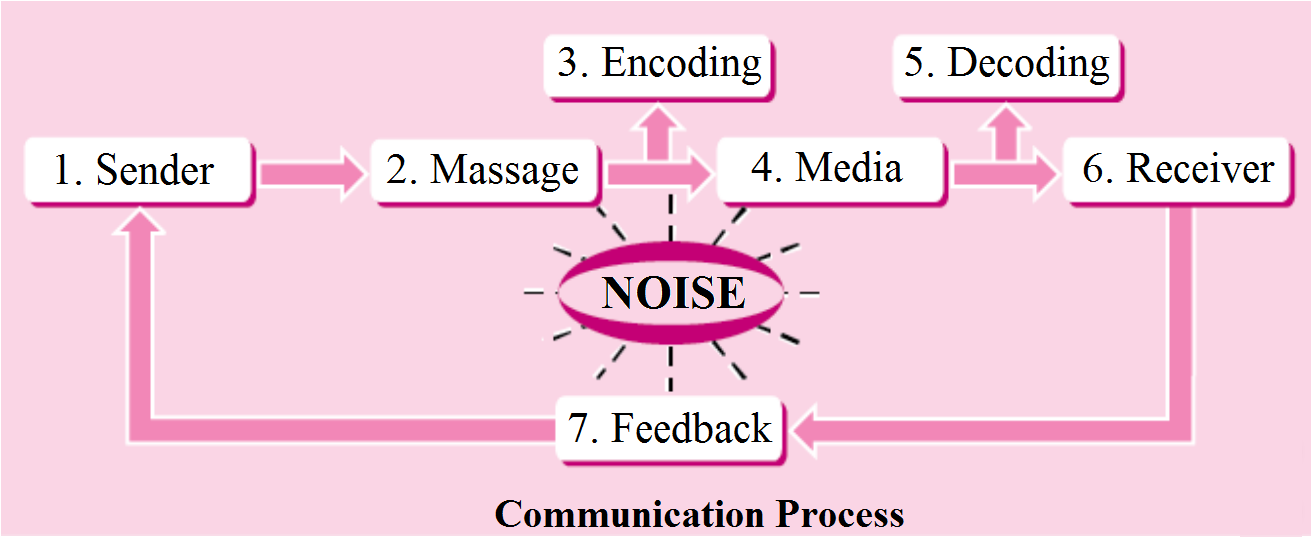
Communication process has been shown in the following diagram:
  1. Sender/ Communicator: Sender is the person who sends his ideas to another person.
  2. Message: It includes opinion, feelings, views, attitude, orders, suggestion, etc. For example, the work plan to be explained by the manager is in the shape of ideas.
  3. Encoding: Anything thought about by the sender is a mental state, which means that something to be communicated has been thought of. Communicating this idea or thinking with the help of symbols, words or diagrams is called encoding.
  4. Media/ Transmission: A person who is anxious to send a message has to make use of some medium for communication. There can be many media of communication like face-to-face conversation, letters, internet chatting, telephone, E-mail, symbols, etc. During the transmission of a message, it is very important to keep the media of transmission free from noise.
  5. Decoding: The sender can send his ideas briefly in the form of symbols or diagrams. Understanding it correctly is called decoding.
  6. Receiver: A receiver is a person for whom the message is sent.
  7. Feedback: Feedback is a signal pointing out to what extent the receiver has really received and understood the sender’s message correctly.
  8. Noise: Noise is the hindrance in the process of communication. It creates hurdle in the way of conversation. It can take place at any step in the communication process.

Need a full question paper?

Generate a complete, print-ready paper with questions like this in minutes — across 16+ boards, with answer keys.
Start Generating Free

Similar questions

''Every action in the organisation is initiated through directing''. Explain any four points of importance of directing in the light of this statement.
Sunidhi has started a designer studio in the basement of her residence after completing her masters in fashion designing. She has appointed ten employees to take care of the various aspects of the work. She interacts regularly with each employee to tell exactly what is expected of him/ her and what he/ she needs to do to be regarded as a good performer. At the same time, she allows a free work environment wherein the employees openly chit chat with each other in order to fulfill their social and emotional needs. Sometimes, these interactions also lead to spreading rumours which are not authentic.
Name and explain the two types of communication being referred to in the above paragraph.
Identify the dimensions of business environment in the following cases:
i. Hand-woven carpets are banned in some European countries as they think there can be involvement of child labour in the manufacturing of these carpets. Products produced through the involvement of child labour are banned in these countries.
ii. With the winning of a new party in a particular country an automobile company has decided to take back its plan of opening 15 plants in that country.
iii. In the month of October a greeting card manufacturing company has decided to increase its scale of production of New Year Greeting Cards.
iv. A chocolate making company has decided to make more sweetened chocolates for people living in a particular country.
v. A super bike producing company has decided to withdraw its earlier proposal of opening 10 new plants in a country as it finds the per capita income of that country too low to purchase its bikes in large numbers.
vi. Advertising of a particular brand is taken back as it is expected to hurt the sentiments of a particular section of society. The company takes this decision on a conscientious level.
Explain the three major decisions that finance manager has to take while performing the finance function.
What is meant by 'Privatisation'? In what ways have the Indian business houses/ management responded to this change?
What are the main features to be considered by the management while planning?
What is meant by ‘Training’ and ‘Development’? Explain any four points of distinction between them.
What is a divisional structure? Discuss its advantages and limitations.
State any five points which highlight the importance of delegation of authority.
What are the main features to be considered by the management while planning?