Question
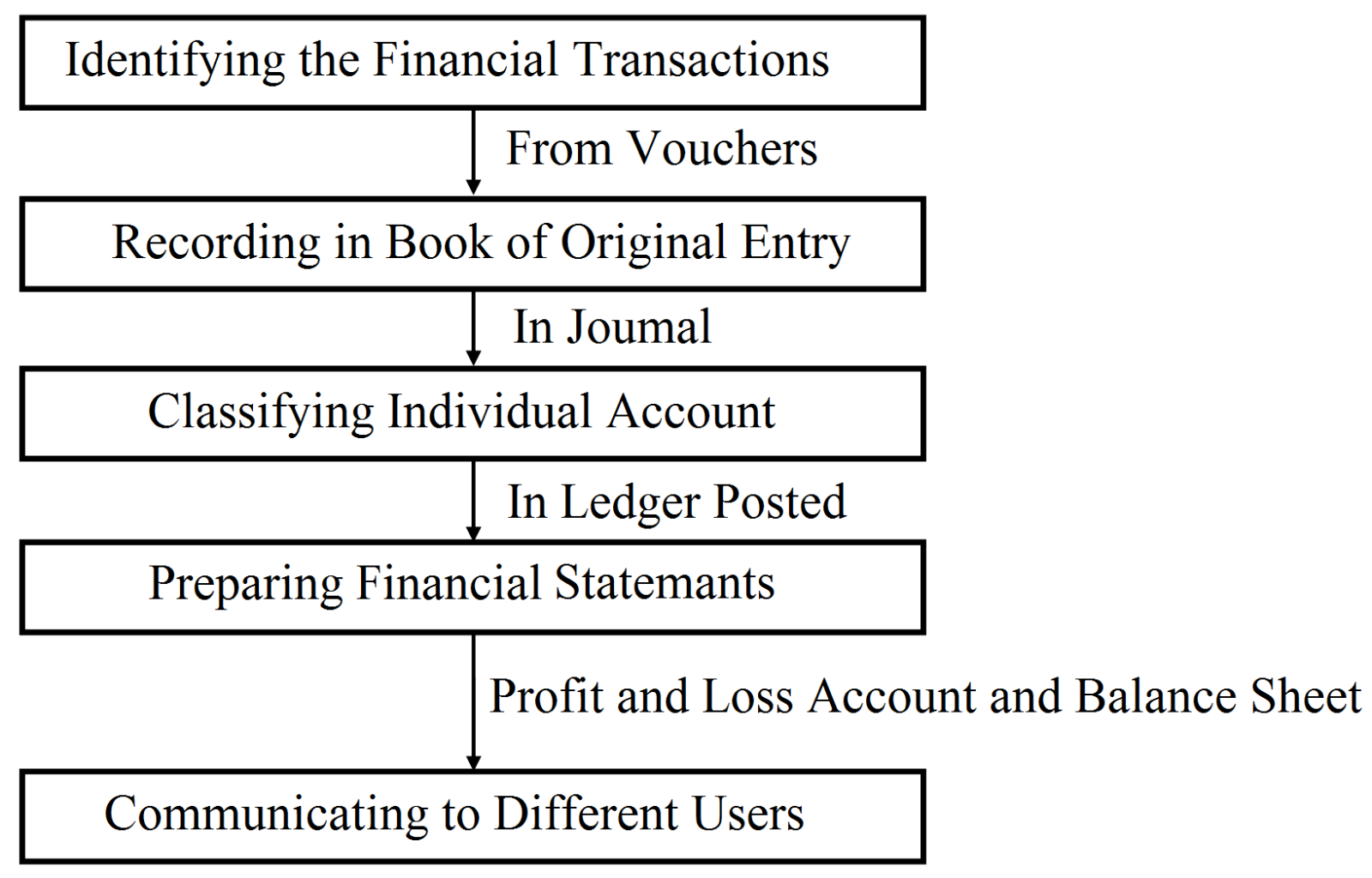
State the three fundamental steps in the accounting process.
Answer

The fundamental steps in the accounting process are diagrammatically presented below.

Need a full question paper?

Generate a complete, print-ready paper with questions like this in minutes — across 16+ boards, with answer keys.

Start Generating Free

Similar questions

On checking the Bank Pass Book it was found that it showed an overdraft of ₹ 5,220 as on 31.12.2014, while as per Ledger it was different to Bank Debit. The following differences were noted:
  1. Cheques deposited but not yet credited by bank ₹ 6,000.
  2. Cheques dishonoured and debited by bank but not given effect to it in the Ledger ₹ 800.
  3. Bank charges debited by bank but Debit Memo not received from bank ₹ 50.
  4. Interest on overdraft excess credited in the Ledger ₹ 200.
  5. Wrongly credited by bank to account, deposit of some other party ₹ 900.
  6. Cheques issued but not presented for payment ₹ 400.
A Trial Balance disclosed a difference of ₹ 417 placed on the credit side of the Suspense Account. Later on the following errors were located:
  1. Goods worth ₹ 200 purchased from Sohan had been posted to his account as ₹ 250.
  2. A purchase of furniture for ₹ 500 was recorded in the Purchases Book.
  3. Instead of crediting Gian’s Account with ₹ 512, it was debited with ₹ 215.
  4. Goods worth ₹ 130 returned by Gian were entered in the Sales Book and posted therefrom to the credit of Gian’s Personal Account.
Pass the rectifying entries and prepare a Suspense Account.
Show the Accounting Equation for the following transactions:
S.no  
(i) Gopinath started business with cash 25,000
(ii) Purchased goods from Shyam 10,000
(iii) Sold goods to Sohan costing ₹ 1,800 1,500
(iv) Gopinath withdrew from business 5,000
Prepare a Purchase Book in the books of M/s Modern Furniture House, Lucknow (U.P) from the following transactions assuming CGST @ 6% and SGST @ 6%.
2017
 
June 5


Bought from Mohan Lal & Co., Kanpur (U.P)
20 Godrej Chairs @ ₹ 2,000 each
5 Godrej Tables @ ₹ 6,000 each
Trade Discount 20%
June 10


Purchased from Bharat Bhushan & Sons, Varanasi (U.P)
5 Almirahs @ ₹ 12,000 each
2 Revolving Chairs @ ₹ 20,000 each
Trade Discount 10%
June 14


Purchased from Surya Traders, Lucknow (U.P)
80 Desks @ ₹ 2,500 each
10 Sofa Sets @ ₹ 20,000 each
Trade Discount @ 15%
June 20
 
Purchased for cash from Gopi Chand Haldi Ram, Delhi
4 Tables @ ₹ 5,000 each
25 June
 
Bought Furniture for office use from New Furniture House, Faridabad on Credit
5 Chairs @ ₹ 2,500 per Chair.
2 Tables @ ₹ 5,000 per Table.
State the meaning of a trial balance?
Prepare Accounting Equation from the following:
  1. Started business with cash ₹ 1,00,000.
  2. Purchased goods for cash ₹ 20,000 and on credit ₹ 30,000.
  3. Sold goods for cash costing ₹ 10,000 and on credit costing ₹ 15,000 both at a profit of 20%.
  4. Paid salaries ₹ 8,000.
Record the following transactions in the Purchases Return Book of Kamla Stores, Delhi for April, 2019:
2019  
April 6 Returned goods to Ramesh Brothers, Delhi purchased for ₹ 5,000 plus CGST and SGST @ 6% each
April 8 Returned goods to Sohan Brothers, Meerut purchased for ₹ 10,000 plus IGST @ 12%
April 17 Returned goods to Mahesh Brothers of ₹ 2,000 plus CGST and SGST @ 6% each
Give the Journal entries to rectify the following errors:
  1. Purchases Book was overcast by ₹ 1,000.
  2. Installation charges on new machinery purchased ₹ 500 were debited to Sundry Expenses Account as ₹ 50.
  3. Radhey Shyam returned goods worth ₹ 500 which was entered in the Purchases Return Book.
  4. Goods taken by the proprietor for ₹ 5,000 have not been entered in the books at all.
Pass Journal entries rectifying the following errors:
  1. A cheque for ₹ 10,000 was received from Ranjan on which ₹ 200 Cash Discount was allowed. The cheque was not honoured on due date and the amount of discount was credited to Discount Received Account.
  2. ₹ 2,000 paid as wages for machinery installation was debited to Wages Account.
  3. ₹ 5,000 received from Rakesh were credited to his Personal Account. The amount had been written off as bad debts earlier.
  4. Repair bill of machinery was recorded as ₹ 100 against the bill amount of ₹ 1,000.
On 31st March, 2015 the Pass Book shows a credit balance of ₹ 9,000. Prepare a Bank Reconciliation Statement from the following particulars:-
 
 
1.
Cheques issued but not yet presented for payment
7,000
2.
Cheques issued but omitted to be recorded in the Cash Book
3,800
3.
Cheques paid into bank but not yet collected by the bank
2,600
4.
Premium on Life Policy paid by the bank on standing advice
360
5.
Payments received from customers direct by the bank
2,000