Question
State the underlying principle of a potentiometer. Write two factors by which current sensitivity of a potentiometer can be increased. Why is a potentiometer preferred over a voltmeter for measuring the emf of a cell?

Answer

Principle: The potential drop, across a part of a length l of a uniform wire of length L (L>l), is proportional to the length l.
Two factors:
  1. Increasing the length L of the wire.
  2. Connecting a suitable resistance, R, in series with the potentiometer wire.
Reason: At the balance position, there is no net current drawn, from the cell and the cell is effectively in an open circuit condition. This is not so for a voltmeter.

Need a full question paper?

Generate a complete, print-ready paper with questions like this in minutes — across 16+ boards, with answer keys.
Start Generating Free

Similar questions

Draw diagrams to depict the behaviour of magnetic field lines near a ‘bar’ of: (i) Copper (ii) Aluminium (iii) Mercury, cooled to a very low temperature (4.2K)
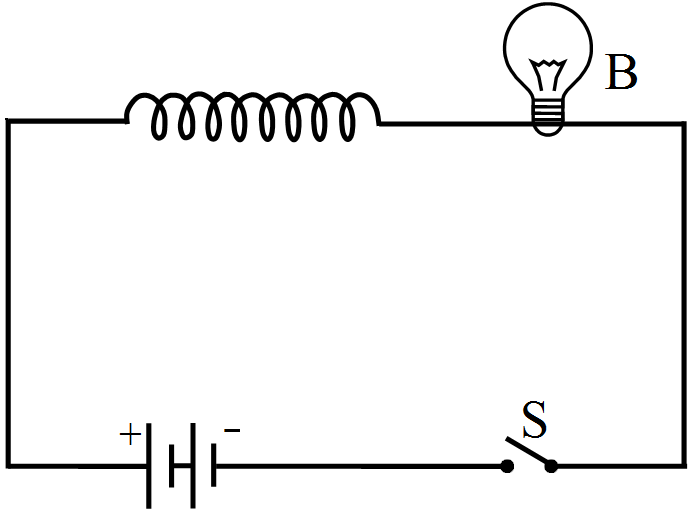
Figure shows a light bulb (B) and iron cored inductor connected to a dc battery through a switch (S).
  1. What will one observe when switch (S) is closed?
  2. How will the glow of the bulb change when the battery is replaced by an ac source of rms voltage equal to the voltage of dc battery? Justify your answer in each case.
Obtain the answers $(a)$ to $(b)$ in Exercise $7.13$ if the circuit is connected to a high frequency supply $(240V, 10kHz).$ Hence, explain the statement that at very high frequency, an inductor in a circuit nearly amounts to an open circuit. How does an inductor behave in a dc circuit after the steady state?
Obtain the formula for the electric field due to a long thin wire of uniform linear charge density λ without using Gauss’s law.
[Hint: Use Coulomb’s law directly and evaluate the necessary integral.]
The magnetic field $B$ inside a long solenoid, carrying a current of $5.00A,$ is $3.14 \times 10^{-2}T.$ Find the number of turns per unit length of the solenoid.
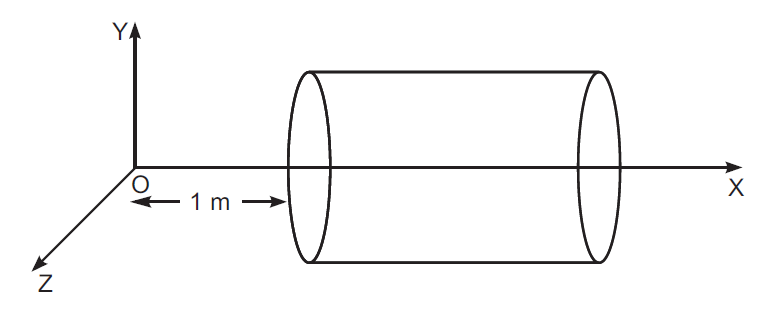
A hollow cylindrical box of length $1 m$ and area of cross$-$section $25 \ cm^2$ is placed in a three dimensional coordinate system as shown in the figure. The electric field in the region is given by$\overrightarrow{\text{E}} = 50\text{x}\hat{\text{i}},$ where $E$ is in $NC^{–1}$ and $x$ is in metres. Find
  1. Net flux through the cylinder.
  2. Charge enclosed by the cylinder.
The conductivity of a pure semiconductor is roughly proportional to $\text{T}^\frac{3}{2}\text{e}^{\frac{-\Delta\text{E}}{2\text{kT}}}$ where $\Delta\text{E}$ is the band gap. The band gap for germanium is 0.74eV at 4K and 0.67eV at 300K. By what factor does the conductivity of pure germanium increase as the temperature is raised from 4K to 300K?
The index of refraction of fused quartz is 1.472 for light of wavelength 400nm and is 1.452 for light of wavelength 760nm. Find the speeds of light of these wavelengths in fused quartz.
  1. Draw a schematic ray diagram of a compound microscope when image is formed at distance of distinct vision.
  2. Write the expression for resolving power of a compound microscope. How can the resolving power of a microscope be increased?
The product of the hole concentration and the conduction electron concentration turns out to be independent of the amount of any impurity doped. The concentration of conduction electrons in germanium is $6 \times 10^{19 }$ per cubic metre. When some phosphorus impurity is doped into a germanium sample, the concentration of conduction electrons increases to $2 \times 10^{23}$ per cubic metre. Find the concentration of the holes in the doped germanium.