Question
State the use of galvanometer as a voltmeter.

Answer

A galvanometer can also be used as a voltmeter.

Image

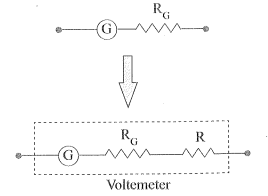
For using galvanometer as a voltmeter it is connected in parallel with that component of the circuit.
A galvanometer is a very sensitive device, so to avoid damage the current passing through it should be very small.
For this a large resistance is connected in series with galvanometer, as shown in the figure.
The resistance of voltmeter is $R _{ G }+ R$
But $R \gg R _{ G }$,
So, $R _{ G }$ can be neglected as compare to R so the resistance of the voltmeter becomes $\approx R$.

Need a full question paper?

Generate a complete, print-ready paper with questions like this in minutes — across 16+ boards, with answer keys.
Start Generating Free

Similar questions

Explain the dependence of the electric potential generated at a great distance due to a small electric dipole, when the point of observation is (i) in the axial position, and (ii) in the equatorial position.
Explain how the mass of an electron can be found using Millikan's oil drop experiment.
As temperature increases, the viscosity of liquids decreases considerably. Will this decrease the resistance of an electrolyte as the temperature increases?
How does the maximum kinetic energy of electrons emitted vary with the work function of the metal?Maximum kinetic energy Ek = hν – W Clearly, smaller the work function W, greater is the Ek This means that when work function of a metal increases, maximum kinetic energy of photoelectrons decreases.
A test charge q is made to move in the electric field of a point charge Q along two different closed paths Fig. First path has sections along and perpendicular to lines of electric field. Second path is a rectangular loop of the same area as the first loop. How does the work done compare in the two cases?

State the important points of Gauss's law.
A cell of emf ‘E’ and internal resistance ‘r’ is connected across a variable resistor ‘R’. Plot a graph showing the variation of terminal potential ‘V’ with resistance R. Predict from the graph the condition under which ‘V’ becomes equal to ‘E’.
A proton and an a particle are accelerated through the same potential difference. Which one of the two has (i) greater de-Broglie wavelength, and (ii) less kinetic energy? Justify your answer.
Draw magnetic field lines when a (i) diamagnetic, (ii) paramagnetic substance is placed in an external magnetic field. Which magnetic property distinguishes this behaviour of the field lines due to the two substances?
The dimensions of an atom are of the order of an Angstrom. Thus there must be large electric fields between the protons and electrons. Why, then is the electrostatic field inside a conductor zero?