Question
State the various postulates of Dalton’s atomic theory of matter.

Answer

Postulates of Dalton's atomic theory:
  1. All the matter is made up of very small particles called 'atoms'.
  2. Atoms cannot be divided.
  3. Atoms can neither be created nor be destroyed.
  4. Atoms are of various kinds. There are as many kinds of atoms as are elements.
  5. All the atoms of a given element are identical in every respect, having the same mass, size and chemical properties.
  6. Atoms of different elements differ in mass, size and chemical properties.
  7. The 'number' and 'kind' of atoms in a given compound is fixed.
  8. During chemical combination, atoms of different elements combine in small whole numbers to form compounds. Atoms of the same elements can combine in more than one ratio to form more than one compound.

Need a full question paper?

Generate a complete, print-ready paper with questions like this in minutes — across 16+ boards, with answer keys.

Start Generating Free

Similar questions

Name two types of animal feed and write their functions.
If the distance between two masses is increased by a factor of $5,$ by what factor would the mass of one of them have to be altered to maintain the same gravitational force$?$ Would this be an increase or decrease in the mass$?$
Using following data, draw time-displacement graph for a moving object:
Time $(s)$
$0$
$2$
$4$
$6$
$8$
$10$
$12$
$14$
$16$
Displacement $(m)$
$0$
$2$
$4$
$4$
$4$
$6$
$4$
$2$
$0$
Use this graph to find average velocity for first $4s,$ for next $4s$ and for last $6s.$
Describe the various steps involved in the separation of iodine, iron filings and salt from a mixture.
A liquid compound $X$ of molecular mass $18u$ can be obtained from a number of natural sources. All the animals and plants need liquid $X$ for their survival. When an electric current is passed through $200$ grams of pure liquid $X$ under suitable conditions, then $178$ grams of gas $Y$ and $22$ grams of gas $Z$ are produced. Gas $Y$ is produced at the positive electrode whereas gas $Z$ is obtained at the negative electrode. Moreover, gas $Y$ supports combustion whereas gas $Z$ burns itself causing explosions.
  1. Name $(i)$ liquid $X$ $(ii)$ gas $Y$, and $(iii)$ gas $Z$
  2. What is the ratio to the mass of element $Z$ to the mass of element $Y$ in the liquid $X$?
  3. Which law of chemical combination is illustrated by this example?
  4. Name two sources of liquid $X$.
  5. Gate an important use of $Y$ in our life.
How does the force of attraction between the two bodies depend upon their masses and distance between them$?$
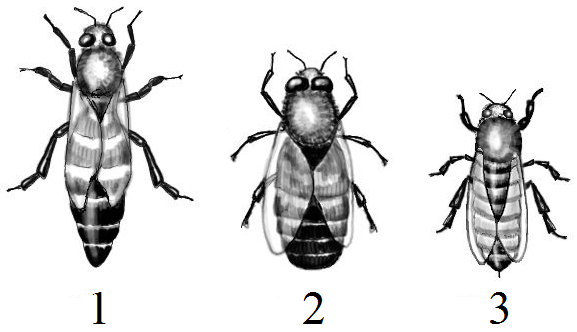
Look at Figures $1, 2$ and $3$ given alongside and answer the following questions.
  1. What do these figures show all together$?$
  2. Which one is queen bee$?$
  3. Which one of them is the haploid, fertile male$?$ What is it called$?$
  4. What is the status of the insect shown in the figure: individual/ social$?$
Explain the terms 'compression' and 'rarefactions' of a wave. What type of waves consist of compressions and rarefactions?
With the help of a labelled diagram, describe the method of separating ammonium chloride from a mixture of ammonium chloride and common salt. Mention the difference in the properties of ammonium chloride and sodium chloride which has made this separations possible.
A car is travelling along the road at $8ms^{-1}$. It accelerates at $1ms^{-2}$ for a distance of $18m$. How fast is it then travelling?