Question
State the various steps involved in the process of photosynthesis.

Answer

The photosynthesis takes place in the following three steps:
  1. Absorption of sunlight energy by chlorophy ll.
  2. Conversion of light energy into chemical energy and splitting of water into hydrogen and oxygen by light energy.
  3. Reduction of carbon dioxide by hydrogen to form carbohydrates like glucose by utilising the chemical energy.

Need a full question paper?

Generate a complete, print-ready paper with questions like this in minutes — across 16+ boards, with answer keys.
Start Generating Free

Similar questions

Two lenses have powers of (i) +2D and (ii) -4D. What is the nature and focal length of each lens?
Why is the leakage of LPG detected easily although it is odourless? State the steps to be taken in case its leakage is detected in the kitchen.
When an object is placed 10cm in front of lens A, the image is real, inverted, magnified and formed at a great distance. When the same object is placed 10cm in front of lens B, the image formed is real, inverted and same size as the object:
  1. What is the focal length of lens A?
  2. What is the focal length of lens B?
  3. What is the nature of lens A?
  4. What is the nature of lens B?
Meena draws magnetic field lines of field close to the axis of a current carrying circular loop. As she moves away from the centre of the circular loop she observes that the lines keep on diverging. How will you explain her observation.
What is meant by ocean thermal energy? Explain how ocean thermal energy can be used to generate electricity.
An object 2cm in size is placed 30cm in front of a concave mirror of focal length 15cm. At what distance from the mirror should a screen be placed in order to obtain a sharp image? What will be the nature and the size of the image formed? Draw a ray diagram to show the formation of the image in this case.
What is electrical resistivity? In a series electrical circuit comprising a resistor made up of a metallic wire, the ammeter reads 5A. The reading of the ammeter decreases to half when the length of the wire is doubled. Why?
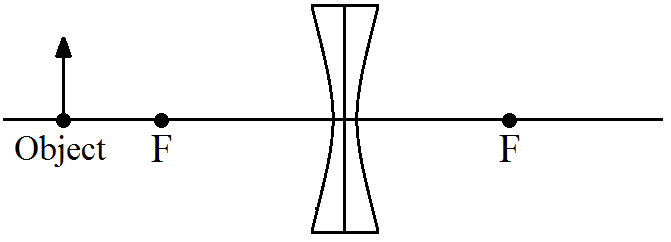
A small object is placed 150mm away from a diverging lens of focal length 100mm:
  1. Copy the figure below and draw rays to show how an image is formed by the lens.
  1. Calculate the distance of the image from the lens by using the lens formula.
A reddish-brown metal ' $X$ ', when heated in air, gives a black compound ' $Y$ ', which when heated in presence of $H _2$ gas gives ' $X$ ' back. ' $X$ ' is refined by the process of electrolysis; this refined form of ' $X$ ' is used in electrical wiring.
Identify ' $X$ ' and ' $Y$ '. Draw a well-labeled diagram to represent the process of refining ' $X$ '.

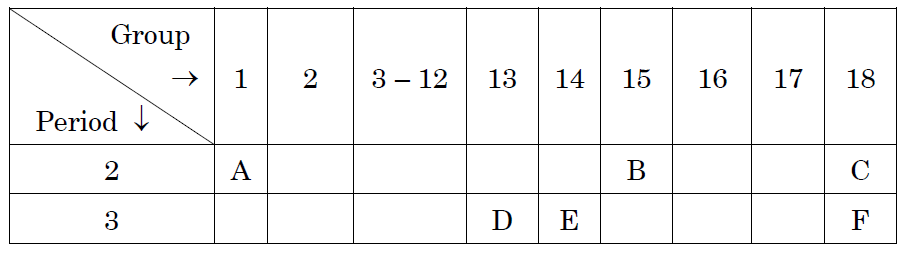
Study the following table in which positions of six elements A, B, C, D, E and F are shown as they are in the modern periodic table:

On the basis of the above table, answer the following questions:
  1. Name the element which forms only covalent compounds.
  2. Name the element which is a metal with valency three.
  3. Name the element which is a non-metal with valency three.
  4. Out of D and E, which is bigger in size and why?
  5. Write the common name for the family to which the elements C and F belong.