Question
  1. State two main differences between globular proteins and fibrous proteins.
  2. Based on their chemical composition, state how are lipids classified Give one example of each class.

Answer

  1. Sr. No.
    Globular Proteins
    Fiberous Proteins
    I.
    II.
    They are cross linked condensation products .
    Three dimensional spherical shape.
    They are linear condensation products.
    Rod like rigid shape.
  2. Lipids are naturally occuring compounds related to fatty acids which include fats, oils, waxes, etc.
  1. Simple lipids (Homolipids): e.g, neutral fats/waxes.
  2. Compound Lipids (Hetrolipids): e.g, Phospholopids/Glycolipids.
  3. Derived Lipids: fatty acids/fatty alcohols/steroids/terpenes, etc.

Need a full question paper?

Generate a complete, print-ready paper with questions like this in minutes — across 16+ boards, with answer keys.
Start Generating Free

Similar questions

Explain the open chain structure of glucose.
A solution containing 30 g of non-volatile solute exactly in 90 g of water has a vapour pressure of 2.8 kPa at 298 K. Further, 18 g of water is then added to the solution and the new vapour pressure becomes 2.9 kPa at 298 K. Calculate :
(i) molar mass of the solute
(ii) vapour pressure of water at 298 K
Explain the methods of preparation of aromatic aldehydes (benzoic aldehyde) from aromatic hydrocarbons.
  1. Account for the following:
  1. Write the preparation of potassium permanganate from pyrolusite ore $\ce{(MnO_2)}.$
  2. $\ce{Mn_2O_7}$ is acidic whereas $\ce{MnO }$ is basic.
  3. Though copper has completely filled $d-$orbital $(d^{10})$ yet it is considered as a transition metal.
  4. Actinoids show wide range of oxidation states.
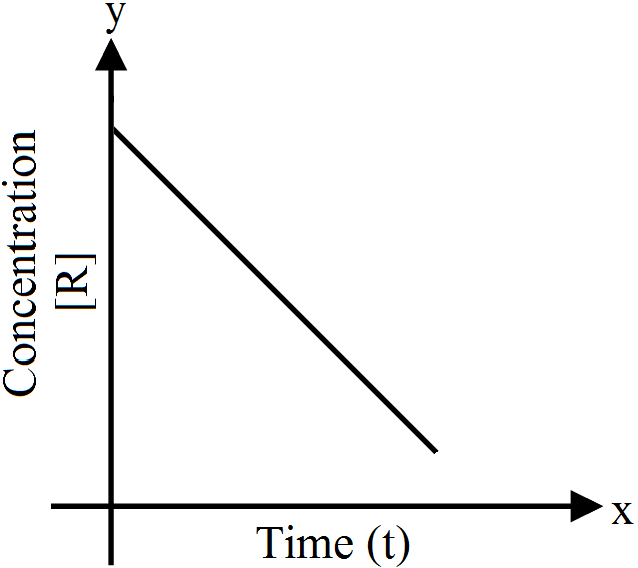
Consider the reaction $\text{R}\xrightarrow{\ \ \text{k}\ \ } \text{P}.$ The change in concentration of $R$ with time is shown in the following plot:
  1. Predict the order of the reaction.
  2. Derive the expression for the time required for the completion of the reaction.
  3. What does the slope of the above line indicate?
The following results have been obtained during the kinetic studies of the reaction :
$2 A+ B \rightarrow C + D$
Experiment$[ A ] / mol L ^{-1}$$[ B ] / mol L ^{-1}$Initial rate of formation of D $/ mol L ^{-1} min^{-1}$
I0.10.1$6.0 \times 10^{-3}$
II0.30.2$7.2 \times 10^{-2}$
III0.30.4$2.88 \times 10^{-1}$
IV0.40.1$2.40 \times 10^{-2}$
Determine the rate law and the rate constant for the reaction.
Describe different electrophilic substitution reaction of chlorobenzene.
Complete the following reactions :
(i) $C _6 H _5 NH _2+ CHCl _3+$ alc. $KOH \longrightarrow$
(ii) $C _6 H _5 N_2 Cl + H _3 PO _2+ H _2 O \longrightarrow$
(iii) $C _6 H _5 NH _2+ H _2 SO _4$ (conc.) ⟶
(iv) $C _6 H _5 N_2 Cl + C _2 H _5 OH \longrightarrow$
(v) $C _6 H _5 NH _2+ Br _2(a q) \longrightarrow$
Explain the collision principle of any chemical reaction.
Answer the following questions:Account for the following$:$
  1. Methylamine in water reacts with ferric chloride to precipitate hydrated ferric oxide.
  2. Diazonium salts of aromatic amines are more stable than those of aliphatic amines.