Question
State work energy theorem for rotational motion.

Answer

According to work energy theorem, work done will be reflected as change in rotational kinetic energy. Work done for a small angular displacement $\text{d}\theta\text{ is },\text{dW}=\tau\text{d}\theta$
$\text{W}=\int\tau\text{ d }\theta=\int\text{I }\alpha\text{ d }\theta$
$=\int\text{I }\text{d }\omega\frac{\text{d }\theta}{\text{dt}}=\int\text{I }\omega\text{ d }\omega$
$\text{W}=\int^\limits{\omega\text{f}}_\limits{\omega\text{f}}\text{I }\omega\text{ d }\omega=\text{I}\Bigg|\frac{\omega^2}{2}\Bigg|^{\omega\text{f}}_{\omega\text{i}}$
$\text{W}=\frac{1}{2}\text{I}(\omega^2_{\text{f}}-\omega^2_{\text{i}})$
It is the change in rotational kinetic energy.

Need a full question paper?

Generate a complete, print-ready paper with questions like this in minutes — across 16+ boards, with answer keys.
Start Generating Free

Similar questions

Two ideal monoatomic gases A and B at 27°C and 37°C are mixed. The number of moles in gas A are 2 and number of moles in gas B are 3. What will be the temperature of the mixture?
A set of 25 tuning forks is arranged in order of decreasing frequency. Each fork gives 3 beats with succeeding one. The first fork is octave of the last. Calculate the frequency of the first and 16th fork.
A pole of length 1.00m stands half dipped in a swimming pool with water level 50.0 cm higher than the bed. The refractive index of water is 1.33 and sunlight is coming at an angle of 45° with the vertical. Find the length of the shadow of the pole on the bed.
What is the angular velocity at any point on the equator so that the body feels weightlessness?
Define centripetal acceleration. Give two examples.
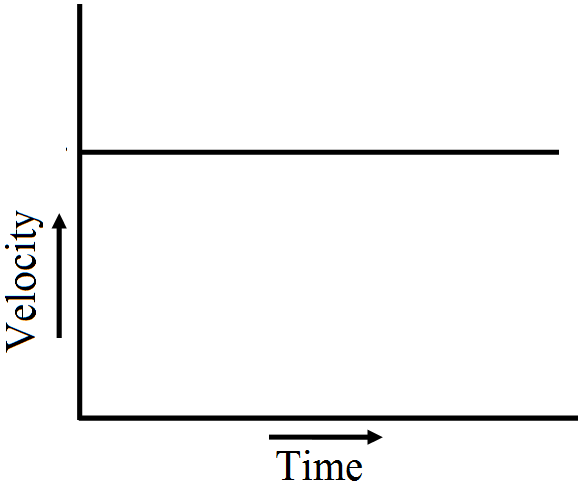
Velocity-time graph of a moving object is shown below. What is the acceleration of the object? Also draw displacement-time graph for the motion of the object.

The force experienced by a mass moving with a uniform speed v in a circular path of radius experiences a force which depends on its mass, speed and radius. Prove that the relation is $\text{f}=\frac{\text{mv}^2}{\text{r}}$
Two cylinders A and B of equal capacity are connected to each other via a stopcock. A contains a gas at standard temperature and pressure. B is completely evacuated. The entire system is thermally insulated. The stopcock is suddenly opened. Answer the following :
(a) What is the final pressure of the gas in A and B?
(b) What is the change in internal energy of the gas?
(c) What is the change in the temperature of the gas?
(d) Do the intermediate states of the system (before settling to the final equilibrium state) lie on its P-V-T surface?
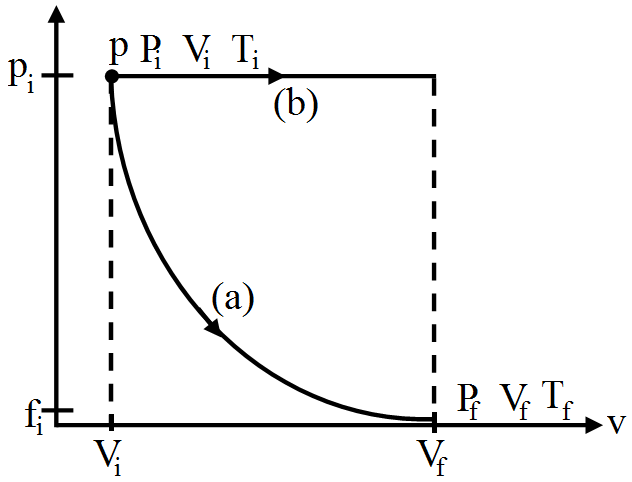
The initial state of a certain gas is (Pi , Vi , Ti ). It undergoes expansion till its volume becoms Vf . Consider the following two cases:
  1. The expansion takes place at constant temperature.
  2. The expansion takes place at constant pressure.
Plot the P-V diagram for each case. In which of the two cases, is the work done by the gas more?

The two specific heat capacities of a gas are measured as $\text{C}_\text{p} = (12.28 \pm 0.2) $ units and $\text{C}_\text{v} = (3.97 \pm 0.3)$ units. Find the value of the gas constant R.