MCQ
Statement-1 $(A): a^2+b^2+c^2-a b-b c-c a=0$ if and only if $a=b=c$.
Statement-2 (R):$(a+b+c)^2=a^2+b^2+c^2+2 a b+2 b c+2 c a$
  • A
    Statement-1 and Statement-2 are True; Statement-2 is a correct explanation for Statement-1.
  • Statement-1 and Statement-2 are True; Statement-2 is not a correct explanation for Statement-1.
  • C
    Statement-1 is True, Statement-2 is False.
  • D
    Statement-1 is False, Statement-2 is True.
Answer

Correct option: B.
Statement-1 and Statement-2 are True; Statement-2 is not a correct explanation for Statement-1.
(b)
Statement-2, being a standard result, is true.
Now, $\quad a^2+b^2+c^2-a b-b c-c a=0$
$ \Rightarrow \quad 2 a^2+2 b^2+2 c^2-2 a b-2 b c-2 c a=0$[Multiplying both sides by 2]
$\Rightarrow \quad\left(a^2+b^2-2 a b\right)+\left(b^2+c^2-2 b c\right)+\left(c^2+a^2-2 c a\right)=0$
$\Rightarrow \quad(a-b)^2+(b-c)^2+(c-a)^2=0$
$\Rightarrow\quad a-b=0$ and $b-c=0$ and $c-a=0 \Rightarrow a=b=c$.
So, statement-1 is also true. Hence, option (b) is correct.

Need a full question paper?

Generate a complete, print-ready paper with questions like this in minutes — across 16+ boards, with answer keys.

Start Generating Free

Similar questions

Statement-1 (A): If $a, b, c$ are all non-zero such that $a+b+c=0$, then $\frac{a^2}{b c}+\frac{b^2}{c a}+\frac{c^2}{a b}=3$
Statement-2 (R): If $a+b+c=9$ and $a^2+b^2+c^2=35$, then $a b+b c+c a=23$
Statement-1 (A): Diagonals of a rectangle are equal.
Statement-2 (R): Diagonals of a parallelogram bisect each other.
Directions: In the following questions, the Assertions (A) and Reason(s) (R) have been put forward. Read both the statements carefully and choose the correct alternative from the following:
Assertion: 0.468 is a terminating decimal.
Reason: A decimal in which a digit or a set of digits is repeated periodically, is called a repeating, or a recurring decimal.
  1. Both Assertion and Reason are correct and Reason is the correct explanation for Assertion
  2. Both Assertion and Reason are correct and Reason is not the correct explanation for Assertion.
  3. Assertion is true but the reason is false.
  4. Both assertion and reason are false.
Statement-1 (A): Two chords of a circle of lengths 10 cm and 8 cm are at the distance 8 cm and 3.5 cm, respectively from the centre.
Statement-2 (R): Of any two chords of a circle the one which is larger is nearer to the centre.
Statement-1 (A): The graph of the linear equation $y=4$ is a line parallel to $x$-axis at a distance of 4 units above it.
Statement-2 (R): The line parallel to $x$-axis at a distance a units above the $x$-axis is given by the equation $y=-a$.
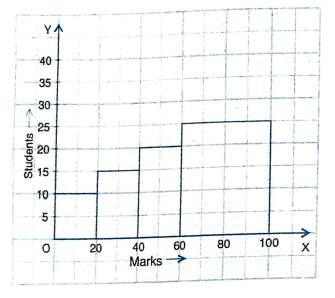
Statement-1 (A): The graphical representation of the frequency distribution
Marks:0 - 2020 - 4040 - 6060 - 100
Number of students:10152025
is as given in Fig.
Statement-2 (R): In a histogram, the areas of the rectangles are proportional to the frequencies.
Image
Directions: In the following questions, the Assertions (A) and Reason(s) (R) have been put forward. Read both the statements carefully and choose the correct alternative from the following:
Assertion: $\sqrt2$ is a irrational number.
Reason: It can not be written inthe form of $\frac{\text{p}}{\text{q}}.$
  1. Both Assertion and Reason are correct and Reason is the correct explanation for Assertion.
  2. Both Assertion and Reason are correct and Reason is not the correct explanation for Assertion.
  3. Assertion is true but the reason is false.
  4. Both assertion and reason are false.
Statement-1 (A):The area of an equilateral triangle the length of whose altitude is 6 cm is $12 \sqrt{3} cm^2$.
Statement-2 (R): The area of an equilateral triangle with altitude p is $\Delta=\frac{p^2}{\sqrt{3}}.$
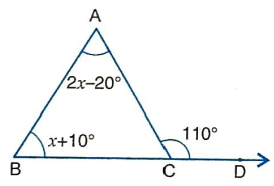
Statement-1 (A): In Fig., side BC of $\triangle A B C$ is produced to D. If $\angle A C D=110^{\circ}$, then $x=40^{\circ}$.
Statement-2 (R): If a side of a triangle is produced, the exterior angle so formed is equal to the sum of the two interior opposite angles.
Image
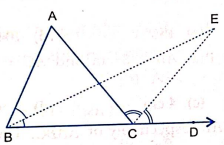
Statement-1 (A): In Fig. side $B C$ of $\triangle A B C$ is produced to a point $D$ such that the bisectors of $\angle A B C$ and $\angle A C D$ meet at a point $E$. If $\angle B A C=80^{\circ}$, then $\angle B E C=50^{\circ}$.
Image
Statement-2 (R): The angle between the internal bisector of one base angle and the external bisector of the other angle of a triangle is equal to one-half of the vertical angle.