MCQ
Statement-1 (A): In fig.  if $C P \| B Q$, then $\angle A C P=140^{\circ}$.
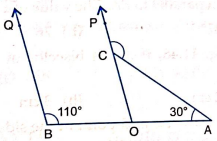
Image
Statement-2 (R): If two parallel lines are intersected by a transversal, then the corresponding angles are equal.
  • A
    Statement-1 is true, Statement-2 is true; Statement-2 is a correct explanation for Statement-1.
  • Statement-1 is true, Statement-2 is true; Statement-2 is not a correct explanation for Statement-1.
  • C
    Statement-1 is true, Statement-2 is false.
  • D
    Statement-1 is false, Statement-2 is true.

Answer

Correct option: B.
Statement-1 is true, Statement-2 is true; Statement-2 is not a correct explanation for Statement-1.
b

Need a full question paper?

Generate a complete, print-ready paper with questions like this in minutes — across 16+ boards, with answer keys.

Start Generating Free

Similar questions

Directions: In the following questions, the Assertions $(A)$ and Reason(s) $(R)$ have been put forward. Read both the statements carefully and choose the correct alternative from the following:
 Assertion: An equation of the type $y = mx$ represents a line passing through the origin.
Reason: Every point on the graph of a linear equation in two variables is a solution of the quadratic equation.
Directions: In the following questions, the Assertions $(A)$ and Reason(s) $(R)$ have been put forward. Read both the statements carefully and choose the correct alternative from the following:
Assertion: If $\sqrt2=1.414.,$ $\sqrt3=1.732,$ then $\sqrt5=\sqrt2+\sqrt3.$
Reason: Square root of a positive real number always exists.
Directions: In the following questions, the Assertions $(A)$ and Reason(s) $(R)$ have been put forward. Read both the statements carefully and choose the correct alternative from the following:
Assertion: The sum of first five prime number is $28.$
Reason: The sum of three consugative integer is $54.$
Assertion (A): If the diagonals of a parallelogram ABCD are equal, then $\angle ABC =90^{\circ}$
Reason (R): If the diagonals of a parallelogram are equal, it becomes a rectangle.
Directions: In the following questions, the Assertions $(A)$ and Reason(s) $(R)$ have been put forward. Read both the statements carefully and choose the correct alternative from the following:
Assertion: $5$ number of solid sphere each of diameter $6\ cm$ that could be moulded to form a solid metallic cylinder of height 45\ cm and diameter $4\ cm$.
Reason: Number of solid sphere $=\frac{\text{volume of cylinder}}{\text{volume of sphere}}$
Directions: In the following questions, the Assertions $(A)$ and Reason(s) $(R)$ have been put forward. Read both the statements carefully and choose the correct alternative from the following:
Assertion: Sum of the pair of angles $120^\circ$ and $60^\circ $ is supplementary.
Reason: Two angles, the sum of whose measures is $180^\circ$, are called supplementary angles.
Directions: In the following questions, the Assertions $(A)$ and Reason(s) $(R)$ have been put forward. Read both the statements carefully and choose the correct alternative from the following:
Assertion: The perimeter of a rectangular swimming pool is $154\ m$. Its length is $2\ m$ more than twice its breadth. Then the breadth of the pool is $25$.
Reason: Baichung’s father is $26$ years younger than Baichung’s grandfather and $29$ years older than Baichung. The sum of the ages of all the three is $135$ years. then the age of Baichungs grandfather is $22$.
Directions: In the following questions, the Assertions $(A)$ and Reason(s) $(R$) have been put forward. Read both the statements carefully and choose the correct alternative from the following:
Assertion: $p(x)=x^5$ degree $=5$.
Reason: $4\sqrt{\text{t}}+\text{t}^6$ degree is $6.$
Directions: In the following questions, the Assertions $(A)$ and Reason(s) $(R)$ have been put forward. Read both the statements carefully and choose the correct alternative from the following:
Assertion: $ABCD$ is a rhombus such that $\angle\text{ABC}=40^\circ$ then $\angle\text{ADC}$ is equal to $40^\circ .$
Reason: In rhombus opposite angles are equal.
Statement-1 (A): The graph of the linear equation 2x - y + 18 = 0 meets x-axis at (-9, 0).
Statement-2 (R): Coordinates of points on y-axis are of the form (0, a), where a is a variable.