MCQ
Statement-1 (A): In Fig.9.16, the trigonometric ratios of angle $\theta$ depend only on the value of $\theta$ and are independent of the position of the point $P$ on the terminal side $A Y$ of angle $\theta$.
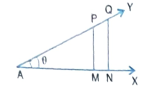
Image
Statement-2 (R) : In a right triangle $A B C$ right angled at $B$, if $\angle B A C=\theta$, then $\sin \theta=\frac{B C}{A C} < 1$ and $\cos \theta=\frac{A B}{A C} < 1$ because the hypotenuse $A C_{\text {is }}$ the longest side.
  • A
    Statement-1 and Statement-2 are True; Statement-2 is a correct explanation for Statement-1.
  • Statement-1 and Statement-2 are True; Statement-2 is not a correct explanation for Statement-1.
  • C
    Statement-1 is True, Statement-2 is False.
  • D
    Statement-1 is False, Statement-2 is True.

Answer

Correct option: B.
Statement-1 and Statement-2 are True; Statement-2 is not a correct explanation for Statement-1.
(B)Statement-1 and Statement-2 are True; Statement-2 is not a correct explanation for Statement-1.
Statement-1 is true (see Theorem on page 462 of the main book).
Statement-2 is also true but it is not a correct explanation for statement-1. Hence, option (b) is correct.

Need a full question paper?

Generate a complete, print-ready paper with questions like this in minutes — across 16+ boards, with answer keys.

Start Generating Free

Similar questions

Directions : In the following questions, the Assertions $(A)$ and Reason $(s)\ (R)$ have been put forward. Read both the statements carefully and choose the correct alternative from the following:
Assertion : $ (A) x+y-4=0$ and $2 x+k y-3=0$ has no solution if $k=2$.
Reason $(R) a_1 x+b_1 y+c_1=0$ and $a_2 x+b_2 y+c_2=0$ are consistent, if $\frac{ a _1}{ a _2} \neq \frac{ k _1}{ k _2}$.
Directions : In the following questions, the Assertions $(A)$ and Reason $(s)\ (R)$ have been put forward. Read both the statements carefully and choose the correct alternative from the following:
Assertion : The slope of the line $2x - y = 0$ is $2$
Reason : The slope of the line which lies in first and third quadrant is positive
Statement A (Assertion) : If L.C.M. = 182, product of integers is $26 \times 91$, then H.C.F. $=13$.
Statement R (Reason) : L.C.M. $\times$ Product of integers $=$ H.C.F.
Statement-1 (A): The distance of the point $(-3,5)$ from the $x$ axis is 3 units.
Statement-2 (R): Abscissa of a point gives the distance of the point from the $y$-axis.
Assertion (A): The sum of the series with the $n$th term. $t_n=(9-5 n)$ is (465), when no. of terms $n=15$.
Reason (R): Given series is in A.P. and sum of n terms of an A.P. is $S _{ n }=\frac{n}{2}[2 a+(n-1) d]$
Directions: In the following questions, the Assertions $(A)$ and Reason(s) $(R)$ have been put forward. Read both the statements carefully and choose the correct alternative from the following:
Assertion: $4x^2+ 9x + 79$ here $4, 9$ are the cofficent in this polynomial.
Reason: In above polynomial $79$ is constant term.
Statement $A ($Assertion$)$ : In a $\triangle \text{ABC}$, if $\ce{DE \| BC}$ and intersects $AB$ at $D$ and $AC$ at $E$, then $\frac{AB}{AD}=\frac{AC}{AE}$.
Statement $R ($Reason$)$ : If a line is drawn parallel to one side of a triangle to intersect the other two sides in distinct points, then these sides are divided in the same ratio.
Directions : In the following questions, the Assertions $(A)$ and Reason $(s) \ (R)$ have been put forward. Read both the statements carefully and choose the correct alternative from the following:
Assertion : $7$ is rational no.
Reason : $9$ is rational no.
Statement-1 (A): If a race track is in the form of a ring whose outer and inner radii differ by 10 m then the absolute ratio of the area of the track and the sum of the two boundries is $10: 3$.
Statement-2 (R): If a race track is in the form of a ring whose outer and inner radii are $R$ and $r$, then the area of the track and the sum of its two boundries are in the absolute ratio $(R-r): 2$.
Statement A (Assertion) : The distance of the point $P(6,-6)$ from the origin is 6 units.
Statement R (Reason): The distance between two points $A\left(x_1, y_1\right)$ and $B\left(x_2, y_2\right)$ is given by
$
A B=\sqrt{\left(x_2-x_1\right)^2+\left(y_2-y_1\right)^2} .
$