MCQ
Statement-1 (A): It is not possible to construct a triangle with lengths of its sides as 9 cm , 7 cm and 17 cm .
Statement-2 (R): The difference of any two sides of a triangles is less than the third side.
  • A
    Statement-1 is true, Statement-2 is true; Statement-2 is a correct explanation for Statement-1.
  • Statement-1 is true, Statement-2 is true; Statement-2 is not a correct explanation for Statement-1.
  • C
    Statement-1 is true, Statement-2 is false.
  • D
    Statement-1 is false, Statement-2 is true.
Answer

Correct option: B.
Statement-1 is true, Statement-2 is true; Statement-2 is not a correct explanation for Statement-1.
(b)
Statement-2 is true. If possible let ABC be a triangle such that AB = 9 cm, BC = 7 cm and AC = 17 cm. We find that $A B+B C \ngtr A C$. So, it is not possible to construct a triangle with lengths of its sides as 9 cm, 7 cm and 17 cm . Hence, statement -1 is true. Thus, both the statements are true but statement-2 is not a correct explanation for statement-1. Hence, option (b) is correct.

Need a full question paper?

Generate a complete, print-ready paper with questions like this in minutes — across 16+ boards, with answer keys.

Start Generating Free

Similar questions

Statement-1 (A): The value of $\frac{(0.027)^3+(0.023)^3}{(0.027)^2-(0.027)(0.023)+(0.023)^2}$ is 0.05
Statement-2 (R): $a^3-b^3=(a-b)\left(a^2-a b+b^2\right)$
Statement-1 (A): A circle of radius 3 cm can be drawn through two points $A, B$ such that $A B=6 cm$.
Statement-2 (R): Through three collinear points a circle can be drawn.
Statement-1 (A): If the side of a rhombus is 10 cm and one diagonal is 16 cm , the area of the rhombus is $96 cm^2$.
Statement-2 (R): The base and the corresponding altitude of a parallelogram are 10 cm ans 3.5 cm respectively. The area of the parallelogram is $30 cm^2$.
Statement-1 (A): The point $P(-7,0)$ lies on $x$-axis.
Statement-2 (R): The ordinate of every point on $y$-axis is positive.
Directions: In the following questions, the Assertions (A) and Reason(s) (R) have been put forward. Read both the statements carefully and choose the correct alternative from the following:
Assertion: $5-\sqrt2=5-1.414=3.586$ is an irrational number.
Reason: The difference of a rational number and an irrational number is an irrational number.
  1. Assertion and Reason both are correct statements and Reason is the correct explanation of Assertion.
  2. Assertion and Reason both are correct statements but Reason is not the correct explanation of Assertion.
  3. Assertion is correct statement but Reason is wrong statement.
  4. Assertion is wrong statement but Reason is correct statement.
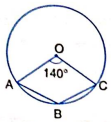
Statement-1 (A): In Fig. $O$ is the centre of a circle and $\angle A O C=140^{\circ}$, then $\angle A B C=110^{\circ}$.
Statement-2 (R): Angle subtended by an arc at the centre is double the angle subtended by it at any point on the remaining part of the circle.
Image
Statement-1 (A): In a histogram, the area of each rectangle is proportional to the class size of the corresponding interval.
Statement-2 (R): To draw the histogram of a continuous frequency distribution with unequal class intervals, the frequencies of classes are adjusted by using the formula:
Adjusted frequency of a class $=\frac{\text { Minimum class size }}{\text { Class size }} \times$ Frequency of the class
Directions: In the following questions, the Assertions (A) and Reason(s) (R) have been put forward. Read both the statements carefully and choose the correct alternative from the following:
Assertion: $\frac{3}{5}$ is terminating decimal expansion
Reason: The remainder become zero.
  1. Both Assertion and Reason are correct and Reason is the correct explanation for Assertion.
  2. Both Assertion and Reason are correct and Reason is not the correct explanation for Assertion.
  3. Assertion is true but the reason is false.
  4. Both assertion and reason are false.
Statement-1 (A): $a^3+\frac{3}{8} a x+\frac{1}{64} x^3-\frac{1}{8}=\left(a+\frac{x}{4}-\frac{1}{2}\right)\left(a^2+\frac{x^2}{16}+\frac{1}{4}-\frac{a x}{4}+\frac{x}{8}+\frac{a}{2}\right)$
Statement-2 (R): $a^3+b^3+c^3+3 a b c=(a+b+c)\left(a^2+b^2+c^2+a b+b c+c a\right)$
Directions: In the following questions, the Assertions (A) and Reason(s) (R) have been put forward. Read both the statements carefully and choose the correct alternative from the following:
Assertion: The terminating decimal has a number of finite terms after the decimal point.
Reason: The decimal expansion of π is terminating.
  1. Both Assertion and Reason are correct and Reason is the correct explanation for Assertion
  2. Both Assertion and Reason are correct and Reason is not the correct explanation for Assertion.
  3. Assertion is true but the reason is false.
  4. Both assertion and reason are false.